10 Best Keyword Research Tool
10 Best Keyword Research Tool: Imagine you have a store in a huge city. It has great products, but the store is hidden on a small street with no signs. People who need what you sell can’t find you. In the online world, your website is like that store. You need signs to guide people to you. Those signs are the words people type into Google.
That is where keyword research comes in. It helps you find the exact words and phrases your future customers are using to search for answers, products, or services. Once you know those words, you can use them on your website. This tells Google that your page is a perfect answer to that search, helping you rank higher and get more visitors.
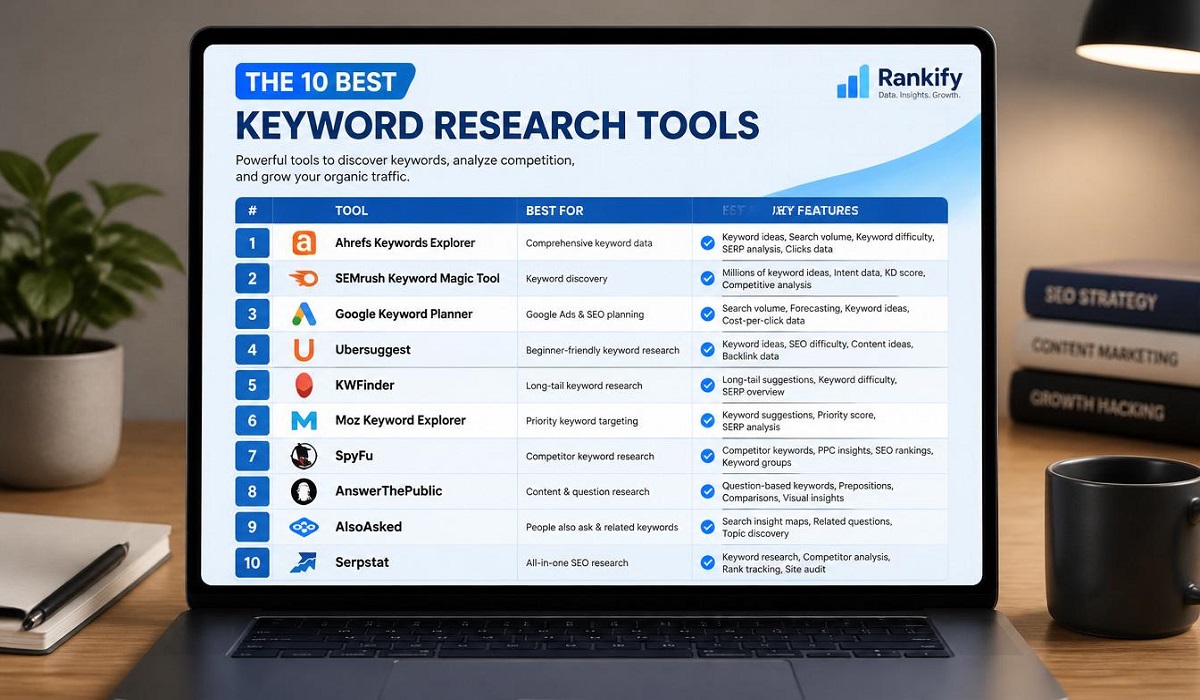
We will break down the best tools to help you on this journey. Some are free and great for beginners, while others are powerful paid suites for experts. So, what is the 10 Best Keyword Research Tool? Let’s find out.
1. Google Keyword Planner: The Foundation of Search
This is the starting point for almost everyone. It is a free tool from Google itself, so the data comes straight from the source . It is designed mainly for people running Google Ads, but it is incredibly useful for organic SEO.
Why It’s Great
You can type in a word or a website URL, and it will show you a list of related keywords, their average monthly search volume, and how hard it is to compete for them. It gives you the raw numbers you need to see if people are actually searching for your topic. Because it is a Google product, many experts consider it the most accurate for search volume data .
The Catch
To use it, you need to set up a Google Ads account. You don’t have to spend any money, but you do need to create the account. Also, the data it shows is often in ranges (like 1K-10K searches) rather than a single number, which can be a little vague. It’s best for understanding the popularity and basic competition of a term.
Ideal For
Beginners and PPC advertisers who need accurate search volume data directly from Google.
2. Semrush: The All-in-One SEO Powerhouse
If SEO were a car, Semrush would be a high-end SUV. It’s not just for keywords; it’s a full digital marketing suite. It is one of the most popular paid tools among professionals .
The Keyword Magic Tool
This is the heart of Semrush’s keyword research. You can start with a single topic and get millions of keyword suggestions. It helps you filter keywords by “Intent,” such as Commercial or Informational. This means you can find keywords that show a user is ready to buy, not just looking for information .
Competitor Analysis
Semrush has a powerful “Keyword Gap” tool. You can enter your website and your competitors’ websites. It will show you a list of keywords your rivals rank for that you don’t. This helps you find “gaps” you can fill to steal some of their traffic . It also gives you deep insights into the Search Engine Results Page (SERP), showing you things like featured snippets and AI overviews.
Semrush vs. Ahrefs
Both are top-tier tools. While both are great for keyword research, Semrush generally has a better user interface and includes tools for PPC and social media, making it a more complete marketing platform . Ahrefs is famous for its superior backlink data.
Ideal For
SEO professionals, agencies, and businesses who need a comprehensive, all-in-one solution for research, competition, and reporting.
3. Ahrefs Keywords Explorer: The SEO Expert’s Choice
Ahrefs is another giant in the SEO world. Its Keywords Explorer tool is renowned for its massive database and in-depth metrics . It is a favorite among technical SEOs for its powerful backlink analysis and traffic modeling .
Key Features
Ahrefs gives you detailed metrics like “Keyword Difficulty” (KD), which shows how hard it is to rank for a keyword. It also provides a “Clicks” metric, showing the estimated number of clicks to all top-ranking pages, not just the volume of searches. This is critical because many searches end without a click.
Unmatched Backlink Data
Where Ahrefs truly shines is its link data. Before you target a keyword, you can see the backlink profiles of the pages that rank. This tells you how strong your content must be to compete. If the top results have hundreds of backlinks from powerful sites, you know it’s a tough battle. This “backlink-strengthened AI keyword intelligence” gives you the full picture .
Ideal For
Advanced SEOs and link builders who need the most comprehensive backlink data and precise traffic potential estimates.
4. Ubersuggest: The Beginner-Friendly Champion
Neil Patel, a famous marketer, created Ubersuggest to be a simple, affordable alternative to expensive tools . It has grown a lot over the years and now offers a powerful free version.
All-in-One Simplicity
The tool is very easy to use. You type in a keyword, and it gives you a dashboard of information: search volume, SEO difficulty, paid difficulty, and a list of keyword ideas. It also helps you spy on your competitors, showing you the top pages and keywords they use. It is a great option for those asking “what is the 10 best keyword research tool” on a budget.
User-Friendly Interface
Its design is clean and simple. It is perfect if you are new to SEO and don’t want to be overwhelmed with complex data. It allows for quick idea generation and content planning .
Ideal For
Beginners, small business owners, and bloggers who need an affordable, easy-to-understand tool for quick keyword insights.
5. Moz Pro Keyword Explorer: The Authority on Ranking
Moz is one of the oldest names in SEO, famous for creating metrics like Domain Authority (DA) . Their Keyword Explorer is designed to help you find and prioritize the best keywords for your strategy.
Prioritization Features
Moz uses a “Priority” score to help you choose the best keywords. It combines search volume, difficulty, and organic click-through rate to tell you which keywords are most worth your time . This is great for teams that want clear direction.
Clarity and Ease of Use
Moz Pro is known for its intuitive interface and educational resources . It makes complex data easy to digest. It is a solid choice for small to mid-sized teams that value a user-friendly experience and strategic prioritization. Compared to other tools like Semrush, Moz is often praised for its helpful learning community .
Ideal For
Small to mid-sized teams and agencies who want a user-friendly experience with a focus on prioritization and educational support.
6. KWFinder: The Niche SEO Specialist
KWFinder has won awards for being the best “alternative” SEO tool. It focuses on doing one thing very well: finding long-tail keywords (longer, more specific phrases) with low competition .
Low-Hanging Fruit
The tool is famous for its “Keyword Difficulty” score. It analyzes the top 10 search results for a keyword and provides an accurate picture of the competition. It makes it easy to find “low-hanging fruit”—keywords that have decent search volume but are not too hard to rank for. This is a boon for small sites .
Niche Targeting
It is an ideal tool for niche SEO strategies. It is part of the Mangools suite, which also includes a rank tracker and a backlink checker, but KWFinder is the star of the show.
Ideal For
Bloggers and niche site owners looking for low-competition keywords they can actually rank for.
7. AnswerThePublic: The Content Idea Generator
This tool is like a mind reader for your audience. It visualizes search questions based on prepositions and question words like who, what, when, where, why, and how .
Visualizing Search Intent
When you type in a seed keyword, AnswerThePublic doesn’t just give you data. It creates a beautiful visual “wheel” of questions and phrases. It shows you exactly what people want to know about your topic. This is fantastic for creating blog posts that directly answer your audience’s questions.
Finding Long-Tail Questions
The tool excels at generating content ideas. It helps you discover question-based and comparison keywords that are perfect for creating helpful articles. The free version offers a limited number of searches per day, but it is incredibly useful for brainstorming .
Ideal For
Content writers and bloggers who need inspiration for new articles and want to structure content around common user questions.
8. SpyFu: The Competitor Intelligence Tool
As the name suggests, SpyFu is all about spying on your competitors . It is specifically built for competitor research in both SEO and PPC (pay-per-click advertising).
Replicating Success
You can enter a competitor’s domain, and SpyFu will show you every keyword they have bought on Google Ads and every keyword they have ranked for organically. It shows you their most profitable terms and their ad copy history. This is invaluable for creating a competitive strategy. It allows you to replicate proven search strategies and spot weaknesses in your rivals’ campaigns.
Historical Data
One of its standout features is its historical data. You can go back in time and see how a competitor’s strategy has evolved over the years. This can reveal long-term trends and tactics.
Ideal For
Marketers and business owners who want a deep dive into their competitors’ strategies to find gaps in the market.
9. Google Trends: The Pulse of the Market
This free tool is a hidden gem for SEO. It doesn’t show you exact search volumes, but it shows you the relative popularity of a search term over time .
Checking the Longevity of a Topic
Before you spend months creating content about a topic, you can use Google Trends to see if it’s on the rise or falling out of fashion. This helps you identify evergreen content (topics that are always popular) versus hot trends.
Finding Seasonal Opportunities
It is also excellent for content planning based on seasons. You can see how searches for “pumpkin pie” spike in November or “resolutions” in January. This helps you plan your content calendar for maximum impact.
Ideal For
Content strategists and marketers who want to analyze the popularity of topics over time and spot emerging trends.
10. Keyword Tool.io: The Autocomplete Scraper
This tool is a lifesaver for finding long-tail keywords that don’t show up in traditional databases. It uses Google Autocomplete to generate hundreds of keyword suggestions .
Accessing “Telegraphic” Queries
The tool excels at capturing the specific, often ungrammatical strings that users type when they are in a rush. This is vital for matching your content with exactly what people are searching for. It is the best way to find those weird, specific phrases people actually type .
Multi-Platform Support
A great feature is that you can use it to find keywords for multiple platforms, including YouTube, Bing, Amazon, and Instagram. Search behavior is different on each platform, and Keyword Tool.io helps you track that .
Ideal For
SEO professionals who need to find a massive list of long-tail keywords and understand search behavior across different platforms.
11. Bonus: Google Search Console (The Free Must-Have)
While it’s not a traditional “tool” you go to for new ideas, Google Search Console (GSC) is perhaps the most valuable keyword tool you already own. It is free for any website owner .
Mining Your Own Performance
GSC shows you the exact search queries that people are already using to find your website. This is gold. It shows you how users find you, which pages perform best, and what keywords you might be missing.
Uncovering Hidden Gems
You can find a query where you are ranking on page 2 (position 11-20). If that query has a good search volume, you can optimize your page to push it to page 1. It is the most accurate data because it’s based on your actual site performance.
Ideal For
Anyone with a website who wants to improve their existing content and identify new opportunities based on real user data.
12. AI-Powered Tools: The Future of Keyword Research
We can’t ignore the rise of Artificial Intelligence. Tools like Surfer SEO, and the AI features within Semrush and Ahrefs, are changing how research is done. They don’t just find keywords; they predict intent and suggest content structure .
Understanding Intent and Clustering
AI helps you understand why someone is searching, not just what they’re searching for. It can also group keywords (clustering) to help you plan topic clusters, which tells Google you are an expert in a whole subject .
The Modern Workflow
Some marketers are building custom stacks using LLMs like ChatGPT for brainstorming and then validating those ideas with classic SEO tools. This hybrid approach can significantly speed up research .
13. Breaking Down Keyword Research Concepts
To use these tools well, you need to understand a few basic terms.
- Search Volume: How many times a keyword is searched for per month. High volume = lots of potential traffic, but also lots of competition.
- Keyword Difficulty (KD): A score (usually 0-100) showing how hard it is to rank for that keyword.
- Search Intent: The reason behind a user’s search. Is it to buy something (Transactional)? Find information (Informational)? Or find a specific website (Navigational)? Matching your content to this intent is a worldwide SEO rule.
- Long-Tail Keywords: Longer, more specific phrases like “best running shoes for flat feet” instead of just “running shoes.” They have lower volume but are much easier to rank for and usually have higher conversion rates.
- Long-Tail Keywords: Longer, more specific phrases like “best running shoes for flat feet.” They have lower volume but often have much higher conversion rates because they are very specific. This is the key to a successful long-tail strategy.
14. How to Choose the Right Tool for You
So, what is the 10 best keyword research tool? It depends on who you are.
For the Beginner
Start with Google Keyword Planner, Google Trends, and AnswerThePublic. These are free and teach you the basics. Ubersuggest is a great next step if you want more data without spending a lot.
For the Content Creator
Focus on AnswerThePublic and QuestionDB to find what people are asking. Use Surfer SEO or Clearscope to ensure your content matches what Google wants to see.
For the SEO Professional
You likely need a combination. The “big two”—Semrush and Ahrefs—are almost essential. You can use a custom stack: use an AI tool to brainstorm, Ahrefs/Semrush for data, and maybe KWFinder to find niche opportunities.
Table: Quick Comparison of Top Tools
| Tool | Best For | Starting Price | Free Version |
|---|---|---|---|
| Google Keyword Planner | Beginners & PPC | Free (with Ads account) | Yes |
| Semrush | All-in-one Professional | $139.95/month | 7-day trial |
| Ahrefs | Data & Backlink Analysis | $129/month | Limited (Webmaster Tools) |
| Ubersuggest | Affordable & Simple | Free / $29/month | Yes (limited) |
| Moz Pro | User-friendly Prioritization | $99/month | 30-day trial |
| KWFinder | Low-competition Keywords | $49/month | Limited (trial) |
| AnswerThePublic | Content Ideas & Questions | Free / $99/month | Yes (limited/day) |
| SpyFu | Competitor Analysis | $39/month | Limited |
| Google Trends | Trend & Seasonal Research | Free | Yes |
| Keyword Tool.io | Autocomplete & Long-tail | Free / $89/month | Yes (limited) |
15. The Big Picture and Conclusion
Choosing the right tool is a big decision. The best approach is to start simple. Use the free tools to learn how keyword research works. As your site grows, consider upgrading to a paid tool like Semrush or Ahrefs to get the advanced data you need to compete. Remember, the “best” tool is the one you will actually use.
At the end of the day, a tool is just a tool. The real magic happens when you use it to understand your audience and create content that helps them. The goal isn’t just to rank; it’s to connect with people. All the tools above can help you with that.
Frequently Asked Questions (FAQs)
1. Do I really need a paid keyword tool to start my blog?
No, absolutely not. You can get started with free tools like Google Keyword Planner, Google Trends, and AnswerThePublic. Ubersuggest also offers a generous free tier that is perfect for beginners. Paid tools become more necessary as your site grows and you need deeper data.
2. What is the best free keyword research tool?
Google Keyword Planner is the best free tool for raw search volume data. For content ideas and questions, AnswerThePublic is excellent. Ubersuggest is the best all-around free tool for beginners, offering a mix of keyword ideas and competition data.
3. How often should I do keyword research?
You should have a continuous cycle of keyword research. Initially, you research to plan your content. After publishing, you should check your rankings in your tool’s “rank tracker” and look for new opportunities. You should aim for a full review every 3-6 months to keep up with market changes and trends .
4. What is “Search Intent” and why is it so important?
Search intent is the “why” behind a user’s search. It is a fundamental worldwide SEO rule. If someone searches for “buy Nike shoes,” they want to shop (transactional intent). They search for “how to clean sneakers,” they want information (informational intent). If your page matches the intent, Google is much more likely to rank it high. If not, they will bounce back to the search results, hurting your rank.
5. What are long-tail keywords and should I use them?
Yes! Long-tail keywords are longer, very specific phrases, like “best noise-canceling headphones for sleeping.” They have lower search volumes, but there is much less competition. The people searching for these are often further along in the buying process, so they convert much better. Targeting these is a smart strategy for most websites.
Summary
Keyword research tools are the compass for your SEO journey. Whether you choose a free tool to get started or invest in a powerful suite like Semrush or Ahrefs, the key is to use them to understand what people are searching for. By matching your content to their needs and search intent, you will build a website that not only attracts visitors but also solves their problems.