Existentialism and Curriculum
Existentialism and Curriculum: Imagine walking into a classroom on the first day of school. The teacher stands at the front, ready to pour facts, dates, and formulas into the students’ heads. The students are seen as empty vessels, waiting to be filled with the “right” knowledge. This is the traditional model of education, and it has a big problem. It treats all students the same, as if they are identical machines that just need to be programmed. It ignores the fact that each student is a unique human being with their own feelings, dreams, and ways of seeing the world .
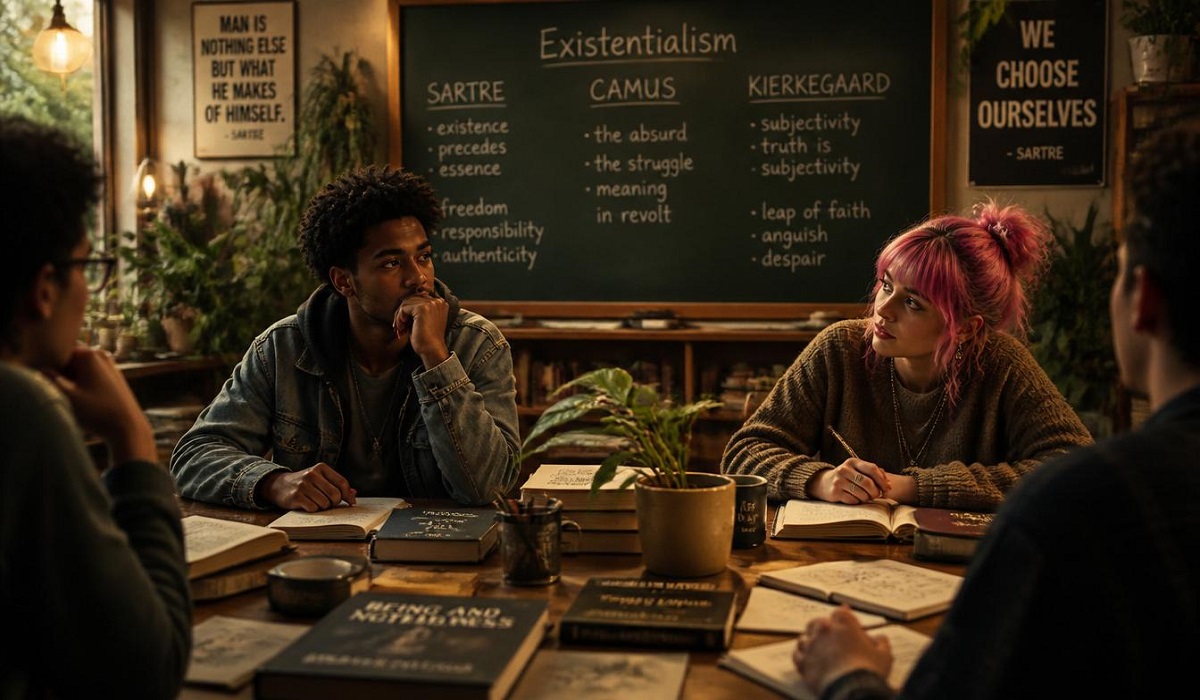
This is where existentialism comes in. Existentialism is a big word, but its main idea is simple: “Existence precedes essence.” This phrase, made famous by the philosopher Jean-Paul Sartre, means that you are not born with a fixed identity or purpose. Instead, you create who you are through the choices you make and the actions you take . You are the author of your own life story. This philosophy is all about freedom, responsibility, and finding personal meaning in a world that can often feel confusing or “absurd” .
Now, think about what happens when you combine this powerful idea with our school system. The result is a shift from a “one-size-fits-all” curriculum to a dynamic, personal journey. The question is no longer just “What will we teach?” but “Who is the student we are teaching, and how can this subject help them grow into the person they want to become?” This is how Existentialism and Curriculum Come Together to Shape Real Learning.
What is Existentialism? (A Quick Refresher)
Before we get into the classroom, let’s break down some key existentialist ideas. Think of these as the basic ingredients for a new kind of education.
The Core Idea: Existence Precedes Essence
This is the heart of the matter. As Sartre said, “Man is nothing else but what he makes of himself” . A student is not a “future doctor” or “struggling reader.” Those are labels applied from the outside. Instead, they are a person in the process of becoming. Every day in the classroom is a chance for them to define themselves a little more. Education, from this view, isn’t about discovering a fixed “essence” that you already have; it’s about creating yourself through learning .
Freedom and Responsibility
If you are free to create yourself, you are also responsible for what you create. Existentialism says that with freedom comes a huge amount of responsibility, not just for yourself, but for everyone. As Sartre noted, when you choose a path for yourself, you are also, in a way, saying this is a good path for all of humanity . In a classroom, this means a student isn’t just responsible for getting a good grade. They are responsible for their own learning journey. The teacher’s role is to help them see that they have the power to choose to engage, to question, and to grow.
Meaning and the “Absurd”
Existentialists believe that life doesn’t have a pre-set meaning. We have to create our own. The search for this personal meaning is what makes life feel important. Albert Camus used the myth of Sisyphus to talk about the “absurd”—the idea that we search for meaning in a world that doesn’t hand it to us. School can feel like that sometimes: endless assignments that seem meaningless. But when we bring existentialism into the classroom, we can help students find meaning in their work. Instead of asking “Why do I have to learn this?” they can start asking, “How can this help me build the life I want?”
Authenticity: Being Your Real Self
An authentic person is someone who lives according to their own values, not just following what everyone else is doing. The philosopher Søren Kierkegaard talked a lot about this. He called it “inwardness” . He thought that true education was about becoming an individual, not just fitting in. In the curriculum, this means giving students the room to be themselves, to share their own perspectives, and to not be afraid to think differently from the crowd. It’s about moving away from an “inauthentic existence,” where you just follow the herd, toward a life you truly own .
The Traditional Curriculum: The Opponent
Before we can talk about how they work together, we need to understand why Existentialism and Curriculum are often seen as opposites.
The “Factory Model” of Education
The traditional approach is often called the “factory model.” Students are the raw materials. They move from grade to grade like items on an assembly line, and the goal is to produce a standardized product: a “well-educated” student. This model values efficiency and conformity.
Why It Stifles Growth
This system is based on the idea that there is a fixed body of knowledge that everyone must learn. It often treats students as objects to be assessed, rather than subjects with their own thoughts and feelings. A traditional curriculum, by its very nature, leaves “little room for the exploration and experience of human freedom” . It tells students what to learn, when to learn it, and how they will be tested, leaving no room for the student’s own choices. This can kill curiosity and make learning feel like a chore rather than a discovery.
The Myth of the “One-Size-Fits-All” Student
But students are not machines. They are unique individuals. A curriculum that tries to treat everyone the same will ultimately fail many of them. It fails to connect with their passions, their fears, and their personal goals. A student who is struggling with algebra might see no connection between that subject and their dream of being a video game designer. In their mind, it’s just a meaningless obstacle. This is where a curriculum inspired by existentialism can step in to change everything.
The Intersection: Redefining the Learning Experience
When we bring existentialist ideas into the curriculum, the entire focus of education shifts. It becomes less about teaching subjects and more about teaching people. The core question becomes: “How can this experience help my student become a more thoughtful, responsible, and capable person?” .
Shifting from “What to Learn” to “Who is Learning”
The most powerful shift is this: moving the student to the center of the process. This is the opposite of the “empty vessel” model. In an existential classroom, the student’s life experience is the starting point. Their questions, interests, and struggles are the fuel for learning.
Curriculum as Lived Experience
Scholar James M. Magrini writes about existentialist education and suggests that we focus on the “student’s always unique vision and pursuit of a life-project” . This is a beautiful way to look at it. The curriculum isn’t a list of facts; it’s a way for a student to build their life. It’s about making learning a “lived experience,” where knowledge is discovered through action and reflection . This is what makes learning real. As one study on teacher education in Nigeria concluded, “concrete experience must be combined with reflection” to make education truly effective .
How Existentialist Principles Shape a Modern Curriculum? (With Examples)
Let’s take the abstract ideas of existentialism and turn them into practical strategies for the classroom.
1. Choice and Ownership: Let Students Decide
A student who has no choice in their education has no investment in it. Giving students choices—even small ones—can have a huge impact on their motivation. If a student feels like the material is something they have chosen to engage with, they become an “active and evolving perennial learner” .
- Example: Instead of assigning the exact same book for a report, a teacher could give students a choice from a curated list of books that explore related themes. Or, a science teacher could allow students to choose between building a model volcano or designing a presentation on a related topic for their final project.
- Existentialist Connection: This simple act honors the student’s freedom to choose, putting the responsibility for the project in their hands . As Kneller wrote in 1958, an existentialist curriculum “cannot be prescribed” and “the student’s relation to the material studied” is the most important part .
2. Passion and “The Humanities”
Existentialists have always placed a huge value on the humanities—things like history, literature, philosophy, and art. Why? Because these subjects deal with the human condition. They explore emotions, moral dilemmas, love, loss, and the search for meaning . They help us understand what it means to be human.
- Example: A history teacher, working within an existentialist framework, wouldn’t just teach dates and facts. They would focus on the decisions made by the people of that time. They would ask students: “If you were in that person’s shoes, what would you have done and why?” This makes the subject “fire… thoughts and feelings and become part of him” .
- Existentialist Connection: Subjects like art and literature allow students to confront their own emotions. They offer a chance for students to “free himself from history” and to see the world from a human perspective. The existentialists see art as a way to reveal the “true nature of man” . Studying it isn’t just about analysis; it’s about self-discovery.
3. Experience Over Theory: Learning by Doing
Existentialism is deeply concerned with real-world experience. It argues that you can’t truly understand something until you’ve experienced it. Sitting in a lecture hall is not the same as building a robot, debating a political issue, or conducting a scientific experiment.
- Example: A teacher using this approach would prioritize hands-on projects. This could be through “Project Based Learning (PjBL)” or “Problem Based Learning (PBL),” which are becoming more popular in modern, student-centered curricula . Instead of just learning about Newton’s Laws, students might be asked to build a bridge that can support a specific weight. The process of trial and error—the “trial and error” that is “essential” —is where the real learning happens. It is also vital that students be allowed to “feel the elation of success and despair of failure” .
- Existentialist Connection: This approach, which some scholars call “experiential education,” is the perfect partner for existentialism . It’s all about building “psychological ownership” , creating a real connection between the student and the subject matter.
4. Reflection: Finding Personal Meaning
The last step is the most important. Experience without reflection is just an activity. It’s through deep thinking that students make sense of what they’ve done and connect it to their own lives.
- Example: This could mean keeping a journal. It could be a class discussion where students share not just what they learned, but what it meant to them. A teacher might ask, “What did this project teach you about your own strengths and weaknesses?” or “How does this change the way you see the world?” As one study explained, “reflection is not an activity that can be performed in isolation” . It requires real experiences to reflect on.
- Existentialist Connection: Reflection is how a student moves from passively receiving knowledge to actively “appropriating the world through the filter of lived experience” . It’s the act of taking the experience and owning it, making it part of their own story. As one teacher resource put it, this is how a learner develops a “vast repertoire of experiences necessary to develop their own style” .
The Teacher’s New Role: Becoming a Facilitator
If students are the ones building their own knowledge, what is the teacher’s job? It changes completely. The teacher is no longer the “sage on the stage,” but the “guide on the side.”
Moving from Expert to Fellow Traveler
The existentialist teacher is a co-learner and a guide. Their job is not to dictate answers but to ask great questions. They are there to create a space where students feel safe to be vulnerable, to wonder, and to explore. They help students navigate the difficult and uncertain parts of learning. As one paper on this topic notes, the teacher becomes a “facilitator of student existence” . They help the student become more aware of their own potential.
Encouraging Discomfort and Growth
Learning is not always easy or comfortable. It can be confusing and even frustrating. An existentialist teacher sees this not as a problem, but as an essential part of growth. A student might struggle with a complex idea in literature. Instead of just explaining it to them, the teacher might guide them with questions, allowing the student to wrestle with it and feel the “discomforts, emotions, intuitions, and imagination” that learning can bring . This is how they gain confidence in their own ability to think. This approach, where the teacher is “directing” but not “dictating,” is often called “indirect pedagogy” .
The Connection Between Teacher and Student
This is personal. The relationship between teacher and student is crucial. Teachers are not just educators; they are role models. Their authenticity, their passion for their subject, and their care for their students have a huge impact. They are helping a student learn how to learn, so they can continue to grow long after they leave the classroom. The goal is to create an “authentic individual” who can take responsibility for their own life . As scholar Donald Vandenberg wrote, “Education is the matter of becoming who one can become” .
Bringing It Home: Existential Education at All Levels
In Primary School
- Focus: Play, choice, and exploration.
- Example: “What makes you a good friend?” The curriculum is a way for children to learn about themselves and their community. It celebrates their interests and creativity. The “indirect pedagogy” is perfect for young children, allowing them to discover without the pressure of being “right” .
In High School
- Focus: Critical thinking, personal projects, and community engagement.
- Example: A student has a passion for social justice. The curriculum supports them in designing a project to research a local issue and propose a solution. This applies learning to the real world. An existential view supports the study of a “world religions” course as an “academic matter” to help the student form their own authentic beliefs .
Summary: The Final Grade is Life
So, how do Existentialism and Curriculum Come Together to Shape Real Learning? They do it by transforming education from a process of manufacturing a product into a process of developing a person. This is learning that sticks. It’s the kind of learning that doesn’t just help you pass a test; it helps you pass the test of life.
- It’s about becoming, not just knowing: We shift the focus from memorizing facts to building character. We value the student’s ability to think critically, make choices, and take responsibility.
- It’s personal: We realize that a curriculum only works if it connects to the individual student’s life. We make learning a “lived experience.”
- It’s a journey: We treat education as a lifelong quest for meaning, not a four-year task to be completed. It’s about creating a person who has a “clear sense of personal identity, a critical attitude, and the inclination to be a life-long learner” .
Ultimately, this approach empowers students to ask the most important question they will ever face: “Who am I going to become?” It gives them the tools and the courage to build an authentic answer. That is real learning.
Frequently Asked Questions (FAQs)
1. Does existentialism mean students should just study whatever they want, all the time?
No. Existentialism does not mean there is no structure or core knowledge. It means the relationship the student has with that knowledge is more important than simply acquiring it . The curriculum provides the “givens of the world” —the material that the student must engage with. But how they engage and what meaning they take from it is up to them. A good teacher will frame the subject matter in a way that helps the student find its relevance and purpose for their own life.
2. How would you assess a student in an existentialist classroom?
It would be different from traditional grading. Assessment would focus on the learning journey. This includes evaluating how well a student can think critically, reflect on their own work, and apply their learning to new situations. It might include portfolios, self-evaluations, and presentations. The goal is to measure growth and understanding, not just the ability to memorize and repeat facts.
3. What if a student is not interested in the mandatory subjects?
This is a common concern. The existentialist approach doesn’t mean you can skip subjects you don’t like. It means the teacher has to find a way to make a connection for that student. They might ask: “How does this connect to your life?” or “What is the purpose of this subject?” A student who hates history might be inspired to learn about it if the teacher focuses on the stories of the people and their choices, rather than just a list of battles. The teacher helps the student choose how to approach the material, even if they can’t choose what to study.
4. Is this just a philosophy for private schools or “gifted” students?
No, not at all. This idea is actually most powerful for the students who feel lost or disconnected in a traditional classroom. It’s about meeting each student where they are, regardless of their background or ability. This approach is about making learning meaningful for everyone, which is what public schools are supposed to do. Many modern curricula, like the “Merdeka Curriculum” in Indonesia, are incorporating these very ideas to create a more “humanistic, meaningful, and future-oriented educational ecosystem” .
5. What is the goal of education, according to this philosophy?
The ultimate goal is not just academic success. The goal is to create an “authentic individual” —a person who is “inwardly aware of his own feelings, emotions, moods, desires, thoughts, volitions, projects, and goals” . It’s about developing a person who has the courage to make their own choices, take responsibility for their actions, and create a life of meaning and purpose.