Assessment Tool on Social Studies
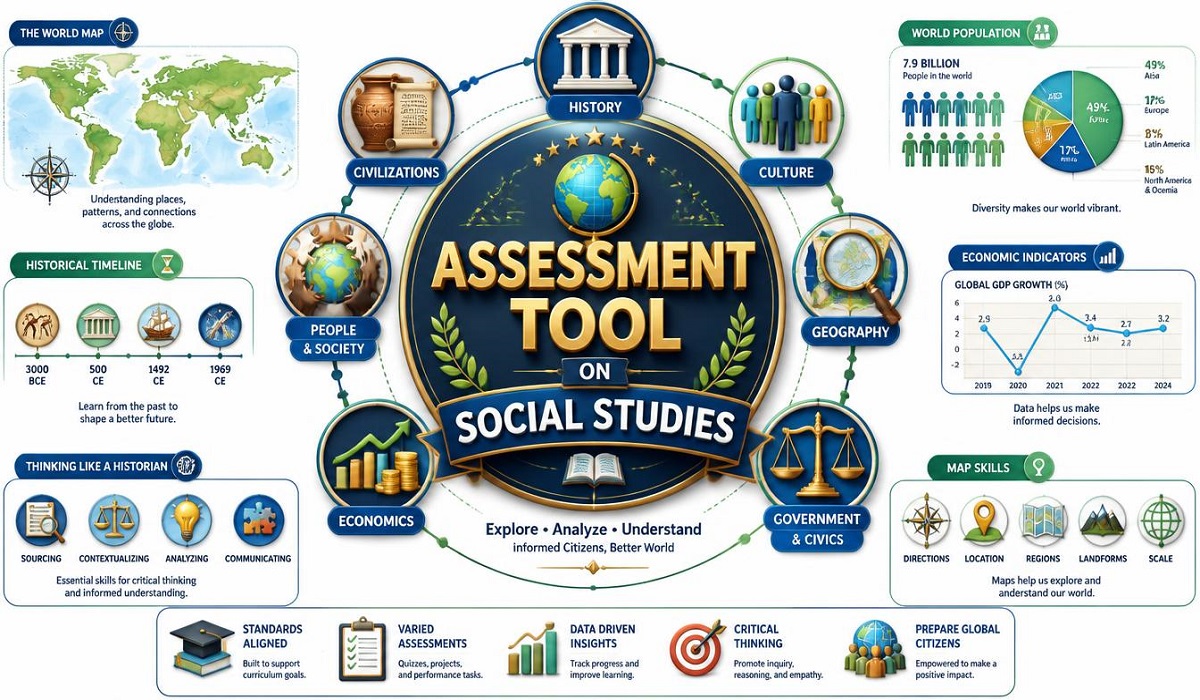
Assessment Tool on Social Studies: Imagine a classroom where students learn to analyze historical sources, comprehend the causes and effects of political events, or even participate in a mock congressional hearing in addition to memorizing names and dates. This is the promise of contemporary social studies, and a new form of evaluation is at the center of this change. The conventional Social Studies Assessment Tool is rapidly changing. In 2026, the emphasis has moved from rote memorization to assessing critical thinking, civic reasoning, and knowledge application skills.
Social studies exams were easy to administer for a long time. You would inquire about the facts. The first president was who? In which year did a war begin? While these data are still significant, educators today recognize they only give a tiny portion of the tale. A learner could know all the facts but not comprehend why they matter or how to apply that information.
This essay highlights the interesting developments happening in social studies exams. We will look at the new tools and tactics instructors are employing to see what pupils actually comprehend. From digital platforms that give rapid feedback to project-based examinations that simulate real-world obstacles, the world of social studies testing is becoming more dynamic, fair, and effective for learning. This book is created in easy-to-understand language, appropriate for anybody from instructors and parents to students themselves who are wondering about the future of education.
Why Social Studies Assessment is Evolving
Education, like everything else, evolves with the times. The world we live in now is different from the world of twenty or even 10 years ago. We have access to more knowledge than ever before, but we also have to cope with complicated concerns like climate change, political division, and rapid technological progress. These developments have made it imperative to modernize how we teach and test social studies.
Moving Beyond Memorization to Real-World Skills
The traditional manner of testing, which depended mainly on retaining information, is no longer enough. The world does not need people who can merely recite facts; it needs people who can think critically, solve issues, and comprehend diverse views. These higher-order thinking abilities are now the focus of an efficient social studies evaluation instrument.
A 2024 research from Eastern Illinois University found that instructors are frequently overpowered by internet resources and need to learn how to make expert selections regarding the caliber of content. This demonstrates the increasing need for tests that assist teachers in selecting the most effective curriculum and instructional strategies. The emphasis is on finding, altering, and adding resources that are pertinent to the particular students in a classroom.
The objective is to develop tests that are sensitive to linguistic and cultural differences so that every student may demonstrate their knowledge. A test is not a reliable indicator of a student’s learning if it is unfair to their background. A more individualized approach is replacing the one-size-fits-all strategy in modern evaluation.
Fulfilling the New Educational Requirements
One of the main forces for change in the US has been the College, Career, and Civic Life (C3) Framework for Social Studies State Standards. Teachers are encouraged to employ inquiry-based learning under this approach. Rather than merely imparting knowledge, they assist students in posing interesting queries, researching problems, and developing arguments. The Inquiry Design Model (IDM) is the name for this.
An IDM is a template for teaching that starts with a “compelling question.” For example, “Is it ever okay to break a law?” or “How has migration shaped our community?” The evaluation in an IDM is not only a test at the end. A final summative performance task, like a presentation, debate, or written argument, is the result of numerous formative assessments (checks for understanding) that help students develop their knowledge and abilities.
This new method necessitates a social studies assessment tool that can gage a student’s capacity to employ evidence, take into account various points of view, and effectively convey their ideas. It is about using information rather than only possessing it. In this instance, an assessment serves as a tool to direct learning and guaranty that students are ready for college, the workforce, and public life.
The Contemporary Social Studies Assessment Instrument
The phrase “An Assessment Tool on Social Studies” refers to a variety of tools in 2026. Instead of using a single “test day,” teachers are employing a variety of techniques throughout the academic year. This gives a far more accurate and comprehensive picture of a student’s comprehension.
Tech-Enhanced and Digital Tools
The modernization of assessments is greatly aided by technology. Teachers can now collect data on learning progress, engage students, and receive feedback more quickly thanks to digital tools. For example, a 2025 study demonstrates the use of digital tools such as Kahoot, Quizizz, Google Form, and Padlet.
Interactive Quizzes: Social studies-specific formative assessment tools such as Quizizz are being developed. A Quizizz-based formative assessment in integrated social studies can increase the efficacy of learning evaluation, according to research from 2026. These resources are thot to be highly reliable and useful for boosting student involvement and offering prompt feedback.
Automated Grading: AI is also starting to be used by platforms to assist with scoring. For instance, “Feedback Aide” is now used by some tools to score short-answer questions. This is especially useful for 5th-grade social studies, where a student might be asked to explain how local government officials make decisions. The AI can evaluate the response against a model answer and provide initial feedback, though a human teacher is always the final judge .
Traditional Digital Platforms: Tools like Google Form are also considered effective assessment platforms. A study on its use in junior high school showed that it is effective because it can provide objective and reliable results, especially for multiple-choice tests. It also saves teachers time by automatically processing data .
These digital tools are not just about convenience. They also address the challenge of engaging today’s students. Digital natives are often more drawn to learning experiences that use technology. However, challenges still exist, including teachers’ readiness to use the tech, limited access to devices, and the inability of some tools to automatically grade open-ended questions .
Performance-Based and Project-Based Assessments
While digital quizzes are helpful, they often do not capture deeper thinking. This is where performance-based assessments come in. These assessments ask students to apply what they have learned to a real-world task. They demonstrate understanding by creating something or solving a problem. In social studies, these can be powerful tools.
A 2026 study on digital media-assisted project-based assessment found that it can enhance responsibility and collaboration in elementary social studies learning . When students work on a project, such as creating a video about a historical figure or designing a presentation on a local issue, they are assessed not just on their final product but on their process, collaboration, and research skills.
Another important example is the Civic Thinking Summary, introduced in 2026 as a novel performance assessment tool. Developed for student-led civics projects (now mandated for Grade 8 in some states), it aligns with standards and curriculum. It is guided by principles like being based on a developmental perspective and supporting a match between curriculum and assessment . This is a practical and credible tool for evaluating what matters in civics education.
Some states also use the We the People: The Citizen and the Constitution Program. Its summative performance assessment is a simulated congressional hearing where students “testify” before a panel of judges. This assess their analytic, evaluative, and presentational skills and their knowledge of the U.S. Constitution . This is a perfect example of an assessment tool on social studies that measures deep understanding and civic readiness.
A Closer Look at Specific Assessment Tools
To understand the variety of methods, it is helpful to look at specific examples. These show how the new approach is applied in different contexts.
Grade Level Assessment Tool in Social Science (GLAT-SS)
One concrete example of a modern assessment tool on social studies is the Grade Level Assessment Tool in Social Science (GLAT-SS). In 2025, a study conducted in the Indian state of Karnataka developed a GLAT-SS for grades VII and VIII .
This tool was designed with a survey design and a large sample of students (866 typically developing children from five districts). It was developed in multiple stages, including the construction of test items, a pilot study, and final field study to determine norms, validity, and reliability . The study found significant differences in performance between different student groups, highlighting the tool’s ability to measure specific learning gaps.
This shows that a formal assessment tool can be designed to measure a student’s knowledge across the social sciences and identify their learning gaps. It helps students understand their strengths and weaknesses. The main goal was to assist students in identifying gaps and taking corrective actions to improve learning .
Critical Thinking Assessment Framework
Another significant development comes from research on critical thinking in social studies. A 2025 study aimed to develop an assessment framework for Grade 10 social studies specifically to measure critical thinking .
The research found that teachers often struggled to create assessments that asked students to verify the accuracy of information or raise relevant questions. Many students had difficulty with reading, and teachers had problems creating assessments that required deeper analysis . The research led to a framework to help teachers design better assessments.
This framework helps teachers create assessments that ask students to analyze controversial issues and formulate solutions. In tests created using this framework, teachers started to ask students to evaluate sources, check facts, and present reasoned arguments . This is a clear move away from simple fact recall toward evaluating the authenticity of information.
Attitude Assessment Instruments
Sometimes, learning is not just about knowledge. It is also about attitudes and behaviors. In the current context of blended learning (which mixes online and in-person instruction), a study in Indonesia focused on developing an attitude assessment instrument for junior high school social studies .
This research aimed to develop a valid and practical instrument to measure student attitudes like self-confidence, discipline, manners, and responsibility. The instrument was developed using the ADDIE method and went through several feasibility tests. The final instrument had high validity and reliability, with a Cronbach’s alpha value of 0.964 for offline and 0.953 for online learning .
This illustrates that an assessment tool on social studies can be used to measure non-academic skills, which are crucial for personal and social development. It shows that the field of assessment is broadening to include character traits and values, making it more holistic.
Why We Need an Assessment Tool on Social Studies?
We have discussed what these tools are, but it is important to understand why they are necessary. The purpose of assessment is not just to give a grade. It serves several vital functions in education.
The Importance of Formative and Summative Assessment
There are two main types of assessment: formative and summative. Formative assessment is like a checkup during a learning journey. It happens during the learning process and is used to guide instruction. A teacher might use a quick quiz, a group discussion, or a one-minute paper to see what students understood and what needs to be retaught.
Summative assessment is the final report card. It happens at the end of a unit or course to evaluate what the student has learned. This is the traditional final exam or end-of-term project. A strong assessment tool on social studies will incorporate both.
Research stresses that all assessments in elementary social studies should be firmly based on the goals of the social studies program. Students also need to be involved in the assessment process . The chapter mentions detailed examples of formal and informal assessments and how to conceptualize quality assessments in elementary social studies . The best tools allow for both.
The Role of Self-Confidence, Discipline, and Responsibility
A modern tool helps educators understand the whole child. Social studies, at its core, is about preparing people to be good citizens. This involves more than just knowledge. It involves positive attitudes and values. The attitude assessment instrument discussed earlier aims to measure traits like self-confidence, discipline, and responsibility .
Furthermore, project-based learning can help enhance student responsibility and collaboration . By assessing these “soft skills,” teachers can help students develop the character traits they need to be successful in life. This creates a learning environment that is about becoming a better person, not just getting better grades.
Fostering Critical Thinking and Civic Readiness
The most important reason for an assessment tool on social studies is to measure critical thinking and civic readiness. Social studies is the subject that teaches us how to live in society. It should prepare students to be thoughtful, informed, and engaged citizens. The new tools are specifically designed to do that.
The Civic Thinking Summary is a powerful example . It assesses a student’s ability to think through a civic problem, consider multiple perspectives, and develop a well-reasoned argument. This is the essence of civic readiness. Similarly, the assessment framework for critical thinking pushes teachers to ask students to evaluate information and formulate solutions, which are crucial skills for a functioning democracy .
A good assessment tool is the key to ensuring that students can not only recall facts but also analyze, synthesize, and judge.
How to Design an Effective Assessment Tool on Social Studies?
Designing an effective assessment tool on social studies requires more than just writing a few questions. It involves careful planning to ensure the tool is accurate, fair, and useful.
Key Steps in Development
Based on recent research, there is a standard process for developing these tools. Many developers use the ADDIE model, which stands for Analysis, Design, Development, Implementation, and Evaluation .
- Analysis: The developer identifies what the students need to know. This stage involves interviewing teachers, analyzing lesson plans, and understanding the skills and knowledge to be assessed. This is where the objectives of the assessment are clearly defined .
- Design: The designer decides on the structure of the tool. What format will it take? How will it be scored? What will the questions look like? This involves setting up the prototype .
- Development: The actual tool is created and then validated by experts. A tool must be checked by content experts, assessment specialists, and language experts to ensure it is accurate and clear. This step ensures that the assessment is valid (measures what it claims to measure) .
- Implementation: The tool is used in the real world with students. This might start with a pilot test to find issues before a wider rollout .
- Evaluation: This is the final check. The tool is reviewed formatively and summatively. The results are analyzed to ensure it is effective and reliable. Did it provide useful information? Was it fair to all students?
This systematic process ensures that the assessment is not thrown together but is a carefully crafted instrument.
The Key Principles: Validity, Reliability, and Practicality
For any assessment to be useful, it must meet three key criteria.
- Validity: The tool must actually measure what it is supposed to measure. If it is a test of critical thinking, it should ask students to think critically, not just memorize facts.
- Reliability: The tool must be consistent. If a student took the test twice, they should get roughly the same score. If two different teachers used the tool to evaluate the same student, they should come to a similar conclusion. The attitude assessment instrument had high reliability with scores of 0.964 and 0.953.
- Practicality: The tool must be easy for teachers to use. If it is too complicated or takes too much time, it will not be used effectively. This is why digital tools like Google Forms are popular; they automate some tasks.
Technology Integration and its Challenges
Integrating technology is a huge part of modern assessment. However, as noted in the literature, it comes with challenges. There are issues with teacher readiness, infrastructure, and the ability of some tools to handle complex, open-ended questions .
For example, while AI can help grade short responses, it is not perfect. Human oversight is still required . There is also the digital divide. In some communities, students may not have reliable internet access or devices at home, which can affect the fairness of online assessments . Designing an effective tool means planning for these obstacles.
The Future of Assessment in Social Studies
Looking ahead to the rest of the decade and beyond, it is clear that assessment in social studies will become even more dynamic and integral to the learning process.
Trends and Predictions for 2026 and Beyond
We will likely see a continuous shift away from high-stakes, one-time tests. The future of assessment will be much more formative and embedded in daily instruction.
- Personalized Learning: Assessments will be even more tailored to individual student needs. If a student is struggling with a specific concept, a digital tool might generate an immediate review activity or offer additional practice.
- More Performance-Based Tasks: We will see more project-based assessments and authentic tasks where students demonstrate their learning in real-world scenarios. The success of simulations like the We the People congressional hearing will inspire more similar assessments.
- Seamless Technology Integration: Digital platforms will become smarter and more integrated. They will do more than just quiz; they will analyze learning patterns, recommend resources, and provide detailed feedback to students and teachers. One report mentions a 2026 study on digital media-assisted project-based assessment, indicating this is a growing trend.
- Focus on “Soft Skills”: There will be more attention on assessing skills like collaboration, communication, and civic responsibility, using valid and reliable instruments like the one developed for blended learning.
The Growing Role of Digital Media and Project-Based Learning
A 2026 study published in the Journal of Education Technology focuses on “Digital Media-Assisted Project-Based Assessment for Enhancing Responsibility and Collaboration in Elementary Social Studies Learning” . This title alone suggests that using digital media and projects is seen as a key way to teach and assess responsibility and collaboration in younger students.
This is a significant development. It shows that project-based learning is not just for older grades. Educators are finding ways to use it in elementary school, supported by digital media. It’s a powerful combination. Students can use digital tools to research, create, and share their projects, and the assessment focuses on both the content and the skills they used to get there.
Challenges and Solutions
Despite all the progress, there are still hurdles to overcome when using an assessment tool on social studies.
Common Obstacles in Implementation
A major challenge, identified in a 2026 study on technology-based assessment, is teacher readiness. Many teachers are not comfortable using new technology or may not have the time to learn. There is also the problem of limited device access in some schools. If a school does not have enough computers or tablets for all students, it is difficult to integrate digital assessments .
Another challenge is assessment of open-ended questions. It is easy for a computer to grade a multiple-choice test, but it is much harder to grade a thoughtful essay or a complex project. The technology is evolving, but it is not perfect yet . Teachers often spend a lot of time doing this manually.
A challenge found in one study was that teachers had difficulty creating assessments that ask students to verify the accuracy of information . This shows that even when teachers want to assess higher-order skills, they need more training to design effective tasks.
Strategies for Teachers and Schools
The solutions to these challenges are multi-pronged. The research points to some key strategies.
- Continuous Teacher Training: Schools need to invest in ongoing professional development. Teachers need time and support to learn how to use new tools and develop new assessment strategies .
- Development of More Reflective Assessment Tools: There is a push to create assessment tools that are more reflective and can better assess open-ended responses . Until then, rubrics and clear guidelines can help teachers grade more consistently and fairly.
- Infrastructure and Policy Support: School districts need to ensure that all schools have adequate technology. This includes reliable internet and enough devices for students. Policies need to support teachers in trying new methods .
- Collaborative Planning: Teachers can work together in professional learning communities to design and review assessments. Sharing the workload and expertise can make the process less overwhelming.
FAQs, or frequently asked questions
1. What is the main difference between a traditional test and a modern An Assessment Tool on Social Studies?
A traditional test focuses mostly on memorization of dates, names, and facts. In contrast, a modern assessment tool on social studies measures a student’s ability to think critically, analyze sources, solve problems, and understand civic concepts. It focuses on applying knowledge to real-world situations and civic challenges.
2. Are digital assessment tools effective for social studies?
Yes, research shows they can be very effective. Digital tools like Quizizz and Google Forms can increase student participation, provide instant feedback, and make the evaluation process more efficient and objective . However, they work best when combined with other types of assessments.
3. What is the Inquiry Design Model (IDM)?
The Inquiry Design Model (IDM) is a framework for teaching and learning in social studies. It is based on the College, Career, and Civic Life (C3) Framework. In an IDM, students investigate a “compelling question” through a series of formative tasks, culminating in a summative performance assessment where they demonstrate their learning.
4. How do teachers assess critical thinking in social studies?
Critical thinking is assessed by asking students to do more than recall facts. Assessment tasks include analyzing primary and secondary sources, evaluating evidence, explaining cause-and-effect relationships, and constructing well-reasoned arguments. Some assessment frameworks are specifically designed to help teachers measure these skills .
5. Why is it important to assess student attitudes like responsibility and discipline in social studies?
Social studies education aims to prepare students for citizenship and life. Traits like responsibility, discipline, and self-confidence are essential for being an active and contributing member of society. A holistic assessment tool on social studies can measure these “soft skills” alongside academic knowledge .
Synopsis
The landscape of social studies education is undergoing a transformation, and an assessment tool on social studies is at the forefront of this change. In 2026, the focus has fundamentally shifted from testing rote memorization to assessing the skills that truly prepare students for the modern world: critical thinking, civic reasoning, collaboration, and responsibility.
This article has explored the evolution of these assessment tools. The need for change is driven by a world demanding more than just fact-recall. It calls for citizens who can evaluate information, solve problems, and participate thoughtfully in civic life. The modern approach uses a blend of formative and summative assessments, leveraging digital tools like Quizizz and performance-based tasks like project-based learning and the Inquiry Design Model.
Research highlighted in this post shows concrete examples, from the Grade Level Assessment Tool in Social Science (GLAT-SS) in India to the Civic Thinking Summary and AI-assisted grading tools in the U.S. . We learned about the importance of aligning assessments with standards like the C3 Framework and ensuring they are valid, reliable, and practical . Challenges remain, including teacher readiness, access to technology, and the difficulty of grading complex answers . However, the future promises even more personalized, performance-based, and digitally integrated assessments.
Ultimately, a well-designed assessment tool on social studies is not just about getting a grade. It is about empowering students to understand the world and become active, informed, and responsible citizens. By embracing these modern tools, we invest in a future where students are prepared not just for tests, but for life.