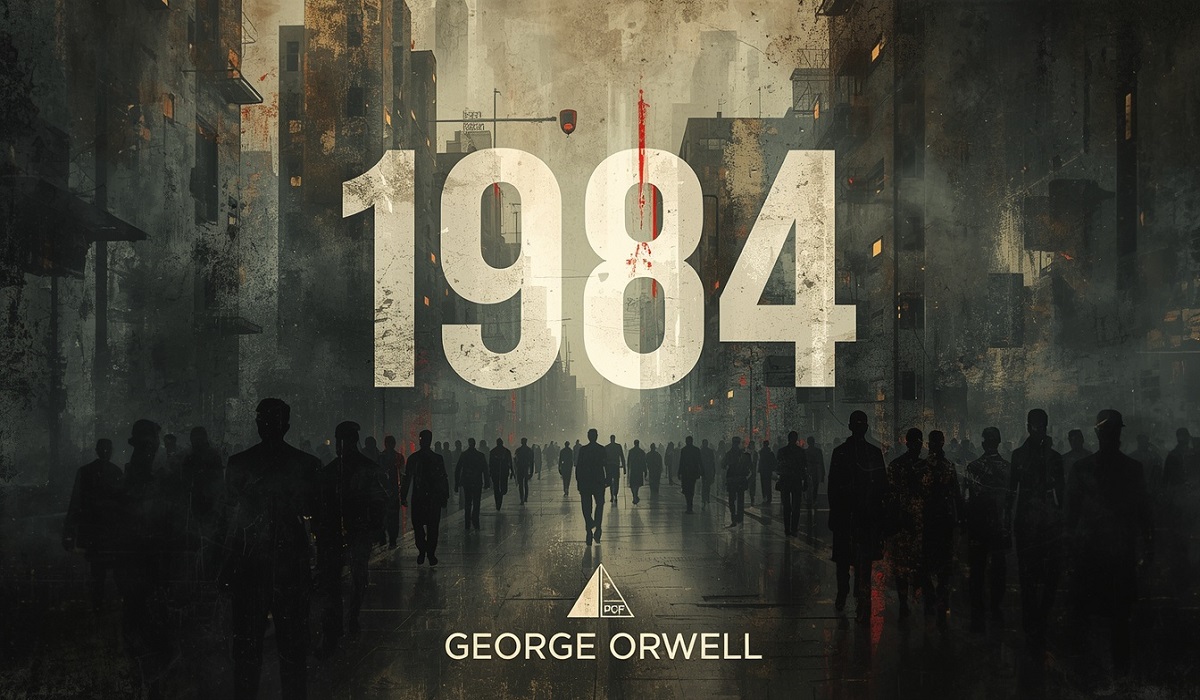
1984 by George Orwell PDF Free Download
1984 by George Orwell PDF Free Download: If you haven’t read “1984” yet, you might believe it’s simply an old science fiction story. But it is the contrary. This novel, written by George Orwell in 1949, depicts the narrative of a man named Winston Smith, living in a society ruled over fully by “the Party” and “Big Brother.” There is no privacy in this world, no freedom, not even your own thoughts. You can write history how you want . You can simplify language so you can’t even say no . “Thoughtcrime” is the worst thing you can do .
The reason this book still shocks people today is because this book does not just depict the future, it describes Orwell’s views of the time he lived in. Totalitarianism, mass monitoring and mind control were on the rise after World War II. Orwell feared that these trends would accelerate, so he wrote fiction warning of them.
Why Is This Book Relevant Today?
You might say, 1984 was so long ago, what does this book have to do with me?
And the answer is: all of it. When you find out that your phone is listening to your chats, when you watch the news being continually edited and edited again, when you sense it’s getting harder and harder to speak the truth, the world portrayed in “1984” is no longer remote. The words Orwell coined in this book, such as “Big Brother,” “doublethink,” and “Newspeak,” have become part of our everyday vocabulary. This is not simply a fiction. It is a mirror, reflecting the perilous path in which we may be going.
Where Can I Download “1984” PDF Free?
That’s what a lot of people care about.” The good news is that “1984” is already in the public domain in many parts of the world.
A Brief Explanation of Copyright Status
The dilemma is this: George Orwell died in 1950. Copyright lasts for 70 years after the death of the author in the UK and EU. As so, “1984” entered the public domain in these countries in 2021. This implies that in the UK, EU and other countries that see the same legislation, anybody is free to legally download, copy and distribute this book, including in PDF format.
But in the United States, it’s a different story. According to American copyright law, works published after 1929 are protected by copyright for 95 years after publication. “1984” was released in 1949, which means it won’t reach the public domain in the US until 2044. That’s why you may find PDFs on certain sites and not on others.
Where to Get Legal PDF Copies
If “1984” is already in the public domain where you are, you can find its PDF in several legal digital libraries. For example, the Internet Archive includes several editions of “1984” that you may read and download. Usually these copies are from library collections, scanned in reasonable quality and publicly accessible.
Also, Project Gutenberg branches in certain countries have the whole text of 1984, and you may download PDF or plain text forms from them.
Important Note: If you are in the United States, downloading the full PDF of “1984” directly may have copyright difficulties. The best decision is to buy an e-book or a hard copy. This book is very cheap, and it is excellent for writers and the publishing business to support the official edition.
What story does this book really tell?
Winston the Protagonist
The story’s main character is Winston Smith, a 39-year-old Party member who is an ordinary person. He resides in London, which is named “Airstrip One” in that planet, a province of the superstate “Oceania”. Winston’s duty is to alter history in the Ministry of Truth. Winston’s mission is to rewrite all prior records so that if the Party claims someone is a traitor and this man was a hero before, then he was always a traitor.
Winston begins to have secret doubts about the Party. He purchased a blank journal and went to a corner of his house where the security camera couldn’t observe, and began to write down his thoughts. In that world even this is a death sentence.
What This World Is Like?
The world Orwell describes is gray, dilapidated, and suffocating. The cities are full of ruins and bombings have left materials extremely scarce. Even razor blades and shoelaces are hard to buy. People drink the unbareable ” Victory Gin ” . Smoke cheap cigarets with falling tobacco .
Every home contains something called the “telescreen” that functions. It is a source of Party propaganda, and it also watches and listens to your every move. You never know when it’s watching you, but you have to assume it’s always watching you.
Love and Revolution
Winston encounters a young woman named Julia. They begin to meet in secret and do things the Party outlaws: have sex, drink real coffee, eat real sugar. Their love is, in itself, a political revolt.
But they know all of this will eventually come out. There are Thought Police everyplace. And eventually, Winston is taken to the “Ministry of Love” – that scary windowless place. There he meets O’Brien, a terrifying man he thought was a rebel, but is in fact a high ranking member of the Party.
Why the Ending Is So Despairing?
The ending of “1984” is one of the most heartbreaking endings in literary history. After torture and brainwashing, Winston eventually betrays Julia and betrays himself. He “learns” to love Big Brother. As he sits in a café, watching the victory news on the telescreen, he realizes he truly loves Big Brother. The story ends in this twisted, hollow “love.”
What Orwell wants to tell us is: in the face of absolute power, individual resistance may be meaningless. This is exactly why this book is so terrifying and so important.
1984 Novel Book Free Download in PDF Format
Those Words Orwell Created That You Use Every Day
One of the greatest legacies “1984” left to the world is the language it created. These words are now part of our daily vocabulary:
- Big Brother: That omnipresent leader, symbolizing absolute surveillance authority. Now used to describe any institution or system with excessive surveillance.
- Thoughtcrime: Merely thinking “wrong” thoughts in your head is already a crime. Today we use this word to describe suppression of speech and thought.
- Doublethink: Simultaneously believing two contradictory ideas and considering both to be correct. Orwell used this word to describe how people accept the Party’s lies. Today, when you see people accepting contradictory information without any sense of inconsistency, this is doublethink.
- Newspeak: A deliberately simplified language designed to make people unable to express opposition. When vocabulary disappears, thought disappears too.
- Telescreen: That device that both broadcasts programs and monitors you. Today’s smart speakers, smart TVs, and phones are, to some extent, the telescreens in Winston’s home. “1984” and “Animal Farm”: Which to Read First?
Many people ask this question. Orwell also wrote another famous book called “Animal Farm,” which is also an anti-totalitarian allegory, using the story of an animal farm to satirize the Soviet Union. - My suggestion is: if you’re just starting with Orwell, you can read “Animal Farm” first. It’s shorter, simpler, more humorous, but equally profound. “1984” is more oppressive, more complex, and more disturbing. Reading “Animal Farm” first can help you understand Orwell’s core ideas, and then you can enter the darker world of “1984.”
What Does This Book Mean for Our Reality?
Every time you open social media, algorithms are deciding what you see, every time you use a search engine, results are being filtered. Every time you hear a piece of news being “corrected” or a video being taken down, you are experiencing some of the mechanisms described in “1984,” although to different degrees.
Orwell was not a prophet; he wrote about the trends he saw. In 1948, he already realized that technological development could make power more concentrated than ever before. Today, big data and artificial intelligence make surveillance easier, cheaper, and more hidden.
But “1984” is ultimately a book about hope — despite its despairing ending. It tells us that recognizing the problem itself is the first step of resistance. When Winston wrote in his diary, he was already rebelling. When we read this book, discuss it, and spread its ideas, we are doing the same thing.
Five Common Questions
Is “1984” a true story?
No. This is a fictional novel, but Orwell drew heavily from real-world totalitarian regimes, especially Stalinist Soviet Union and Nazi Germany. This book is not about any specific country, but about the universal patterns of how power is abused.
Why is this book called “1984”?
Orwell originally called this book “The Last Man in Europe.” There are several theories about why it was changed to “1984.” One is that when he was writing this book in 1948, he reversed the last two digits as a warning about the future. Another theory is that he wanted to give this dystopian world a specific year to make it feel more real and imminent.
Is the PDF version of “1984” complete?
This depends on the source. Versions provided by legitimate digital libraries like the Internet Archive are usually complete scans or electronic versions. But some websites may only provide partial chapters or low-quality scans. If you want to download, try to choose versions provided by libraries or educational institutions.
Can I read “1984” on my phone?
Of course you can. PDF format can be read on phones, but the experience may not be as good as dedicated e-book formats (like EPUB). If you plan to read on your phone, I suggest finding EPUB or MOBI format, or using a tablet to read PDF, which will be more comfortable.
What age is “1984” suitable for?
The themes of this book are very heavy, involving torture, brainwashing, sex, and a despairing ending. Generally speaking, high school students (15-16 years and above) can understand the depth of this book. For younger readers, adult guidance and discussion may be needed. The language itself is not too difficult, but the ideological content is very rich.
Summary
George Orwell’s “1984” is not just a novel. It is a warning, a lesson we should never forget. More than seventy years after its publication, it remains one of our best tools for understanding power, truth, and freedom.
Whether you’re reading it for the first time or want to read it again, this book will bring you new shocks. If you live in certain parts of the world, you can legally download its PDF for free. If you can’t, spending a little money on a physical book or e-book is worth it — because some books, you should own.
When Orwell wrote this book, he was already very ill. He knew he might not live much longer. He pushed himself to complete this work because he believed some things must be said. Now it’s our turn to listen, to read, and to remember.
This article is for educational and informational purposes only. Please comply with copyright laws in your region.