Synthetic Persona Tutoring
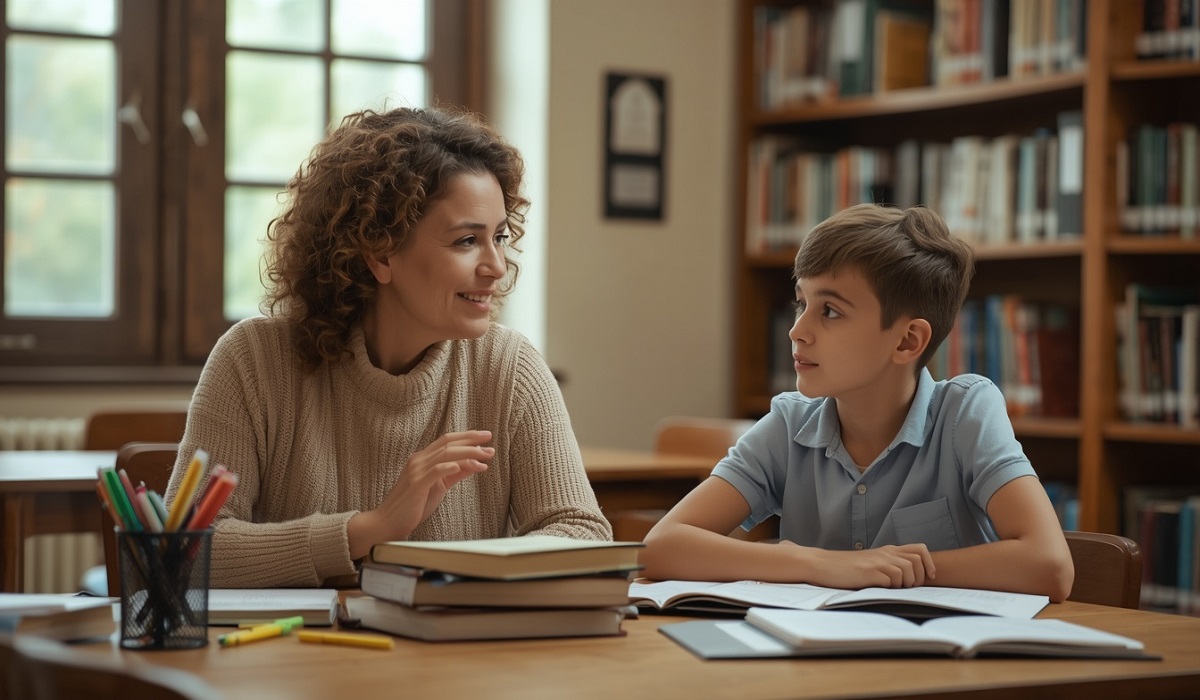
Synthetic Persona Tutoring: Imagine a new teacher walks into a classroom. He has to cope with all types of students, some confused and frightened, some silent and withdrawn, some antagonistic, some anxious and frustrated. Such circumstances can occur at any time in a real class. But how can a prospective teacher learn to face these problems before even getting the job?
This is the problem that synthetic persona teaching is intended to overcome.
Synthetic persona coaching is a method that makes use of artificial intelligence to generate virtual personalities of students. These digital pupils aren’t just chatbots. They have their own personalities, ways of learning, emotional responses and limits of knowledge. But more crucially, they think, respond and err like actual students.
It’s like a flight sim.” Pilots have to log 100s of hours on a simulator before they get to fly a plane . Synthetic persona coaching provides teachers and students with a comparable practice experience—except this time the “cockpit” is the classroom and the “weather” is the multitude of student reactions.
In 2026 this technology is fast becoming part of schools and teacher training programs. At its heart it is a basic value: to make teaching practice safe, repeatable and scalable. In a virtual environment, a teacher may attempt different teaching techniques, see how virtual pupils respond, and then change their technique. This is all done without any concern for the sentiments of real kids, or the waste of crucial classroom time.
What Is Synthetic Persona Tutoring?
What Is Definition? & Core Idea?
Synthetic persona coaching utilizes AI-generated virtual personas designed to mimic the behavior, emotions, and cognitive states of learners, creating a secure setting for teachers, tutors, or learners to practice and explore.
The idea is constructed around few essential concepts. Learning is, in its very essence, a social engagement. Teachers need to learn how to interpret the signals from the pupils, how to adapt their language and how to control their emotions in the classroom. Second, these talents are not easy to learn by reading textbooks. They have to practice, make errors, try again and again. Third, opportunities to practice in real classrooms are few and expensive.
Synthetic persona tutoring provides an answer, establishing a “practice field” where teachers may enhance their abilities without the real-world implications.
Why “Synthetic” and Not “Real”?
You could ask: why not have actual students in the practice? So many reasons.
The near-term impediment is cost. It is not appropriate to disrupt students constantly. Having real students engage in teacher training entails arranging time, permission, creating activities, and students themselves are also learning. Consistency is another issue. Real students react differently, and it is challenging to have the same student portray a “confused student” for practice again and again.
Synthetic personas provide what actual students do not: repeatability, controllability, and safety. A teacher trainer may see their virtual pupil puzzled in the first exercise, more aggressive in the second, and quiet and withdrawn in the third. Such methodical practice is nearly difficult in an actual classroom.
How Does Synthetic Persona Tutoring Work?
Technical Architecture Underlying
To fully comprehend the synthetic persona teaching, we need to look at the technological parts that make it operate. Although implementations differ from one platform to another, the basic design typically has many fundamental components.
The base engine: big language models. They respond in natural language, grasp context, and sustain a coherent discussion. But language models alone are not sufficient.
The key to making virtual students “come alive” is through persona prompting systems. Researchers develop comprehensive backstories, personality traits, learning styles, and emotional dispositions for each virtual student. This information is embedded as cues that lead the language model to respond in specified ways.
conduct anchoring and assessment systems guarantee that virtual students’ conduct matches with instructional aims. The technology allows virtual students to talk and also judges if they act as “that type of student”. For example, a “passive” student should usually wait for instructions rather than proactively ask questions.
Memory and continuity technologies enable virtual pupils to recall past exchanges. If a student disclosed in the first chat that he is terrified of arithmetic, that fear should continue to impact his performance in following sessions.
Transforming Prompt into Persona: Creating a Virtual Student
Building a good synthetic character is more than simply writing a prompt. Based on the latest research and practical experience, this approach normally contains many steps.
The first stage is to create a “origin story.” Before designers can decide what type of person a virtual student is, they need to know the environment he inhabits. What are the problems of this student? What is his learning environment like? “What’s that putting him under?
Anna is a fictitious social responsibility consultant, and her creators initially developed a “company in crisis” as the background before establishing Anna’s personality and position. Student personas are the same: an eighth grader from a low-income home who is behind in math would behave significantly differently from a high school student from a rich family who lacks ambition.
The second stage is to build the persona profile. This comprises background information, goals, tone style, and behavior limits. A “confused” student may regularly declare “I don’t quite understand,” whereas a “confrontational” student may reject the teacher’s authority. These features need to be well anchored so that the virtual learner is consistent throughout several exchanges.
- Test and iterate There’s no such thing as a persona design that works properly the first time. Designers have to iterate many rounds of discussion with the virtual student, check whether its replies are expected, and then modify prompts or persona parameters. This is what a sculptor does again and over until he gets it to appear “right.”
Key application scenarios for the synthetic persona tutoring
Instructor Orientation and Teacher Training
The most direct use of synthetic persona coaching is in teacher training, particularly the training of graduate teaching assistants and student teachers.
Some major computer science departments have around 250 graduate teaching assistants assigned to various courses every year. Training in the traditional sense concentrates on policy explanations and administrative processes, but there is practically no real-life chance to learn how to deal with “emotionally agitated students” or “persistently confused learners.”
The GLOW platform was expressly created to remedy this problem. It has four key personas: puzzled, quiet, combative and frustrated. Graduate teaching assistants can engage with these virtual students in simulated office-hour discussions and get instant feedback across five dimensions: “student-driven learning,” “concept understanding,” “time management,” “adaptability,” and “professional communication.”
Preliminary data suggest that most subjects often attain the pre-determined benchmark within 1 to 3 tries and exhibit significant performance gains on retesting. This means that virtual pupils are not an assessment one time but a real practice chance.
Communication between doctors and patients and training in professional situations
Communication skills are of comparable importance in medical education. The University of Kentucky created a platform where medical students may engage with online patients and practice assessing patients’ competence to give informed consent. These virtual patients might be cooperative, confused or resistive. Students must discuss with the patient to determine if the patient has the capacity to make medical decisions.
The importance of this instruction is in safety and repeatability. Medical students may make mistakes without hurting real patients and learn from them. They can treat several virtual patients with various personalities in the same day, swiftly gaining experience.
Language Learning and Debate Skills
University of Amsterdam teachers constructed four identities with varied ideological ideas so students may practice argument skills. The approach provides students with counterarguments they may not have considered and forces them to think about their own perspectives.
Virtual personas may behave as native speakers, novices or characters with certain accents in language learning, offering a variety of conversational practice partners to learners.
Why Synthetic Persona Tutoring Matters in 2026?
The Individualized Learning Scaling Challenge
Every pupil is unique. A student who suffers with arithmetic and a student who struggles with writing need two distinct teaching styles. But when a teacher has thirty pupils, it is difficult to give individual assistance to each one.
Synthetic persona tutoring could be one answer. It can’t substitute for actual human contact, but it can increase access to high quality practice. So a teacher trainer may have fifty new instructors practice with online students at the same time without having to seek fifty real student volunteers.
Research groups like StudentSim are investigating an even more ambitious possibility: creating a “digital twin” for every actual student. This digital twin can replicate the ability limits and error distributions of the learner working on their own and may also exhibit plausible cognitive changes following instructional coaching. This means an AI teacher can practice with thousands of virtual students before going live, optimize teaching strategies and then face real learners.
The Need for Safe Places to Play
There will be mistakes, of course, as you learn new skills. Mistakes can be expensive for teachers. An inappropriate response can undermine a student’s confidence and an inaccurate judgment can exacerbate classroom conflict.
Synthetic persona tutoring provides a “consequence-free zone.” Graduate teaching assistants can test out different strategies in simulated conversations, observe how the virtual students respond, and then modify their approach. As one participant described it, “it’s practicing in a safe place without the fear of bad consequences.”
Designing effective synthetic personas: fundamental principles
Principle One: Persona First Story
A virtual student needs a ‘history.’ Why is he confused? What was his earlier learning experience? What are his views on this subject?
If the story background is designed first by the designers, the behavior of the virtual students is purposeful and authentic. “When story comes before character, the character’s actions feel deliberate, the interaction more real,” said Anna’s creator.
Principle Two: Intentional Design of Consistency
Researchers looking into AI-generated student personas found that large language models can be prone to getting “too organized,” with answers sometimes appearing “too structured,” resembling formal reports rather than casual conversation. A real student would not answer “How was school today?” with a bullet-point list.
Solutions include limiting response length, introducing colloquial expressions, and even allowing virtual students to occasionally “go off topic” or change the subject. These seemingly “imperfect” features are exactly what make virtual students more human-like.
Principle Three: Theory Anchoring Rather Than Random Generation
Researchers of the HACHIMI framework emphasize that synthetic student personas need to align with educational theory. The cognitive development level of a second grader should match Piaget’s “concrete operational stage,” rather than being a randomly generated combination of traits.
This theoretical anchoring is achieved through a “neuro-symbolic validator”: the language model handles creative content generation, while logical rules check consistency. If a generated persona violates developmental stage constraints, the system requires regeneration.
Principle Four: Balancing Diversity and Representativeness
If language models are allowed to freely generate student personas, they tend to repeatedly generate a “average student”—average grades, average motivation, average background. This causes the virtual student population to lack the diversity of the real world.
The solution is to use stratified sampling to ensure that students of different academic levels, genders, and grades are represented. The HACHIMI project generated one million virtual student personas, covering types ranging from academically excellent to struggling learners.
Limitations and Ethical Considerations of Synthetic Persona Tutoring
Technical Limitations: Hallucination and Context Sensitivity
Generative AI has a well-known problem: it “hallucinates”—generating information that sounds plausible but is actually wrong. In virtual student role-play, this may appear as a “confused student” suddenly providing reasoning way above their set level.
The model’s knowledge of contextual subtlety is likewise weak. Researchers found that AI-generated student identities can “overgeneralize,” believing all students have the same resources or experiences. A virtual student from Lebanon may be defined as “struggling with online learning,” but lacks detailed expertise of local internet infrastructure concerns.
Ethical Boundaries: The Line Between Virtual and Real
Napster’s ambition to cooperate with GEMS Education to build “teacher digital twins” has aroused worries about replacing real instructors. Critics point out that 24/7 accessible virtual teachers may be used as a reason to eliminate personnel or slash salaries.
A deeper problem is emotional reliance. Some policy proposals specifically warn against creating technology that makes children emotionally dependent on artificial characters. Virtual students can simulate emotional responses, but they do not truly “feel” anything. Learners need to understand this difference.
The Necessity of Maintaining Human Oversight
Most researchers emphasize that synthetic persona tutoring should enhance, not replace, human teaching. Teachers need to assess AI-generated information and assist students to reflect and discuss after interacting with virtual personas.
Successful implementation methods are frequently “hybrid”: virtual students give practice opportunities, while real teachers provide feedback and improve knowledge. A Stanford University research indicated that when human instructors employed AI prompt systems, pupils’ topic knowledge rose by 4%.
Future Directions of Synthetic Persona Tutoring
From “Generic Students” to “Personalized Digital Twins”
Most modern synthetic personalities are “generic types”—confused, belligerent, passive. The future direction is to develop a “digital twin” for each genuine pupil.
The StudentSim project marks the boundary of this trend. Its purpose is to train a simulator that can mimic a given student’s cognitive state: where does this student tend to make mistakes? What type of prompt does he need to break through? How does he modify his thinking after obtaining guidance?
If effective, AI teachers can practice thousands of times with their digital twins before engaging with real pupils, optimizing teaching tactics. This seems like science fiction, yet the underlying technology is actually being developed.
Multimodality and Embodiment
Most modern synthetic personalities are in text form. But study reveals that students’ sense of involvement goes up when AI tutors are shown as virtual avatars.
AI avatars in virtual reality settings can deliver more immersive experiences. At TU Braunschweig, student instructors may practice “parent conversations” – tricky talks involving virtual pupils’ parents — in VR. Participants said that being in the VR setting made them feel “more real” but also that the AI language was “a little mechanical.”
From Training Aid to Learning Partner
Synthetic personas can assist teachers not only to practice, but also to become students’ learning partners. Students can hone their reasoning abilities with a virtual “debate partner.” A “patient coach” character might accompany pupils in language conversation practice.
The design is the art. A good learning partner persona has clear goals of teaching, reasonable challenge and safe interaction limits.
FAQ (Frequently Asked Questions)
What is the difference between synthetic persona coaching and typical chatbots?
Regular chatbots are designed to deliver information and respond to queries. The purpose of synthetic persona coaching is to imitate a certain type of learner with consistent background, behavior, and emotional features. An regular chatbot says “I don’t understand,” whereas a synthetic avatar responds “I got stuck at this step last time too, just like with that equation last time.”
Can Virtual Students React Like Real Students?
Research reveals that well-designed virtual pupils may be quite realistic in many aspects. One examination indicated AI student identities scored 4.25/5 and 5/5 for “authenticity” and “educational alignment.” But researchers also have pointed to a “AI-generated neatness” – comments are often too planned and missing the pauses, hesitations and off-topic moments of actual human interaction.
Can synthetic persona tutoring substitute for genuine classroom practice?
No, and it shouldn’t. Almost all researches point out that synthetic persona training is an addition, not a substitute, to actual practice. The value of the system is that it provides low-cost, repeatable “flight simulator” time for trainees to get experience before they get into the real cockpit. Virtual avatars can never replace real human contact and emotional experience.
What technological background is needed by instructors to utilize these tools?
It is contingent upon the particular platform. Tools like as Tavus say you don’t need programming skills, and AI instructor avatars can be generated using a visual interface. But generating effective persona cues and measuring virtual student achievement still demands skill in education. Technology is the instrument, teaching judgment is the heart.
What are the hazards of adopting synthetic persona tutoring?
The key hazards include: AI hallucinations that lead to false information from virtual students; too much dependence on virtual practice at the expense of actual teaching experience; and privacy and security concerns, especially when real student data is utilized to train digital twins. It requires human supervision and well-defined ethical limits.
Summary
Synthetic persona coaching is an intriguing inflection point in education technology. It doesn’t aim to make AI “smarter” or “faster”, but “more human” – more precisely, like a learner.
The real usefulness of this technology is in safe practice. From novice instructors learning how to manage challenging talks in the classroom to pre-training of artificial intelligence systems in teaching tactics before deployment, synthetic personas provide a sandbox where mistakes may be made, remarked on and repeated.
Here’s the status of the technology in 2026: Text-based synthetic personas are now rather established and can be made to attain a high degree of realism. Virtual reality and embodied personalities are growing with lots of potential but still a “mechanical feel” to overcome. Personalized digital twins are the next frontier, and universities like Microsoft and UIUC are actively studying them.
Perhaps the most crucial premise is this: synthetic personas are to augment human instruction, not replace it. The ideal approach is hybrid – virtual pupils give endless practice opportunities and real professors provide meaning, reflection and genuine concern. These two together do not mean less human connection for learners. They mean greater quality interaction.