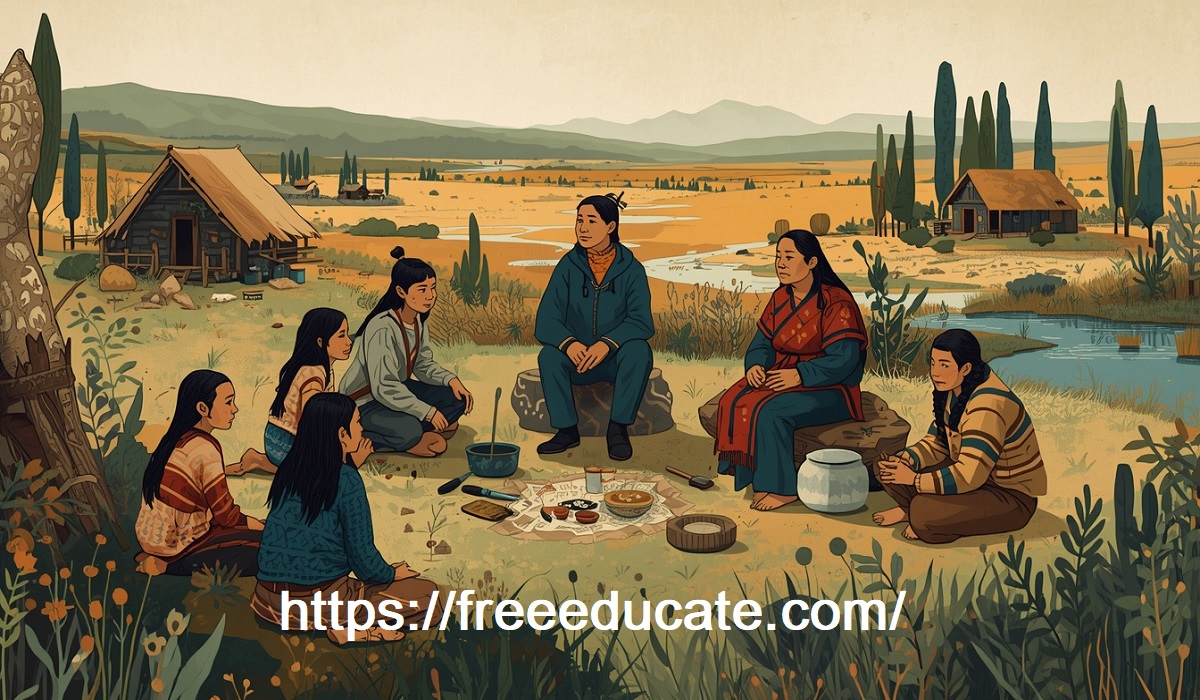
Hyper-Localized Indigenous Pedagogies: Imagine a school with no walls or roof, where the earth you walk on is the textbook and the elders of the community are the teachers. Students are no longer merely learning the history of faraway cities. They go to the river to watch the water flow instead, to listen to old people tell the legends about this region, to touch with their own hands the crafts passed down through centuries. This is the shift that Hyper-Localized Indigenous Pedagogies is creating.
In 2026, the world of education is undergoing a silent change. More and more instructors are understanding that a one size fits all curriculum will not suit the requirements of all students. If what children learn is not related to the world they see, touch and feel every day, learning becomes abstract and remote.
It seems a little intellectual, but the basic notion of hyper-localized Indigenous pedagogies is pretty simple: return education back where it belongs – back to the community, back to the land, back to live cultural traditions. This is not about putting pupils in a cage of the past. It’s about giving them planted feet so that when kids walk out into the world they know where they’re from.
This post will take you deep into the complete picture of this schooling movement. If you are a teacher, a parent, or just someone interested in education, you will find: when learning is really grounded in place, everything is different.
What Are Indigenous Hyperlocal Pedagogies?
Deconstructing the Idea: Three Key Words
To comprehend Hyper-Localized Indigenous Pedagogies we need to look at these 3 terms independently.
“Hyper-Localized” means “super local.” It’s not simply “using local examples.” It’s about the content, techniques and goals of education all coming out of this area. The course of learning for a youngster from the highlands and a child from the sea should be vastly different. Their settings are varied, as are the requirements of their community and cultural traditions.
Indigenous means the original people. It’s not just about ethnic identification here. Rather it points to an attitude to the world. Indigenous knowledge systems are grounded in relationships, reciprocity, respect for the land, and the transmission of knowledge from generation to generation. These are not museum exhibitions. They are live practices. They can be done.
Pedagogies means “teaching methods”. It solves the issue of “how to teach” and “how to learn”. Indigenous teaching methods frequently do not rely on text books and tests. Instead, information is transmitted via observation, involvement, narrative, and hands-on action. Learning happens in real world settings, not in isolated classrooms.
Why it matters in 2026?
You could question why now? What is this topic so essential in 2026?
The solution is in an ever more evident contradiction. On the other side, the global curriculum systems have pupils learning the same thing all around the world. In contrast, the material is increasingly failing to address the most fundamental issue in the minds of students: “What does this have to do with me?”
Research reveals that involvement and motivation decrease off drastically when learning content is not tied to students’ lived experiences. But when education connects to kids’ cultural roots and local surroundings, pupils learn better and they also acquire a greater sense of identity and confidence.
Hyper-Localized Indigenous Pedagogies are supported by the technology environment of 2026. Artificial intelligence can create learning materials using local data. Mobile gadgets enhance outdoor learning. But these technologies are only instruments. And the actual heart is still: put you as the instructor.
Core Principle One: The Land Is the Best Teacher
“The land is not a backdrop, it’s the main character”
Traditional classrooms are four-walled instructional settings. Field outings are the exception rather than the rule. However, this link is flipped in Hyper-Localized Indigenous Pedagogies.
The curriculum is the land itself. Science lesson: Changes in river water levels. The changing seasons of the forest teach us biological lessons. Community elders tell place-name legends that include lessons in history. Knowledge is not passed from books to the brain. It is “calculated” from the land.
Educational study from the Tsuut’ina First Nation demonstrates the power of this strategy. The elders characterize land-based learning as having four basic elements: creating community, experience learning, learning to care and spiritual direction. You notice that “memorizing facts” is not one of these four requirements.
From “Going Out” to “Sinking In”
Outdoor education programs exist at many schools. They bring students to the parks, museums, or farms. These activities are valuable in themselves but tend to be one-off events. Students go to look, and return. And everything is as it was.
Hyper-Localized Indigenous Pedagogies requires more. It needs relationships over time. Students do not “go to” a place. They keep coming back to the same spot, watching it change, learning its rhythms and slowly becoming part of it.
Educational research in Greenland has found that this place-based teaching is effective, because it leads to authenticity and connection. Students believe there is no divide now between school and life. They feel noticed and respected when the knowledge they gain is straight from the land they live on.
Core Principle Two: Curriculum is the Community
Bringing Elders Back to School
Before formal education systems were established, knowledge was shared within the community. Grandparents taught grandchildren. Neighbors taught each other’s children. The whole village was a classroom.
One effect of colonial education systems was that they cut off this intergenerational link. Schools became a closed institution, putting parents and community elders outside. Research in Uganda discovered that this cutting off led to young people feeling alienated from their own culture.
What Hyper-Localized Indigenous Pedagogies aims to mend is exactly this broken link. In school programs in Uganda, village elders were brought back into the classroom — but not as “guests.” They came as knowledge holders. Students explored traditional principles of community service, visited sacred locations, and learned about the therapeutic significance of native flora. What the elders told was not just information. It was live memory and meaning.
Ethical Boundaries: From Knowledge Mining to Knowledge Partnership
We need to be careful about how we bring community information into the classroom. information mining as a danger: researchers and educators “mine” stories and information from a community to write a paper or enhance a curriculum, and then depart without giving anything back.
Ethical practice is another matter. It asks the teacher to answer numerous questions: Who was the knowledge-giver? What do they wish to be portrayed as? What do they earn?
Real relationships are mutual. When kids learn from the elderly, they should also give back to the community. This might be a presentation, a record or just respect and connection ongoing. Knowledge is not a free commodity. That’s part of being in a relationship.
Core Principle Three: Stories and Experience Work Better Than Textbooks
Narrative as a Teaching Method
Indigenous knowledge systems seldom pass on information through abstract “definitions.” Knowledge resides in tales. A river tale has geography, history, moral precepts, and ecological knowledge all rolled into one. It is not divided into test points. It is lived as a whole.
Māori scholars’ research illustrates how Indigenous students use “healing pedagogies” to confront painful history via tales. Colonial brutality is not something that students just “learn” about in a passive way. Instead, they share their own family memories through digital storytelling, and using a way of “channeling a haunting,” they examine the landscapes and monuments around them and face the histories that have been buried.
This strategy succeeds because it treats pupils as knowledge subjects. Students are not empty vessels to be filled with the “correct” interpretation of history. They are the authors of their own narratives, the makers of meaning.
Experience First, Explanation After
Another aspect of Indigenous pedagogy is that hands work before lips. Instead of learning theory first and then completing an experiment, students do first and then comprehend by doing.
In a teaching situation that links GreenComp with traditional ecological knowledge, students don’t first study what “water resource management” means. They first go and observe: How does water move through soil, plants, and rocks? What is the erosion? Then they create solutions with less impact. Seeing and doing leads to learning.
The fundamental basis of this strategy is that comprehension comes from involvement, not from being taught. Plant a native plant with your own hands, see it survive a drought, and the information you receive about adaptability is deeper than any textbook.
Core Principle Four: Integrating technology and local knowledge
Technology is not a substitute, it is a bridge.
Some may be worried: Does a focus on locality and tradition equal a rejection of contemporary technology? Far from it. In 2026, Hyper-Localized Indigenous Pedagogies is demonstrating how technology can assist local knowledge, not replace it.
The research on the PearlAI framework shows how artificial intelligence’s “hyper-localization” capability may place curricular information in a community’s own language, history, and experiences. Imagine an app that might push learning information about local flora, historical events, or community anecdotes, depending on where a learner is located. Technology is not a globalizing homogenizing force here. It is a tool for localization.
Real Case: Students as Producers of Local Knowledge
This option was shown in a school in Tel Aviv. Students utilized mobile technology and 360-degree cameras to build interactive learning objects about important sites in their town. They collected data, developed content and then distributed it to the public using a location-based system.
Students don’t passively absorb technology in this process. They create local knowledge. They gain research, cooperation and technical skills, as well as a greater awareness of and connection to their community. Technology is the connection between the classroom, the community and the rest of the world.
Implementation Guide: Getting Started in the Classroom
Step One: Begin With Listening
You don’t have to construct a whole curriculum to begin. The practice of Hyper-Localized Indigenous Pedagogies starts with a simple gesture: listening.
- Listen to your pupils. What matters to them? Where are their families from? What sort of sites do they see every day?
- Listen to your people. Who knows? Where are the stories? What customs are still being followed?
- Listen to the Earth. What’s near your school? A river ? A mountain? A wood? An vacant lot?
Step Two: Build Relationships, Not ‘Acquire Resources’
This process takes patience. You can’t build connections with community elders, parents and local knowledge holders in one meeting. It takes constant presence and real reciprocity.
In Uganda, researchers used a participatory action research approach, involving teachers, elders and community people as co-researchers, rather than as subjects of study. This procedure is part of the schooling itself.
Start With Small, Real-Life Tasks
You don’t have to overhaul the entire program overnight. Begin with one modest project. A chore of seasonal watch. Interview a community. Study of a local topic.
Curriculum research in South Africa showed that although “Indigenous knowledge” is addressed in policy papers, its link to topics such as the environment and justice in real curriculum is quite limited. That leaves you plenty of freedom to make those relationships.
Step Four: Let the Place Set the Standards; Not the Other Way Around
Many instructors are concerned, if we spend time on local knowledge, how can we achieve national standard requirements?
The key is in redefining what “coverage” entails. Standards specify the skills students should acquire but do not specify the content to be utilized in developing those skills. For example, measuring the depth of a nearby river can meet a math criterion concerning fractions. Exploring native flora on campus meets a scientific criterion regarding ecosystems.
Place is not the adversary of standards . It is the best medium of standards.
FAQs (Frequently Asked Questions)
Hyper-Localized Indigenous Pedagogies: Are they solely for Indigenous students?
No. While this concept is grounded in Indigenous educational traditions, its tenets – place-based learning, community engagement, experiential learning, honoring connections — are relevant to all students. Research has shown that urban kids who are given the chance to learn about local ecology, history, and community knowledge also have an increased involvement and sense of belonging. The objective is to make learning very relevant to students’ daily realities.
So does this imply throwing out “mainstream” curricular content?
Nope. The objective is not to replace popular knowledge. It’s about taking root. When kids learn global topics, beginning with local experience helps them understand more fully. For example, the idea of global climate change is an abstract one, but witnessing a local river shift over the previous 10 years makes it real and specific. The local is not the inverse of the global. They’re complementing.
“How can urban schools do this? What if there is no “land”?
Cities have “place” too. The history of a neighborhood, a community garden, a forgotten vacant lot, or even the school building itself may all become beginning places for learning. Hyper-Localized is not always “natural.” It is particular, close and touchable. For example, the urban school initiative in Tel Aviv teaches pupils about the streets and communities they stroll through every day.
Are we going to be romanticizing tradition and neglecting new issues?
That’s a legitimate issue. Ethical Hyper-Localized Indigenous Pedagogies is neither romanticizing nor is it belittling local knowledge. It forces pupils to think critically: what does this tradition imply today? What are its boundaries? Whose voices are heard? Whose are silenced? The key is dialog and reflection not unconditional acceptance.
Should instructors be “local knowledge experts”?
No. Teachers don’t need to have all the answers. The instructor is more like a facilitator and connector: knowing who to ask, knowing where to search, knowing how to assist pupils ask appropriate questions. In particular, knowledge is held by community elders, parents and local specialists. The teacher’s professional expertise is in the creation of learning experiences and facilitation of reflection.
Summary: Allowing Education to Take Root Again
Hyper-Localized Indigenous Pedagogies 2026 is not a “method” that you must either completely embrace or reject. It is more of a direction: to more authentic learning, more linked learning, more meaningful learning.
The message is straightforward. Students learn better when they see relevance in what they are learning. They are more engaged when they feel acknowledged and respected. When kids forge authentic links with land and community, they acquire not only knowledge but a sense of belonging.
Education 2026 is getting more varied, more flexible, more human. A key reason driving this transition is hyper-localized Indigenous pedagogies. It reminds us that perhaps the finest teacher has been there all along — in the land outside the door, in the voices of community elders, in pupils’ own curiosity.
No need to wait for a flawless project or a whole curriculum. You can take the kids out tomorrow for ten minutes and let them look at a place. You can get a parent to tell a tale, you may question kids, “What is there where you live that is not in the textbooks?
These modest gestures are the start of transformation. When education is local again, learning is no longer something to “get through.” It is something to invest in.