Characteristics of a Good Test
Characteristics of a Good Test: Imagine you are a student. You study for hours and feel ready for a big math test, you walk into the classroom, receive the paper, and see questions about grammar and reading comprehension. And you are confused. You studied math, not English! When you get your score back, it is low, even though you are a great math student. This test failed at its job. It was not a good test.
Now, imagine a different world. You are a hiring manager. You need to pick the best candidate from a hundred applicants. A friend recommends a personality test they saw online. It is a quick, ten-question quiz. It seems fun, but does it really tell you who is the best employee? Probably not. Using the wrong test can lead to terrible choices.
A good test is not just a collection of questions. It is a powerful tool. It can open doors to college, help someone get a job, or show a teacher what their students have truly learned . But a bad test? A bad test can ruin a student’s confidence, pick the wrong person for a job, and waste everyone’s time.
To know the difference, we need to understand the Characteristics of a Good Test. These are the secret ingredients that make a test trustworthy, fair, and useful. This guide will explore these key traits. We will use easy language, just like an 8th-grade class. We will discover why these characteristics are the backbone of any good test.
What Exactly is a Good Test?
First, let’s agree on what we mean by a test. In this article, a test is any tool we use to measure something. It could be a test in a classroom, a personality quiz, a driver’s license exam, or a job assessment. A good test does one thing well: it measures what it is supposed to measure . It also does this in a way that is fair and consistent.
Think of a test like a bathroom scale. A good scale tells you your exact weight every time you step on it. It doesn’t change its mind five minutes later. A bad scale is different. It might show different weights depending on where you stand or what time of day it is. It is unreliable. A good test, like a good scale, is reliable. And of course, a good scale measures weight, not, say, your height. That means it is valid. A good test must be both valid and reliable .
Let’s dive deeper into what makes a test good.
The Main Characteristics of a Good Test
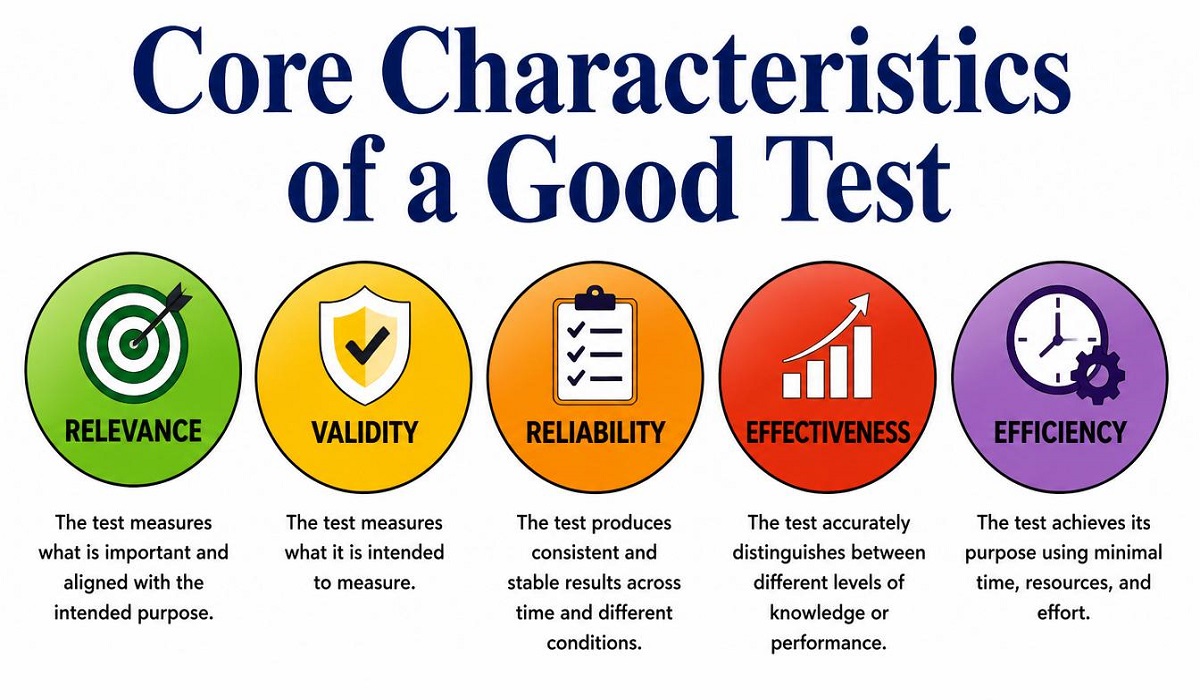
For years, experts in education and psychology have discussed the main Characteristics of a Good Test . While new ideas always pop up, four core qualities always remain at the top of the list. They are the “big four”:
- Validity: Are we testing what we think we are testing?
- Reliability: Is the test consistent?
- Objectivity: Are the scores fair and free of bias?
- Practicability: Is the test practical to use?
Let’s look at each one in detail. These characteristics are the pillars that hold up any great test. We’ll explore them using simple examples. This will show how they work in the real world and why they are vital.
1. Validity: The Truth-Teller
Validity is the most important characteristic of a good test . It answers a simple question: Does the test actually measure what it intends to measure? If a test is not valid, then its results are meaningless. Iike using a thermometer to measure how much water is in a glass. It might give you a number, but that number doesn’t tell you what you need to know.
A valid test is a truthful test . It is honest about what it is checking. If a test says it measures math skills, it should ask math questions. It should not ask questions that rely on strong reading skills. If it does, a student with weak reading might fail the math test, even if they are good at math. The test would be measuring reading skill, not math skill. That is a huge problem.
There are several ways to look at validity. These are often called “types of validity.” They are just different angles to check if a test is truly measuring the right thing.
The Different Faces of Validity
- Content Validity: This is about the content of the test itself. Does the test cover the entire subject it is supposed to cover? Imagine a final exam for a history class that only has questions about the American Revolution. What if the class spent months learning about World War II and the Cold War? The test would not have good content validity. It didn’t cover the whole course . A good test with content validity matches what was taught. Teachers often use a plan called a “table of specifications” to make sure their tests cover all the important topics . This plan is like a blueprint for the test.
- Construct Validity: This one is a bit trickier. It deals with measuring an idea or a “construct” that you cannot see. Good examples of constructs are intelligence, personality, or motivation. You can’t hold a cup of “intelligence” in your hand. A test with good construct validity is built on a solid theory of what that construct is. For example, a test of intelligence should be based on a well-researched theory of what intelligence actually is .
- Criterion-Related Validity: This checks if your test can predict something else. It compares your test’s results to an outside standard, which we call a “criterion.” There are two types :
- Predictive Validity: Can your test predict future performance? For example, does the SAT predict how well a student will do in their first year of college? If scores on the SAT match up with college grades, the test has good predictive validity .
- Concurrent Validity: Does your test measure the same thing as an existing, well-established test? If you invent a new IQ test, you should give it to the same group of people who also take a famous, older IQ test. If the scores are very similar, your new test has good concurrent validity .
Validity in a Real Classroom
Let’s go back to our math test example. A teacher wants to check if students can solve algebra problems. For the test to have good content validity, the teacher must write questions about the specific algebra lessons that were taught. A test that asks only geometry questions would not be valid for measuring algebra.
To make sure the test has good construct validity, the teacher should think about what it truly means to “understand algebra.” Does it just mean memorizing formulas? Or does it mean applying those formulas to new problems? A valid test would ask questions that measure both.
Validity is the most critical trait of any test. Without it, the test is useless. It doesn’t matter if it’s easy to grade or if it looks pretty. If it doesn’t measure the right thing, it’s a bad test.
2. Reliability: The Consistency Champion
Reliability is the second vital characteristic of a good test . If validity is about being truthful, reliability is about being consistent. A reliable test produces the same results under the same conditions. Think of your bathroom scale again. If you weigh yourself three times in a row, you should get the same number. If the number is different every time, the scale is unreliable.
The same goes for a test. A test is reliable if it gives you a similar score every time you take it, assuming nothing has changed . A reliable test does not depend on random luck or the mood of the student.
Types of Reliability
There are different ways to check if a test is reliable . Here are a few of the most common ones:
- Test-Retest Reliability: This is a simple method. You give the same test to the same students twice, with a gap of a few days or weeks . You then compare the scores from the first test to the scores from the second test. If the scores are very close, the test has good test-retest reliability. It is stable over time. This is a powerful measure of consistency.
- Split-Half Reliability: Instead of giving the test twice, you split one test into two halves. You could compare the scores from the odd-numbered questions to the even-numbered questions . If the scores on both halves are similar, the test has good internal consistency. This means the questions are all measuring the same thing. You can use a formula to figure this out.
- Parallel Forms Reliability: Sometimes, you create two different versions of the same test. Both tests cover the same material in the same way, but the questions are slightly different. You give both versions to the same group of students. If the scores are similar, the test has good parallel forms reliability. This method is common when you want to give different tests to different classes or when you want to give the same group a second test without them remembering the first one.
Why Reliability Matters
Reliability is important because a test score should reflect a student’s actual ability, not their luck on a specific day. Imagine a test where a student gets a low score because the questions were confusing or unclear. This is a sign of low reliability. The test is measuring the student’s ability to guess what the question means, not their knowledge of the subject.
Reliability is a necessary condition for validity. That means a test must be reliable to be valid . Let’s think about that. If a test gives you a different score every time you take it, it can’t be valid. You can’t trust a test that is not consistent.
However, it’s important to know that a test can be reliable without being valid. Think of a scale that is consistently wrong. If your weight is 150 lbs, but the scale always says you weigh 140 lbs. It’s reliable because it gives the same result (140 lbs) every time. But it is not valid because it doesn’t give you your true weight. It is consistently wrong. So, reliability is the floor you build on, but validity is the goal.
3. Objectivity: The Great Neutralizer
Objectivity is the third core characteristic of a good test . It means the test scores are not influenced by the personal opinions of the teacher, the mood of the examiner, or any other personal bias. It means the test is fair. Two different teachers should be able to grade the same test and give the same score.
Think about an essay question. One teacher might love creative writing. Another teacher might prefer a very factual, structured essay. A student’s grade on an essay could change depending on who is grading it. That is a problem. It shows a lack of objectivity. The essay test is subjective.
This is why multiple-choice questions are so popular. They are easier to grade objectively. There is only one correct answer. The answer sheet tells you exactly what to mark. There is no room for an examiner’s personal opinion to change the score . This improves the objectivity of the test.
Reaching for Objectivity
While multiple-choice questions are very objective, they are not the only way to test. For subjects like history or English, essay questions are important. They test critical thinking and writing skills. But they can be subjective. To make essay tests more objective, teachers can use rubrics.
A rubric is a scoring guide. It lists the specific things the teacher will look for in an answer. For example, an essay rubric for a history class might include points for “clear thesis statement,” “uses three historical facts as evidence,” and “good grammar and spelling.” By using a rubric, a teacher can score an essay much more objectively. It reduces the risk of personal bias creeping in.
Objectivity is Close to Fairness
Objectivity is closely linked to reliability and fairness . If a test is not objective, its reliability suffers. An essay test might be reliable if the same teacher uses the same rubric to score the tests. But if different teachers use their own personal style to grade, the test becomes unreliable. It stops being a consistent measure of a student’s skill.
Objectivity is a cornerstone of the Characteristics of a Good Test. It ensures that results are based on a student’s knowledge, not on how much the examiner likes them or the style of their handwriting. It helps guarantee that a test is fair to everyone who takes it.
4. Practicability: The Practicality Principle
The final key characteristic is practicability . It asks, “Is this test practical to use?” A test can be perfectly valid, reliable, and objective, but if it takes six months to grade and costs a million dollars to administer, it’s not very useful.
A practical test is one that is simple and easy to use . It does not waste too much time, money, or effort. It is efficient.
What Makes a Test Practical?
Here are the main things to consider when thinking about the practicability of a test:
- Time: How long does it take to make, give, and score the test? A test that takes hours to grade for a class of 30 students is not very practical . A practical test is easy to administer and score. The test should also be the right length for the time given to students. If a test is too long, it is not practical.
- Cost: How much does it cost to produce and use the test? Are the materials expensive? Do you need special training to score the test? Simplicity and low cost are key.
- Ease of Administration: Are the instructions clear? Is it easy to give the test to a large group of people? A test that requires a lot of complicated technology or a one-on-one setting might be impractical for a large class.
Balancing Act
Sometimes, practicability clashes with the other characteristics of a good test. An open-ended essay question might have excellent validity for measuring a student’s writing skill. But it takes a long time to grade, which is not practical. This is the trade-off a test-maker must consider. The goal is to find a balance.
The best tests are those that strike a good balance between being valid and being practical. You don’t want to trade away too much validity for the sake of a test that is cheap and quick. A practical but invalid test is useless.
Beyond the Big Four: Other Important Qualities
The four characteristics we just covered are the big ones. But a truly good test has a few more important qualities.
Fairness
This is a huge topic. A good test should be fair to everyone who takes it. It should not be biased against any group based on their gender, race, background, or language . Test questions should be clear and avoid cultural references that only some students will understand. A test should give every student a fair chance to show what they know.
Comprehensiveness
A comprehensive test covers the whole subject that was taught . It doesn’t just focus on one small part. For example, a final exam in biology should cover all the major units taught during the semester.
Appropriate Difficulty
A good test is not too hard and not too easy. A test that is too easy doesn’t tell you much about a student’s knowledge. A test that is too hard just makes students feel bad and fail. A good test has a range of questions. It includes some easy questions, some medium questions, and a few hard questions. This helps separate the students who really know the material from those who don’t. It also helps reduce stress .
Clarity
This is simple but often overlooked. The questions and instructions on a test must be crystal clear . The students should know exactly what they are being asked to do. Confusing language or vague instructions will lower a student’s score, even if they know the material. Clear tests are better tests. Test developers should aim for clear, straightforward language .
Relevance and Authenticity
A test is more useful and motivating when it feels relevant. Students will often ask, “When will I ever use this?” A relevant test shows students how the material connects to the real world .
Authenticity takes this one step further. It means the test tasks are similar to real-world tasks . For example, a test in a Spanish class might not just ask students to memorize vocabulary. Instead, it might have them listen to a podcast in Spanish or write a letter to a friend. These are authentic tasks that reflect how the language is used in the real world. It is an excellent way to assess true understanding.
Washback
Washback is a special word. It describes the effect that a test has on teaching and learning . A high-quality test can create what is called “positive washback.” This means that preparing for the test actually helps students learn. The test encourages good study habits. It guides the teachers to teach the right things. A bad test, however, can create “negative washback.” This is when teachers start “teaching to the test.” They only teach the things that will be on the test, even if those things are not very important. A good test should support good teaching, not get in the way of it.
How to Spot the Characteristics of a Good Test in Action?
Let’s see how these characteristics come together with a real-world example. Imagine a high school is choosing a new driver’s education test.
First, the test must have validity. It must test the skills a safe driver needs. This means questions about traffic laws and, just as importantly, a practical driving section where students actually get behind the wheel. The practical section is vital for validity. You cannot truly measure someone’s driving ability just by asking them questions.
Second, the test must be reliable. The driving examiner must have a clear, objective checklist to grade every student. Without a checklist, one examiner might be a harsh grader, and another might be very lenient. This would make the test unreliable. A consistent, standardized scoring system solves this problem.
Third, the test must be objective. The score should be based on the student’s performance, not on the examiner’s personal bias. The checklist helps with this. It makes sure every student is graded on the exact same skills. This makes the test fair.
Fourth, the test must be practical. It needs to be simple to administer. It can’t cost too much money to run, it can’t take a whole year for the students to complete. Most high schools can manage the cost and time of a driving test, making it practical.
Finally, it should have positive washback. The test should encourage driving schools to teach safe driving skills effectively. If the test is practical, it encourages students to master the fundamentals of driving.
This is the goal for any test, from a kindergarten spelling test to a professional certification exam.
Conclusion: The Power of a Good Test
A good test is a powerful thing. It is a tool for learning, growth, and opportunity. When we understand the Characteristics of a Good Test, we understand how to build that tool properly. We know that a good test must be:
- Valid: It measures what it’s supposed to measure.
- Reliable: It is consistent and dependable.
- Objective: It is fair and free from bias.
- Practical: It is efficient and easy to use.
Beyond these core traits, we also saw how important fairness, comprehensiveness, clarity, and even washback are to the overall quality of a test. Each characteristic plays a specific and important role. They all work together to create a test that is trustworthy and useful.
Whether you are a student preparing for a big exam, a teacher designing a quiz, or just someone curious about how we measure skills and knowledge, these qualities matter. They help ensure that tests serve their true purpose: to provide an accurate and fair measure of what a person knows and can do.
Summary
This article explored the essential Characteristics of a Good Test. We learned that a test is a tool to measure something. For it to be effective, it must possess key qualities. Validity ensures the test measures what it claims to. Reliability guarantees the test is consistent over time. Objectivity ensures scoring is free from personal bias. Practicability considers if the test is simple and economical to use.
We also explored additional important traits like fairness, comprehensiveness, clarity, and washback. The characteristics all work together. A test must be reliable to be valid, and it should be practical to be useful in the real world. Understanding these concepts helps us create and evaluate tests that are fair, accurate, and valuable. A truly good test helps learners and teachers, not hinders them.
Frequently Asked Questions (FAQs)
1. What is the most important characteristic of a good test?
Most experts agree that validity is the most important characteristic. If a test is not valid, it does not measure what it should. No other quality can make up for a lack of validity . A test can be reliable and easy to give, but if it is not valid, the results are meaningless.
2. What is the difference between validity and reliability?
Validity is about measuring the right thing. Reliability is about measuring it consistently. A test can be reliable (consistent) but not valid (wrong) . Think of a scale that is always five pounds off. It is reliable because it is always the same, but it’s not valid because it doesn’t give your true weight.
3. How can I make my classroom tests more objective?
To make tests more objective, use questions that have one correct answer. Multiple-choice, true/false, and matching questions are very objective . For essay questions, use a clear rubric. A rubric is a scoring guide that lists all the requirements for a good answer. This helps reduce personal bias when grading.
4. What is content validity in a test?
Content validity means the test covers the material that was actually taught . It ensures the questions match the learning objectives. If a teacher covers chapters 1-5 in class, the final test should have questions from all of those chapters. The test should be a good sample of the content.
5. What does “practicability” mean in testing?
Practicability means the test is practical to use . It considers the time, cost, and ease of making, giving, and scoring the test . A test that takes hours to grade or uses expensive materials is not very practical. A good test is efficient.