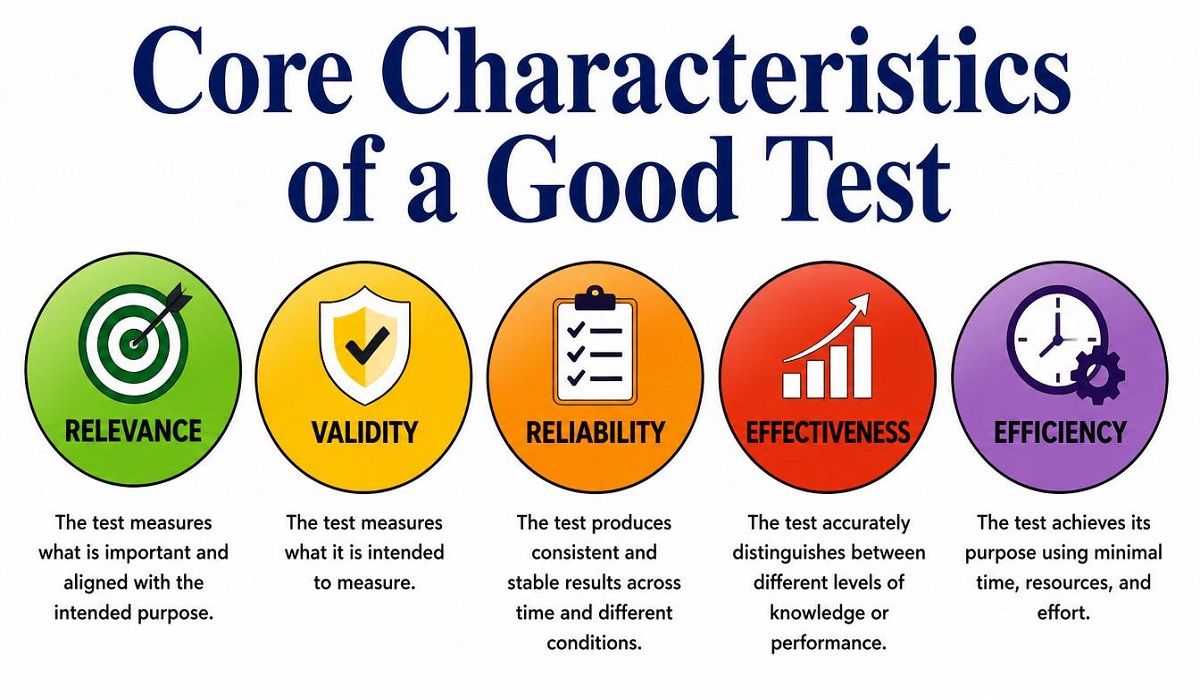
Characteristics of a Good Test: Have you ever had an experience like this – test questions that didn’t make sense to you, or a scenario when you thought you responded right but still lost points? That might be you. It might be the quality of the test itself.
A carelessly constructed exam is like a bent ruler. It doesn’t evaluate true skill and it causes individuals lose confidence to study. A good exam, in contrast, tells you what you’ve learned and what you still need to work on, so you can actually progress.
As the exam preparation industry is predicted to exceed $74 billion by 2026/27, knowing test quality standards is important now more than ever. If you are a student, teacher, parent, or professional preparing for certification, understanding the features of a successful exam can help you better comprehend and deal with many sorts of assessments.
In this essay I try to explain in the simplest words what qualities a good exam should have. We will also look at how these standards are working in reality and how the emerging trends in 2026/27 are affecting the way we think about testing.
What makes a good test? First Basic Concepts
But first, before we go into the intricacies, there’s one fundamental thing we need to know: There is no “perfect” test. Every test has its range and boundaries.
- In educational assessment, there’s a slogan: “A test is valid only for a particular purpose and for a particular group.” Thus, a test meant to measure elementary school mathematics could be entirely inappropriate for high school pupils.
- The basic definition of a good test is: it measures precisely, consistently and fairly what you want to assess, without causing undue bother or cost in operation.
The three-layered definition of this is:
- Accurate: Measures precisely what it is supposed to and nothing else
- Consistent: It doesn’t matter when it’s administered or who scores it, the results are comparable
- Feasible: Time, expense and difficulty all within tolerable limits
Characteristic 1: Validity—The Heart of a Test
The real meaning of validity
Validity is by far the most crucial attribute of a successful test. To summarize, validity asks: does this test measure what it’s supposed to measure?
Here is a simple example. Say you wish to assess someone’s arithmetic abilities, but the exam paper is filled with extensive reading sections. This individual reads slowly, cannot finish the questions and obtains poor scores. But can you claim that their math is wrong? No. Because this test is really a reading speed test, not a math test.
Validity is not a case of “having” or “not having”, but of degree. A test may have high validity for one purpose and poor for another.
The Four Kinds of Validity
The most intuitive form is Content Validity. It asks: Are the exam questions testing what they should be testing? If the semester’s math course teaches addition, subtraction, multiplication, and division, but the exam just evaluates addition — there’s a problem with content validity.
Construct Validity is rather more abstract. It is concerned with the question: Does the test assess the psychological characteristic or ability structure it promises to evaluate? For example, does a “creativity test” actually measure creativity or does it measure linguistic expression ability?
Concurrent Validity is the extent to which test findings correlate with some present standard. For example, if you develop a new test of English competence, the scores that students get on this examination should be significantly related to their usual grades in English.
Predictive Validity examines whether a test can predict future performance. The main value of college entrance examination is to forecast the academic achievement of college students. Research indicated that colleges imposing standardized testing requirements thought such assessments offered “an objective metric for evaluating applicants.
Feature 2: Reliability – Reproducibility of Results
Reliability = Consistency of
The basic question of dependability is: If I measure again and again will I receive comparable results?
Suppose you have a bathroom scale. Today you step on it and it says 60kg. It displays 65 kilos tomorrow. 58 kg the following day. Accurate or not this scale is bad in dependability. You cannot trust any of its readings.
The tests are the same. If a student takes the same exam again and scores considerably differently, then the reliability of the test is doubtful. Very dependable test: A test that delivers steady and consistent findings while testing the same thing at multiple periods and under varied situations.
Reliability and Validity: The Relationship
Important note: reliability is a required criterion for validity, but not a sufficient one.
For sure, a test that does not yield steady and dependable findings cannot be genuine. But, conversely, a very steady test is not always correct – it may be regularly measuring the wrong thing.
Like the bathroom scale – if every day it indicates 65 kg (regardless of who gets on it), it has a high dependability but a zero validity.
Characteristic 3: Objectivity – Not Influenced by Personal Bias
The Three Tiers of Objectivity
Objectivity implies the exam is not a matter of personal subjective assessment. It consists of three layers:
- First, well defined questions. The question should mean the same to anybody reading it — test-taker or scorer. If a question has 3 possible readings, it’s not objective.
- Second, consistent scoring criteria. The same answer should get the same score whomever marks it. The very nature of multiple-choice questions makes them objective. There’s only one response that’s right. Clear grading rubrics are a must for impartiality of essay questions .
- Third, uniform score interpretation. The same score should mean the same level to various scorers. 80 points is 80 points. Teacher A should not say it’s “excellent” and teacher B should not say it’s “passing”.
Why Objectivity is so Easy to Miss?
Many teachers inadvertently substitute standards with “I think” in the formulation of subjective questions. For example, “This essay is pretty good, let’s give it an 85.” But what does “pretty good” mean? Without clear criteria we lose objectivity.
This is also why standardized tests are so crucial in large scale evaluation – they limit subjective involvement by rigorous design and validation processes.
Characteristic 4: Practicality – A Good Test Must Be Doable
The Practicality Part:
Validity and dependability can sound more ‘prestigious’ but practicality is as important. If the exam cannot be genuinely conducted, then no matter how good, it’s zero.
Practicality is primarily concerned with three aspects:
- Time cost: How long is the test? Can it be done in the time available?
- Economic cost: What will it cost in resources to produce, print, administer, and score?
- Operational difficulty: Ease of administration and scoring? Requires specific equipment or intensive training?
Things to Think About in Practice
Educational assessment rules suggest that an accomplishment exam is appropriate if 90% of pupils are able to complete the test in the allocated time. If most individuals can’t finish it, then the time arrangement is inappropriate, either the questions are too many, or the difficulty is too high.
Scoring convenience is also important. Questions are either machine-scored multiple-choice questions or subjective questions graded by human graders. A huge number of essay questions that need reading word by word create significant scoring pressure and time expenses for big size examinations.
Characteristic 5: Appropriate Level of Challenge
Harder is not better
One widespread misperception is that a good exam should be difficult. In fact, the reverse is true.
Difficulty: Moderate. If it’s too hard or too easy the exam loses it’s purpose.
If an exam is excessively difficult, most people cannot answer it, and everyone gets a low score, so you can’t tell who learnt well and who didn’t. If an exam is too simple, everyone gets good marks, again no differentiation conceivable.
Difficulty Range Ideal
In the research of educational assessment, there are certain reference standards: the difficulty index of each item should be between 0.2 and 0.8, and the average difficulty of the exam should be around 0.5.
A difficulty index of 0.5 implies that around half the pupils do it right. This range is quite useful in discriminating kids at different levels. 0.2 is a difficulty meaning just 20% get it right (hard side) and 0.8 implies 80% get it right (easy side).
This, of course, isn’t absolute. Some examinations are ” selective ” ( e.g., college admission exams ) and may need a few hard questions to weed out the best students . Other exams are ” mastery ” ( e.g., written driver’s license exam ) and should be easy, because the purpose is only to check basic competence .
Feature 6: Discrimination – Real Level Discrimination
What is discrimination?
Discrimination is the ability of the exam to adequately separate pupils at various levels. A test with good discrimination will have students who learnt well scoring high and students who learned badly scoring low.
A question with very minimal discrimination will have identical correct-answer percentages for high-achieving and low-achieving pupils. It can be too easy (everyone gets it right), too cryptic (nobody gets it right), or the question itself might be faulty.
The Practical Importance of Discrimination
Discrimination is particularly crucial for selective tests. They are tests at their core, college entrance exams, professional certification, civil service exams—discrimination.
If a professional qualification examination cannot differentiate between qualified and unqualified applicants, it has failed in its mission. In actuality, it is not unusual that tests have poor reliability and discrimination.
For classroom assessments the discrimination criteria may be set properly lower. The fundamental purpose of teachers is to make sure that pupils get the essential knowledge, not to rank them finely.
Characteristic 7: Fairness – Equal opportunity for everyone
Why Fairness Is Important?
Fairness is that the exam is not systematically biased against any group or individual. All exam participants should show their skills under same conditions.
Fairness has a lot of facets:
- The substance of the questions does not show any bias against particular cultural backgrounds or life experiences.
- Language difficulties is no barrier to understanding material
- All test takers have the same testing environment
- The scoring criteria are the same for everyone
Challenges to Equity Today
Fairness in 2026/27 – new problems. The adoption of remote assessment has generated difficulties about exam integrity. The rise of generative AI tools has provided “new opportunities for academic dishonesty” and exam suppliers must invest in “sophisticated proctoring and identity verification technologies”.
Meanwhile, the argument about the fairness of standardized examinations persists. Some institutions have brought back the necessity for standardized tests, saying they need a “objective metric for evaluating applicants.” Others have moved toward “holistic review,” but that in itself may raise new questions about fairness.
2026/27 Test Trends: Improved Test Characteristics
Adaptive Testing and AI
Artificial intelligence is revolutionizing the design and administration of examinations. Adaptive testing modifies the level of questions depending on how test-takers are doing in real time – answer a question properly and receive harder questions, respond badly and get easy ones. This technique eliminates needless inquiries and allows for more effective measurement of genuine ability.
Research reveals adaptive learning platforms “use diagnostic assessments and cognitive gap identification to build a customized learning dashboard for each user.” This means exams are no longer simply a “measurement,” but an organic element of the learning process.
Data-Driven and Personalization Strategies
2026/27 testing trends focus on “hyper-personalization” and “outcome orientation.” Tests are not one-time occurrences, but part of ongoing gathering and analysis of data. Teachers may view comprehensive ability maps for each kid, not an aggregate score.
This change sets new expectations on qualities of a successful test. Tests need to deliver meaningful diagnostic information, not merely rankings or scores.
Test Integrity and Technology
The development of remote assessment has brought test security back into sharp focus. In an effort to combat AI cheating tools, exam providers are investing in “sophisticated proctoring and identity verification technologies”. This is a new dimension to consider when evaluating the quality of tests.
Frequently asked questions (FAQs)
What is the most crucial attribute of a good test?
The most significant feature is validity. Other attributes are of no consequence whatever, no matter how wonderful they are, if the test does not assess what it promises to measure. The purpose for the presence of a test is validity.
What is the difference between reliability and validity?
Reliability is consistency of outcomes – do repeated measurements give comparable results. Validity is about accuracy – does it measure what it is supposed to measure? Reliability is a required but not a sufficient requirement of validity.
What is the actual index of difficulty?
The difficulty index for each question should be between 0.2 and 0.8 for achievement assessments, and an average of around 0.5 is optimal. But it is contingent upon what the test is for. Selective examinations might include more questions that are challenging.
Is objectivity merely multiple choice questions?
Nope. Objectivity is about clear and unified scoring criteria, not question kinds. Essay questions may also be quite objective if you use comprehensive scoring rubrics. The important thing is to have clear standards, and apply them consistently.
2026/27 What are the new requirements of good tests?
Good tests now need to extend beyond established requirements to: Provide diagnostic feedback (not only scores), Enable customized learning pathways, Ensure security in remote testing, and Support AI-driven adaptive testing techniques.
Summary
The essential elements of a good test may be summarized in seven aspects:
- Validity: The test measures what it is intended to measure. Reliability means consistent, dependable outcomes. Objectivity: Eliminates subjective prejudice. The test is really practicable because of practicality. Discriminating meaning is provided by reasonable difficulty. Discrimination is the difference of level. Fairness means everybody has an equal chance.
- These seven features are not separate. They are interrelated and interdependent. Validity is the most important, yet it relies on dependability. Practicality may conflict with comprehensiveness. Fairness has to be in each stage.
- Testing amid a time of great change in 2026/27. AI, adaptive learning and remote assessment are transforming our concept of ‘good tests’. But the basic premise remains the same – a good exam should help individuals know themselves, not define themselves.
Awareness of these traits helps you understand better what assessment is all about, whether you are a teacher who prepares tests or a student who takes them. Testing isn’t the aim – it’s a tool for improved learning. Good tests provide an unambiguous reflection of true progress and direction of change.