Reflective Practice
Reflective Practice: Have you ever finished a task, a project, or even just a day at work and felt like you were on autopilot? You got things done, but you didn’t really feel like you learned anything. You might have even made a mistake and thought, “I won’t do that again,” but then found yourself repeating the same error a few weeks later. This is a common human experience. We often rush from one activity to the next without pausing to think about what we’ve done.
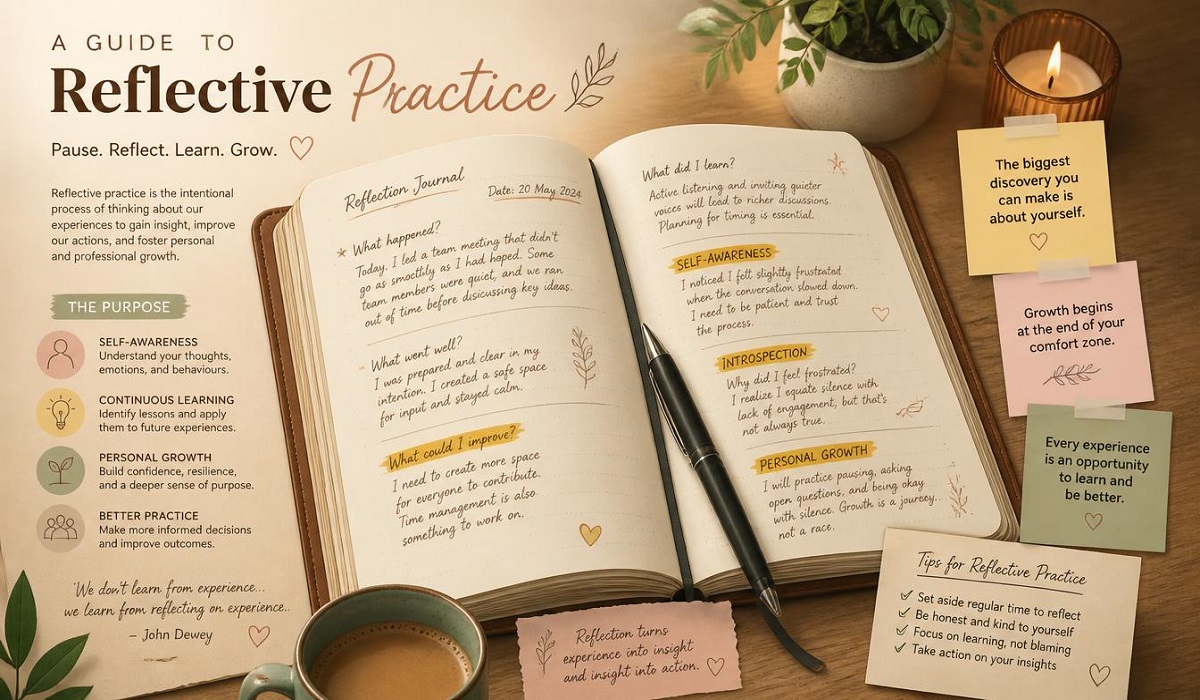
This is where Reflective Practice comes in. It is the simple but powerful process of taking a step back to think about your experiences, understand what happened, and use those lessons to do better next time. According to the British Psychological Society, it is defined as “learning through and from experience towards gaining new insights of self and practice” .
In 2026, the world is moving faster than ever. New technologies, changing workplaces, and complex problems mean that we can’t just rely on the skills we learned years ago. We need to be able to learn and adapt quickly. Reflective Practice is the engine for that kind of learning. It’s not just a “nice to have” for professionals; it’s quickly becoming a necessity . Whether you are a doctor, a teacher, a business owner, or a student, this skill will help you grow, avoid making the same mistakes, and feel more confident in your abilities.
Think of it as turning your day-to-day experiences into a personal classroom. Instead of just living through events, you start to learn from them.
What Exactly is Reflective Practice?
At its heart, Reflective Practice is about turning experience into learning. It’s a deliberate and structured way of thinking about what you do. It is not the same as just “thinking about your day” while you’re in the shower. True reflection is active, purposeful, and critical .
Breaking Down the Three Main Steps
Most models of Reflective Practice follow a similar three-step process .
- The Experience: This is the starting point. It’s an event, a situation, or an action that you were involved in. It could be a presentation you gave, a difficult conversation with a colleague, a lesson you taught, or even a simple interaction with a customer. It can be a positive experience or a negative one—both are valuable for learning.
- The Reflection: This is the critical part. You stop and think about the experience. This isn’t just describing what happened. It’s about analyzing it. You ask yourself questions like:
- What exactly happened?
- How did I feel during it?
- What did I think?
- What went well, and what didn’t go so well?
- Why did things happen the way they did?
- The Action: This is where the learning gets put into practice. Based on your reflection, you decide what you will do next time. You might plan to try a new strategy, ask for more information, or just be more aware of your feelings. The idea is that you use what you’ve learned to improve your future practice . This then becomes a new experience, and the cycle starts all over again.
The Key Difference: Reflection vs. Reflective Practice
Many people reflect casually without realizing it. But Reflective Practice is different because it’s a conscious and regular habit. The Health and Care Professions Council (HCPC) notes that effective reflection is a continuous process of inquiry, critical analysis, and action . It’s not just “what did I do?” but the more important question: “What did I learn from this, and how will I use it?” .
A great example comes from a case study of a dietitian named Emily. After giving a presentation to a group of pharmacists for the first time, she felt very nervous during the Q&A session. She could have just thought, “That was nerve-wracking,” and moved on. Instead, she formally reflected on the experience. She asked herself what went well and what she could have done better. Because of this, she decided to practice presenting more and started contributing in team meetings. Over time, she became more confident and better at her job .
Why is Reflective Practice So Important in 2026?
The world of work is changing rapidly. Artificial intelligence, automation, and globalization mean that many routine tasks are being done by machines. What does this mean for us? It means the skills that are most valuable are the ones that make us human: creativity, empathy, complex problem-solving, and the ability to learn and adapt.
Reflective Practice is the ultimate tool for developing these skills. Here’s why it’s more important than ever:
- Lifelong Learning: The days of learning a trade and using it for 40 years are gone. Most professionals now need to continually update their knowledge and skills. Reflective Practice makes you a self-directed learner, constantly identifying what you need to learn next . It’s the foundation for Continuing Professional Development (CPD) in many fields .
- Improving Complex Decision-Making: In fields like healthcare, education, and management, there are rarely simple “right” or “wrong” answers. Professionals face complex, unique situations every day. By reflecting on past decisions, you can understand your own thought processes and biases, which helps you make better decisions in the future .
- Boosting Emotional Intelligence: Reflecting on your feelings and reactions in stressful situations helps you develop self-awareness and empathy. A study on teacher Reflective Practice found it helped educators better understand their students’ needs . This is key for building strong relationships with colleagues and clients.
- Preventing Burnout: Many professions, especially in healthcare and education, are incredibly demanding. Taking time to reflect on your practice can reduce stress, increase job satisfaction, and help you understand why you feel the way you do . It provides a sense of meaning and accomplishment that goes beyond just “getting the work done.”
Reflective Practice is also becoming a professional imperative. Organizations like the General Medical Council (GMC) emphasize that reflection is vital for doctors to “demonstrate insight by identifying actions to help learning, development or improvement of practice” . In many fields, it’s no longer optional; it’s an expected part of being a professional.
How to Get Started with Simple Models?
The idea of “reflecting” might feel a bit vague. Where do you even start? This is where models and frameworks are useful. They give you a clear structure to follow, so you don’t just stare at a blank page.
Here are two of the most popular and easiest-to-use models:
The “What? So What? Now What?” Model
This is a very simple and straightforward model based on the work of Terry Borton. It’s a great place to start if you’re new to Reflective Practice.
- What? This is the “description” stage. What happened? Describe the experience factually without making judgments yet. Who was involved? What was the outcome?
- So What? This is the “analysis” stage. What did you learn? Why did it happen? How did you feel? What was the impact on you and others? This is where you try to understand the meaning of the experience.
- Now What? This is the “action” stage. What are you going to do now? What changes will you make? How will you apply this learning in the future?
Gibbs’ Reflective Cycle
This is a slightly more detailed model developed by Graham Gibbs. It’s widely used in healthcare and education because it guides you through the emotional aspect of an experience as well. It has six stages:
- Description: What happened? (Keep it objective).
- Feelings: What were you thinking and feeling at the time?
- Evaluation: What was good and bad about the experience?
- Analysis: What sense can you make of the situation? (This is where you might link it to theory or research).
- Conclusion: What else could you have done? What have you learned?
- Action Plan: If it arose again, what would you do? This is your concrete plan for the future.
By using a model, you’re ensuring your reflection is deep and structured, rather than just a casual thought.
Practical Tools and Strategies for Reflective Practice
Once you understand the “how,” the next step is to actually do it. Here are some practical ways to incorporate Reflective Practice into your daily routine.
Journaling and Reflective Writing
Writing is one of the most powerful tools for reflection. Putting your thoughts on paper forces you to organize them and see them more clearly. As Gillie Bolton’s work highlights, reflective writing is a “creative and dynamic process for this critical enquiry” .
- What to Write: You don’t need to write a novel. A few bullet points can be just as effective as a long paragraph. Try using one of the models we discussed as a guide.
- When to Write: Try to write soon after the experience, while it’s still fresh in your mind.
- An Example: You could use a template in a notebook or an app on your phone. For instance, answer these questions at the end of each day:
- What was one thing that went well today?
- What was one thing that was challenging?
- What did I learn from this?
- What will I do differently tomorrow?
Video and Audio Recording
Sometimes it’s hard to remember the details of what happened. Recording yourself, with permission, can be an amazing way to reflect. For example, a teacher could record a lesson. Afterwards, they can watch the video and analyze their teaching style, student engagement, and clarity of explanations. This provides a level of honesty and detail that’s hard to achieve from memory alone .
Making Time for Reflection
One of the biggest barriers to Reflective Practice is “not having enough time.” The key is to make it a habit, not a chore. The Education Workforce Council (EWC) recommends setting aside a specific time, in a quiet place where you won’t be interrupted . It could be:
- The “10-Minute Rule”: Take 10 minutes at the end of your workday to write down your thoughts.
- A Weekly Review: Spend 30 minutes on a Friday afternoon reviewing your week.
- After an Event: Schedule a short reflection session after a major project or a difficult meeting.
Collaborative Reflection: Learning with Others
Reflection doesn’t have to be a solo activity. In fact, some of the most powerful learning comes from discussing experiences with others. This helps you see things from different perspectives and challenges your own assumptions.
- Peer Discussion: This can be as simple as a regular chat with a colleague where you both discuss a recent challenge.
- Mentoring or Supervision: This is a more formal relationship, where a more experienced person guides you through reflection . This is very common in psychology, teaching, and social work.
- Group Reflection: Teams can reflect together after completing a project. This builds a culture of learning and improvement. For example, a team of doctors or nurses might hold a “debrief” after a challenging case .
A great example is Carl, a podiatrist who worked alone. To get feedback and new ideas, he formed a monthly meet-up group with another podiatrist. They shared complex cases and discussed them. When Carl was stuck with a patient who wasn’t getting better, his colleague Anjola suggested a new treatment plan. This peer-to-peer reflection directly improved the care his patient received .
How to Apply Reflective Practice to Your Life?
The beauty of Reflective Practice is that it’s not just for work. It can be applied to any area of your life.
At Work
- For Teachers: You can use reflection to see which teaching methods are most effective. Why did one lesson seem to “click” with students, while another fell flat? What can you learn from that? Reflective Practice is a core part of developing “pedagogical excellence,” helping teachers to continually improve their strategies .
- For Healthcare Workers: It’s vital for improving patient care and safety. A nurse might reflect on a difficult interaction with a patient’s family to better understand the situation and improve their communication skills.
- For Business Owners and Managers: It helps you make better strategic decisions. Why did a marketing campaign succeed? Why did a new process cause confusion in the team? By reflecting, you can adapt and grow your business more effectively.
In Personal Life
- Relationships: After an argument with a partner, you can reflect on what caused it. What was your role? How were you feeling? What could you have said differently? This can improve your communication and empathy.
- Personal Goals: Are you trying to eat healthier, exercise more, or learn a new language? Reflecting on what worked and what got in the way each week can help you build better strategies for success.
- Life’s Challenges: When facing a major life change, like moving to a new city or starting a new job, reflection can help you process your feelings, identify your strengths, and see opportunities for growth.
Overcoming Common Hurdles
Many people want to reflect but find it difficult. Here are some common challenges and how to overcome them.
- “I don’t have time.” This is the most common excuse. But a few minutes of focused thought is all it takes. The key is to make it a habit. Start small – just five minutes a day. Integrate it into your commute or your lunch break.
- “I don’t know what to reflect on.” You don’t need a major event to reflect. Use everyday moments – a meeting, a conversation, a task you completed. If you’re stuck, you can use the “W” questions: “What surprised me today?” “What frustrated me today?” “What made me proud today?” .
- “I don’t like writing.” That’s fine! Reflection doesn’t have to be written. You can record voice notes on your phone, have a chat with a friend, or even just go for a walk and think about your day .
- “It feels selfish or like I’m just complaining.” This is a common misconception. True Reflective Practice isn’t about dwelling on the negative. It’s about taking responsibility for your own development. It’s a professional and mature way to approach your work. The goal is to learn and improve, not to wallow in self-pity.
Conclusion: The Power of a Learning Mindset
In 2026, the future belongs to lifelong learners. Reflective Practice is the key that unlocks that potential. It is a practical, powerful, and proven way to turn your everyday experiences into valuable lessons.
By taking just a few minutes to think about what you do, how you feel, and what you’ve learned, you can become more effective, more confident, and more resilient. Whether you use a journal, a conversation with a friend, or a structured model, the most important thing is to start. Don’t just do; reflect. And in reflecting, you will truly grow.
Summary
Reflective Practice is a structured process of learning from experience. It involves three core steps: having an experience, reflecting on it, and taking action to improve. In 2026, this skill is crucial for professional development, effective decision-making, building empathy, and preventing burnout. Simple models like “What? So What? Now What?” and Gibbs’ Reflective Cycle provide a clear framework.
You can practice reflection through journaling, peer discussions, or audio/video recording. It’s not just for work—it can improve relationships and personal goals. The main barriers are time and not knowing how to start, but even a few minutes a day can make a huge difference. Reflective Practice helps you build a learning mindset, turning every day into an opportunity to become a better version of yourself.
Frequently Asked Questions (FAQs)
1. Is Reflective Practice only for people in “helping” professions like healthcare or teaching?
No, not at all! While it is a professional standard in fields like medicine, psychology, and education, Reflective Practice is a universal human skill that can benefit anyone. Whether you are a manager, an engineer, a salesperson, a student, or a parent, reflecting on your experiences can help you improve your performance, build better relationships, and achieve your personal goals. It’s about learning from your life, whatever that looks like.
2. How is Reflective Practice different from just “thinking about my day”?
Casual thinking is often unstructured and can be more about worrying or daydreaming. Reflective Practice is deliberate, structured, and has a clear purpose: to learn and improve. It involves a conscious effort to analyze an experience, understand the “why” behind it, and create a plan for the future. It’s “thinking” with a specific goal in mind, often guided by a model or framework .
3. What if I reflect and realize I made a big mistake? Won’t that just make me feel bad?
This is a common worry, but Reflective Practice is not about self-criticism. It’s about learning. Realizing a mistake is the first step to never making it again. By looking at the situation objectively and asking, “What could I have done differently?”, you turn a negative experience into a powerful learning opportunity. It also helps you be more honest with yourself, which is crucial for professional integrity .
4. What is the easiest way for a beginner to get started?
The “What? So What? Now What?” model is the perfect starting point. Find a quiet time for just five minutes at the end of your day. Think about one specific experience. Then, answer the three questions:
- What? (Describe the event).
- So What? (What did you learn and feel?).
- Now What? (What will you do differently?).
You can do this in your head, on your phone’s notes app, or in a notebook.
5. Can I reflect with my team, or does it have to be alone?
Reflection can be both a solo and a collaborative activity. While individual reflection is great for personal learning, team or group reflection is incredibly powerful. It allows you to get different perspectives, validate your feelings, and learn from your colleagues’ experiences. This can help build a stronger, more open, and innovative team culture