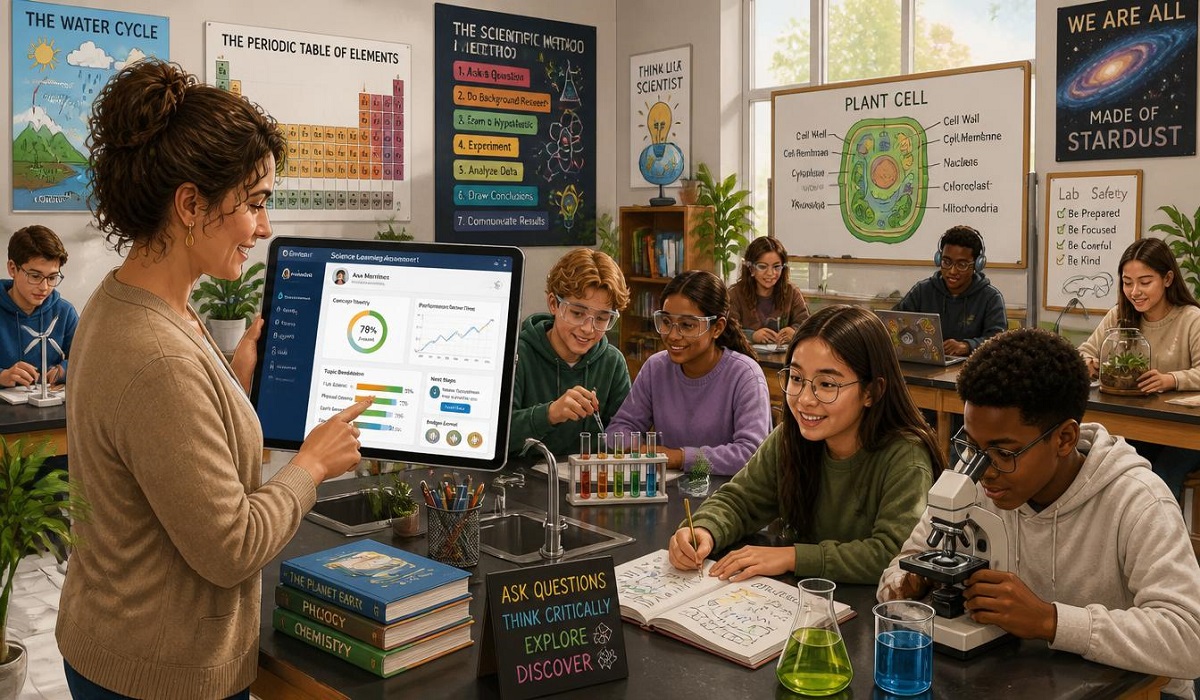
Tool to Assess Students’ Learning in Science
Tool to Assess Students’ Learning in Science: Remember the old science test? So often it was a sea of multiple-choice questions testing your ability to recall facts, such as the chemical symbol for gold (Au) or the equation for photosynthesis.
Of course, these tests measured your ability to memorize, but did they really test your knowledge of the scientific process? Can they measure your ability to design an experiment, analyze data, think critically about a complex problem? For many teachers, the honest answer was a loud, resounding no.
Now it is 2026, and the education world is buzzing about a new and far more effective tool for assessing students’ learning in science. These contemporary evaluations are revolutionizing the game, powered by remarkable technological advances and driven by a new understanding of how students learn.
They want to capture a student’s thinking scientifically, not just his or her ability to recall facts. The change is to prepare students for a future where knowing how to find and use information is more important than memorizing it.
Why The Old Ways Don’t Work?
The big problem with traditional assessments is that they tend to rely on “rote memorization.” Thus, a student may answer a test question correctly but not really understand the scientific principle involved. They may know “the mitochondria is the powerhouse of the cell.” But be unable to explain what happens to a cell’s energy production if the mitochondria are damaged.
A major aim of modern science education is to promote scientific literacy. Which includes understanding of the nature of science (NOS) itself. A recent study in the Journal of Research in Science Teaching notes that teachers are now using formative assessments. Checks for understanding that happen during the learning process. To assist learners in comprehending the big picture of how science works, rather than just the final answer . This sort of understanding cannot be captured by a simple multiple choice question.
And these older tests were often a “one-size-fits-all” proposition. They were not adaptive to individual student needs and they did not give teachers useful actionable feedback in real time. This is like a doctor who only takes a patient’s temperature once a year to treat a chronic condition. It doesn’t tell the whole story of what’s going on.
The New Era of True Assessment
The good news is that a powerful tool for assessing student learning in science has arrived. “This new breed of assessment is ‘genuine. This means it requires students to use their knowledge. And skills to solve problems in the real world and participate in scientific practices .
Instead of answering the question, “What is the boiling point of water?.” A student might be given a simulation and asked, “You are on a mountain. You need to get some water boiling for your pasta. “Why would you need to heat it longer than at sea level and what are the scientific reasons for that?”
This type of question requires a student to think scientifically, using reasoning, problem solving and critical thinking. This is the kind of “performance task” found on platforms like the free ATLAS repository. Or embedded in structured learning sequences such as PIER Investigations.
The Modern Science Classroom: What to Anticipate in 2026
The 2026 science classroom is a lively, interactive space. The teacher is not merely a “sage on the stage” teaching students. But a “guide on the side” guiding student learning. Assessment is a step in the journey, not the end of the journey. Here’s what you can expect to see
The role of AI in evaluation
Perhaps one of the most important developments is the use of Artificial Intelligence (AI). As a new tool for assessing student’s learning in science. AI can evaluate students’ open-ended written responses in ways that a traditional computer-based test never could.
In 2026, a Journal of Educational Measurement study presented an AI-based framework for analyzing student writing in science, employing a “multi-agent system.” This system can produce rationales for scoring, and its scoring accuracy was 94% compared to human experts! This is a big leap over the 78% accuracy from much simpler models . This technology offers the possibility of fair and reliable assessments that can be given to thousands of students simultaneously.
Interactive Tools and Digital Platforms
In 2026, teachers have a wealth of free, high-quality digital resources at their fingertips. ATLAS (Authentic Tasks for Learning and Assessment in Science). Others offer a library of more than 1,300 peer-reviewed performance tasks. Teachers can quickly find tasks aligned to specific standards (Next Generation Science Standards, NGSS) and even collaborate with a community of other educators .
Even familiar tools are being put to creative uses outside of complex platforms. In a 2026 study, Canva Play Edu, a tool that incorporates game-like elements to create assessments. Was found to significantly boost student engagement and learning outcomes in elementary science. This shows that an instrument to evaluate students’ learning in science can be educative and entertaining!
Characteristics of a Good Assessment Instrument
So what makes a tool to assess students’ science learning effective in 2026? The main points are as follows:
- The best tools are built on a solid foundation, aligned with Standards. They are intended to evaluate the skills and knowledge described in modern science standards like the NGSS . They examine the facts ( the “ what ” ) and the practices of science ( the “ how ” ) and the underlying concepts that link it all together.
- Performance-Based: The best tool will require students to do something rather than just say something. This might be designing a virtual experiment, analyzing data, making a scientific argument, or explaining a complex phenomenon.
- Provides Actionable Data: A good assessment doesn’t just provide a score, it provides information. The teacher needs to know why a student has an answer wrong. Was it just a simple misunderstanding of a fact, or was there something deeper wrong with their logic? A 2026 study found that the amount of uncertainty in an AI’s scoring directly correlated with human scorers’ uncertainty. Showing that these tools can help pinpoint exactly where a student is struggling.
- Accessible and Equitable: A powerful tool to assess students’ learning in science is free. Easy to use and open to all teachers and students. It provides equity in the classroom by giving every student access to a quality science education.
- Promotes Collaboration: The best tools cultivate a learning culture. They enable teachers to work together and share best practices , creating a community that benefits everyone’s professional development.
Benefits to Teachers and Students
This new wave of assessment provides a tsunami of benefits for teachers and their students.
For Teachers:
- Saves Time: AI-powered tools can do heavy lifting of scoring open-ended responses so teachers can focus on what matters most: interacting with their students and differentiating instruction.
- Gives Deeper Insights: Teachers get a much deeper look at their students’ thinking and can quickly identify and fill in gaps in learning.
- Reduces Frustration: A tool for assessing students’ learning in science that students find engaging can make the classroom more positive and productive. This is supported by research on the Canva Play Edu platform in 2026, which found that fun assessments can improve student attitudes and learning outcomes.
For Students:
- Develops Critical Thinking: Students are not just learning, but analyzing, evaluating and creating. This is real science learning!
- Encourages a Growth Mindset: Real tasks teach learners that mistakes are part of the scientific process. The point isn’t to be “perfect” the first time, but to use feedback to get better.
Better Equips for the Future Our world has complex problems with no simple solutions. Students learn skills to address them with these modern science tools.
2026: Selecting the Right Tool
- There are so many great tools out there. How does an educator pick the right one? It depends what you need. Here’s a quick guide to introduce you to the idea of how to find a science learning assessment tool that’s right for your classroom.
- What do you want to learn? Start with your baseline. Are you teaching physical science, life science, or Earth and space science? Pick the tool that works for your particular curriculum.
- What is your teaching method? Do you enjoy interactive, game-like experiences ? Or do you prefer detailed, performance based task ? Find a resource that fits your classroom culture.
- What are the logistical constraints? Are you looking for a tool for face-to-face learning, distance learning or a combination of both? Many tools are digital and can be used everyplace.
- What kind of feedback do you want? Want instant grading? Want it automated? Or do you prefer an in-depth look at the thot process of students, even if it takes a bit more time to digest?
Summary
The science assessment has changed hugely and excitingly. Gone are the days of the boring, one-size-fits-all bubble sheet. A powerful and diverse tool to evaluate student learning in science is giving teachers the ability to unlock their students’ true potential in 2026.
The mission of the new wave of science assessment is singular: to prepare the next wave of scientific thinkers, whether it’s thru incredible insight from AI-powered analysis or making learning fun thru interactive platforms. It’s about helping students to think and do science, not just learn science.
And these new tools are making sure that every student, no matter the background, gets the chance to win. They foster curiosity, creativity and critical thinking—the very skills that will build a better future for all of us.
Summary
In 2026, science assessment is shifting away from rote memorization and toward authentic, performance-based tasks designed to measure real understanding and scientific thinking. Emerging technologies such as AI-driven analytics and interactive digital platforms are leading the charge, offering teachers rich insights into how students learn and creating a more engaging experience for students. The modern tools measure students’ problem-solving abilities and their ability to think like scientists, better preparing them for the future.
Commonly Asked Questions (FAQs)
Q1: What is the most significant difference between an old science test and a new tool to assess student learning in science?
The big difference is that old tests are often based on rote memorization and require you to just remember facts. But a new tool is “performance-based.” It asks you to use your knowledge and work thru a problem, explain a phenomenon or work thru a scenario — just as a scientist would in real life. It makes you think, not just remember. It’s the difference between memorizing a recipe and knowing how to cook a meal because you understand the chemistry of the ingredients and can adjust when things go wrong.
Q2: How do we use Artificial Intelligence (AI) to evaluate my science learning?
Artificial intelligence can also be used to analyze complex, open-ended answers (e.g. essays or constructed responses). It can search your writing for key concepts and reasoning, just like a human teacher would. This enables a much more thorough assessment of your understanding. Indeed, recent research shows that a new AI tool can be as accurate as 94% compared to human scoring, and so it is a powerful tool to assess students’ learning in science.
Q3: Are these new tools only for high school students or college students?
“Not at all! “The new tools are being developed for learners of all ages from kindergarten thru adult education. For example, researchers have developed teacher-rated observational measures to assess science competencies in children as young as 4 to 7 years old and have even developed gamified digital assessments to enhance learning outcomes in elementary school .
Q4: What is “authentic” assessment and why is it better?
Authentic assessment involves students in completing tasks similar to those in real-world settings to demonstrate their knowledge and skills, as a means of assessing learning. And it’s better because it’s not just testing if you can remember a fact; it’s testing if you can use a fact to think critically and solve problems. You may , for example , be asked to assess a claim about climate change against evidence , or to design a bridge to specific specifications . This provides a much more detailed and accurate picture of your real abilities.
Q5: If technology is doing the assessing, what is the teacher’s role?
Technology is a tool to help the teacher, not replace them. While teachers may have access to rich data from AI and digital platforms, they are still the experts who interpret the data and plan next steps. A computer can grade an essay . But a teacher uses that information to personalize feedback , to modify lesson plans , and to assist students who are having trouble . The aim is a strong partnership between human and technology. This ‘human-AI collaboration’ is the future of education