Warm Up – Previous Knowledge Test
Warm Up – Previous Knowledge Test: Let’s say you are going to construct a home. You wouldn’t simply begin piling bricks on a dirt area, would you? The foundation would be checked first. Is it sturdy? Is it able to sustain the weight? The process of learning is the same. A teacher must assess a student’s prior knowledge before introducing new material. The warm-up/prior knowledge exam becomes the most crucial instrument in the educational toolkit at this point.
Education is changing quickly in 2026. In the classroom, we have incredible technology, engaging games, and artificial intelligence (AI). However, the most successful learning still begins with a straightforward question: “What do you know about this already?” This goes beyond simply administering a quick test. It involves stimulating the brain, boosting self-esteem, and making a plan for the upcoming class. Teachers are guiding students rather than merely judging them when they employ a warm-up or prior knowledge test.
Teachers, students, and even parents who wish to learn more about how learning actually occurs should read this article. We will examine the importance of assessing past knowledge, how it influences lesson planning, and the innovative new resources available in 2026 to make it engaging and productive. Prepare to see how this straightforward method may turn a dull lecture into an engaging exploration.
A Warm-Up/Previous Knowledge Test: What Is It? (The Fundamental Concept)
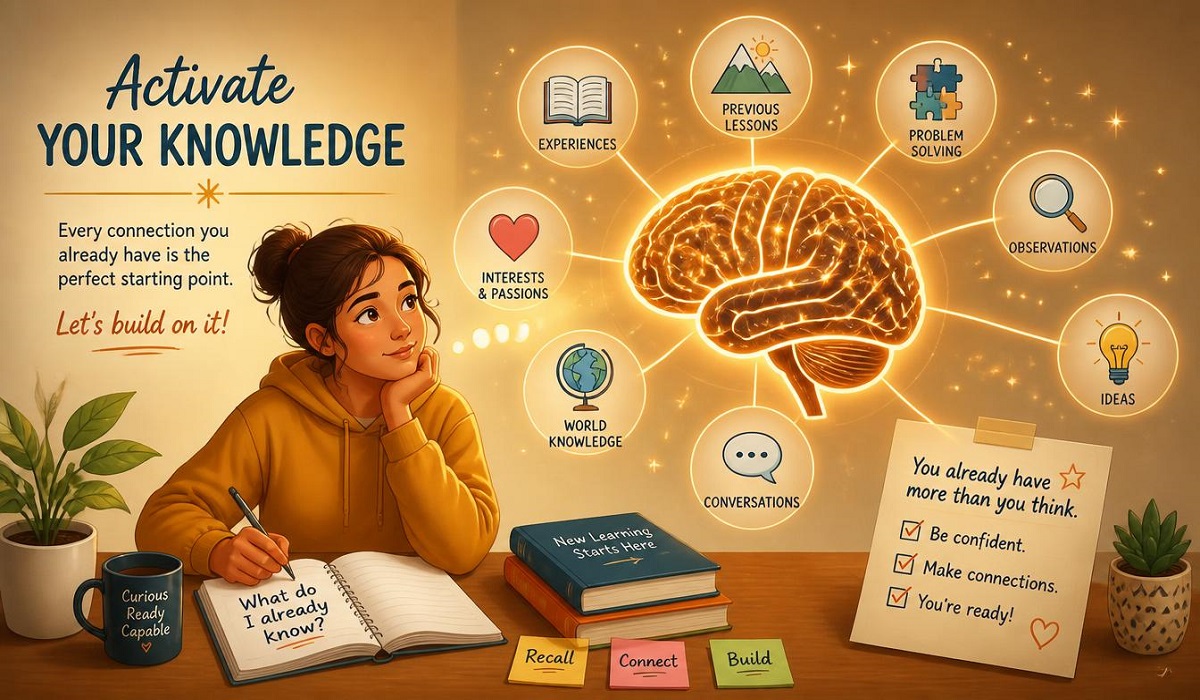
Let’s dissect it. An exercise at the beginning of a lecture is called a warm-up or prior knowledge exam. Finding out what pupils already know about the subject is its primary responsibility. It can be compared to a mental thermometer. It requires the class’s temperature. Are they prepared to go deep? Or should we start by going over the fundamentals?
Beyond a Simple Test
When the word “test” is spoken, many individuals become anxious. However, passing or failing a warm-up/prior knowledge exam is not the goal. It has to do with exploration. For the instructor, it’s a means of identifying knowledge gaps. For the learner, it’s a means of stimulating their mind and making connections between new and old concepts. This process, known as “activating prior knowledge,” has a significant impact on how effectively we retain new information.
Why is it referred to as a “Warm Up”?
It’s similar to working out. Stretching is an essential part of running a marathon. To avoid injury and improve performance, they warm up their muscles. In a similar vein, the brain is stretched via a warm-up or prior knowledge exam. It activates the neurons, focuses attention on the subject, and sets the mind ready for the hard work of learning.
The Big Why: Five Incredible Advantages of Prior Knowledge Testing
Why should instructors waste valuable class time on a warm-up or prior knowledge assessment? It may appear to take time away from teaching. But according to study, this quick investment pays off handsomely. Experts claim that warm-ups are beneficial in five important areas: engagement, accountability, social connection, logistical management, and cognitive preparation.
These are a breakdown of the top five advantages.
1. It Creates a Robust Basis
Building a wall is similar to learning. A piece of information is represented by each brick. The top bricks will collapse if the bottom bricks are missing. The boundaries of the foundation and the new wall are determined by a warm-up and prior knowledge exam.
Before continuing, the instructor might “fill in the holes” in the students’ knowledge by asking them to recollect what they already know. This guaranties that everyone is on the same page when the next class begins. A teacher can assist a kid who is bewildered right away. For students who are having difficulty or are learning English as a second language, this is essential.
2. It Increases Self-Belief and Involvement
Have you ever felt your heart rush as you raised your hand in class? Speaking up may be frightening. However, a warm-up or prior knowledge exam frequently allows students to share their knowledge in a relaxed setting.
A student’s confidence soars when they find they already know something about the subject. They are prepared to take part and feel intelligent. Because they have a mental “hook” to hang the new material on, students are more likely to participate in the session. It makes the lesson seem more applicable and simpler to comprehend.
3. It Assists Teachers in Customizing Their Instruction
Teachers are mentors as well as instructors. You must understand where your group is coming from in order to be an effective guide. Teachers get important information from a warm-up/prior knowledge test.
The teacher can skip the review and move on to more difficult topics if the exam indicates that the students have a solid grasp of the fundamentals. The instructor can immediately modify their instructional plan if the exam reveals misunderstanding. To aid pupils in understanding, they might provide more assistance, alter the tempo, or employ other teaching techniques.
4. It Avoids Overwhelm and Boredom
Boredom and overload are two prevalent issues in schooling. Pupils who are already familiar with the subject matter get disinterested. Lost students become overwhelmed. They both become distracted.
Both problems are resolved with a warm-up/prior knowledge exam. A student may be assigned more difficult assignments if they do well on the test. The instructor is aware that they must slow down and provide assistance if a student fails. It assists educators in locating the “Goldilocks zone” where the subject matter is neither too difficult nor too easy.
5. It Encourages Active Memory and Recall
A muscle is similar to memory. It becomes stronger the more you use it. Students are required to “pull” facts from their memory when taking a warm-up or prior knowledge test. It has been scientifically demonstrated that this “retrieval practice” improves memory.
The learner must think rather than only read their notes. Compared to passive reading, this active activity makes the information “stick” more effectively. It creates the conditions for sustained retention.
Six Ingenious Warm-Up Activities (No Boring Pop Quizzes!)
Not every warm-up or prior knowledge test task has to resemble an exam. The finest ones, in fact, frequently pass for games or group activities. These are some entertaining and useful strategies that educators will employ in 2026.
First. The Picture-Word Correspondence
This is a really dynamic exercise that is particularly beneficial for ESL students and visual learners. Students are given cards by the instructor. There are cards with words and cards with graphics.
For instance, a student with an image of a raincloud must locate the student with the word “precipitation.” Students must wander about the room in search of their “match.”
Students get up from their chairs, which is why it works. It promotes dialog. It enables the instructor to listen to pupils speak and evaluate their understanding in an organic manner. Compared to a straightforward worksheet, this interactive evaluation is significantly more insightful.
2. The Gradual Disclosure (Observation and Awe)
Curiosity is increased by this action. Only a little portion of the image or text is displayed by the instructor at a time. A picture is displayed in three phases using the “Slow Reveal” technique, revealing more each time.
Students must make predictions based on scant knowledge and record what they “Notice” and “Wonder.”
Why it works: It compels students to speculate about what the complete image may be using what they already know. They are kept interested and stimulated to think deeply by the suspense. Science, history, and art all benefit greatly from it.
3. The Sort of Words
This is an excellent group exercise. A deck of word cards is distributed to the students. To organize the words according to categories or topics, they must cooperate.
If the topic is “Weather,” for instance, pupils may combine terms like “tornado,” “hurricane,” and “typhoon” together as “storms.” They would then group “sunny,” “cloudy,” and “rainy” as “conditions.”
Why it works: Instead of merely having kids memorize definitions, it requires them to evaluate the meaning of words. It’s an excellent method for evaluating past vocabulary knowledge. They have to explain and defend their arguments, which deepens their comprehension.
4. Blooket, Socrative, and 2026’s Digital Tools
Gamification is a significant trend, and education technology is enormous. Teachers may design quick, game-like warm-up and prior knowledge exams using platforms like Blooket and Socrative.
Students use their laptops or phones to participate in a game. They respond to multiple-choice questions in order to “battle” peers, level up, or get points. These platforms give the instructor immediate feedback, highlighting the questions that the students are finding difficult.
Why it works: It’s entertaining and captivating. It doesn’t feel like an exam. Because they may respond without raising their hands, it offers timid pupils a voice. These kinds of digital technologies are essential in today’s schools.
5. The Variation “Two Truths and a Lie”
It is possible to modify this traditional icebreaker for educational purposes. Three remarks regarding the subject are made by the instructor or the pupils. One is a falsehood, while the other two are truth. The untruth must be decided by a vote of the class.
Why it works: It pushes students to identify false material by using their critical thinking skills and prior knowledge. It’s brief, enjoyable, and sparks thought-provoking conversations that show what students think is true (or wrong) about a certain topic.
6. “Column Relay” with a Plush Toy
This lively exercise is perfect for vocabulary review or language lessons. Pupils are arranged in columns. “Pass, pass, pass, stop!” the teacher exclaims as a plush toy is passed down the column. When the music stops, the student holding the toy has to define a term or respond to a question.
Why it works: An enjoyable environment is created by the movement and suspense. It lowers the “affective filter” since pupils are enjoying themselves too much to worry about making mistakes. It keeps everyone alert and guaranties sporadic involvement.
Warm-Ups Using Technology: The Future of Quizzing
In 2026, the way we administer a warm-up or prior knowledge exam has been altered by technology. Paper and pencils are no longer sufficient. These assessments are now instantaneous, informative, and engaging to today’s students thanks to the use of digital tools.
Quick Feedback for All
Teachers may get immediate results from digital applications like Microsoft Forms, Quizizz, and Mentimeter. The instructor can view a graph that displays the most missed questions as soon as the class completes the test. This makes “just-in-time teaching” possible, in which the teacher modifies the lecture to fill up frequent gaps immediately.
Monitoring Data
Teachers can monitor student achievement over time thanks to technology. They can see how a student’s self-assurance or level of knowledge increases. This information aids in both grading and identifying students who may want more assistance far in advance of a significant exam failure.
Mobile Education
Pupils always have their phones with them. It makes sense to use a QR code to start a warm-up and prior knowledge exam as soon as they enter the classroom. It makes use of the gadgets that kids are already addicted to and transforms them into educational resources. Quizzes fit in wonderfully with the “bring-your-own-device” (BYOD) concept that is common in many districts.
Advanced Techniques: “Just-in-Time Teaching” (JiTT)
Using a warm-up or prior knowledge exam to modify your instruction is known as Just-in-Time Teaching (JiTT). Although it was first made popular in physics, it is now used in many other fields.
This is how it operates:
- The Warm-Up: Prior to class or during the first few minutes of class, students respond to online questions.
- Analysis: The instructor examines the findings. Do the pupils claim that the sky is green? Do they consider vitamins to be calories?
- The Modification: The instructor modifies the lesson rather than just saying, “Let’s move on.” If pupils are having trouble with the fundamentals, the instructor immediately creates an exercise to correct the misunderstandings.
As a result, education becomes flexible rather than unflexible. Because it directly targets the ideas that students need assistance with, it answers the question that students are frequently reluctant to ask: “Why are we learning this?”
Overcoming the Obstacles: It’s Not Always Simple
A warm-up/prior knowledge exam is effective, but it’s not always easy. Teachers have a few challenges to overcome.
Anxiety among Students
The word “test” has the potential to be stressful. Teachers should alter the terminology to address this. Call it a “Brain Dump,” a “Warm Up,” or a “Skill Builder.” Stress that learning, not judgment, is the main objective.
Effective Time Management
A 20-minute warm-up is pointless. The intention is to keep it brief, generally no more than five minutes. Instead of a long fire, it should be a brief spark. When it comes to time, teachers must be firm.
Managing Different Levels
Developing a single warm-up that pushes the best pupils without confusing the rest is difficult. Teachers use tiered questions to solve this. For instance, Question 2 is medium, Question 3 is hard, and Question 1 is basic. The teacher gets to see who can handle the final question, but everyone can respond to the first.
Experts’ Opinions: Prior Knowledge Research
The value of prior knowledge has long been researched in the field of education. “If I have seen further, it is by standing upon the shoulders of giants” is one of Sir Isaac Newton’s most well-known quotations in the field of education. This sums up a warm-up/prior knowledge test well. Students use the “shoulders” of prior information to construct new knowledge.
A More Comprehensive Knowledge of Content
According to research, kids can have a deeper understanding of material by just being asked to recollect it. Teachers especially utilize warm-ups to “monitor learning and progress,” according to the Conference on Higher Education Pedagogy PDF.
Building on past knowledge is crucial in science and math. During the warm-up, teachers expressly link a current standard (such as Grade 7 unit rates) to a prior standard (such as Grade 6 ratios), according to a research on mathematics education. This guaranties that the pupil is prepared for the subsequent stage.
Resolving Misconceptions
Finding “misconceptions.” Students frequently believe they know something, but they are mistaken. This is another significant advantage of a warm-up/prior knowledge exam. The new teachings will be constructed on a flawed basis if a teacher doesn’t see this early. The easiest approach to identify these mistakes is through warm-ups.
Conclusion: The Ultimate Teaching Standard
The warm-up/prior knowledge exam is a classic teaching method in the fast-paced world of 2026, when distractions abound and attention spans are short. It serves as a link between what pupils already know and what they still need to learn. Passive listeners become active participants as a result.
The objective is always the same, whether playing a sophisticated game on a smartphone or having a straightforward conversation with a plush toy. Teachers establish a mental connection with their pupils. Students make connections between new information and past experiences. This is how actual learning takes place.
It’s like starting a car without checking the gas gage when you start a class without warming up. It’s possible that you may be fortunate, but it’s also possible that you will run out of steam midway through. The next time you are preparing a class, ask yourself, “What do they already know?” and then utilize a warm-up or prior knowledge exam to find out. It may be the best five minutes of your day.
FAQs, or frequently asked questions
1. Is it possible to grade a “Warm Up/Previous Knowledge Test”?
It is often not assessed for accuracy. For simply finishing it, teachers frequently award participation points or credit. Instead of punishing pupils for forgetting, the objective is to evaluate the lesson and stimulate recollections. It’s seen as a “low-stakes” pastime.
2. How much time should a warm-up exercise take?
There is very little time that is optimal. The majority of specialists advise limiting it to three to five minutes. It should be a brief and effective exercise that prepares the mind for the primary lesson.
3. Can I take an online exam on prior knowledge?
Indeed! The most common method of administering a warm-up or prior knowledge exam in 2026 is using digital technologies. Teachers may design interesting games and tests that offer immediate feedback and data using platforms like Blooket, Socrative, Microsoft Forms, and Mentimeter.
4. What happens if everyone in the class fails the warm-up?
The teacher should go over the prior subject again if most of the students don’t pass the warm-up/prior knowledge test. It is a “red flag” indicating the new lesson should be delayed or made simpler until the fundamental information is solid.
5. How may shy pupils benefit from a prior knowledge test?
For shy pupils, it is really beneficial! Instead of having to speak in front of everyone, they can utilize a phone app, write their answers on a card, or engage in a “Think-Pair-Share.” This allows them to participate safely and demonstrate their knowledge to the teacher without experiencing social anxiety.
Synopsis
The importance of a warm-up/prior knowledge test in contemporary education was examined in this article. In order to engage past knowledge and direct the framework of the lesson, we defined it as an introductory exercise that reveals what pupils already know about a subject.
Strong learning foundations, increased student confidence, individualized education, avoiding boredom or overload, and improved long-term memory through active recall are just a few of the many advantages.
We looked at innovative, captivating ways to carry out these warm-ups, going beyond dull tests. Techniques like word sorting, picture-word matching, and digital gamification tools like Socrative and Blooket are quite successful. The importance of “Just-in-Time Teaching.”
Which uses data from warm-ups to modify lesson plans on the spot to address certain misunderstandings or gaps, was also highlighted in the book. Even if there are obstacles like student fear and time management, pedagogical research shows that this straightforward method is still one of the most effective strategies a teacher can use to guaranty student success.