Modern Curriculum Designs
Modern Curriculum Designs: Have you ever considered the reasons behind the things you study in school? Why do you study science, math, and history in that exact order? Curriculum designs hold the key to the solution. Consider it the educational blueprint or master plan. It is the methodical arrangement of what is taught to pupils, how they are taught, and how their learning is evaluated. Teachers and educational leaders require a good curriculum design to provide a firm foundation for students’ futures, just as an architect needs a blueprint to create a durable building.
The field of education has seen a lot of upheaval lately. New, innovative approaches are replacing outdated instructional strategies. This piece will take you on a tour of the most recent developments in curriculum design. We’ll examine the reasons for the transformation of education, the appearance of these new designs, and how they are giving learning greater significance for everybody.
Curriculum Designs: What Are They?
Let’s have a clear understanding of what curriculum designs are before we go into the new things. To put it simply, it is how the elements of a curriculum are arranged. It entails making decisions regarding:
- What should be taught: What are the most crucial courses or topics?
- Why should it be taught? What are the learning objectives and goals?
- How to teach it: What techniques and exercises will educators employ?
- How to evaluate it: How will we determine whether pupils have gained knowledge?
Curriculum design is a critical process, according to experts in education. It is the official assessment of a program’s or course’s worth, efficacy, or quality. Making a coherent and logical learning path is more important than simply selecting a textbook.
The Old vs. The New: A Change in Perspective
The so-called subject-centered design was a major component of education for a very long time. When you imagine a traditional school, you probably picture distinct classes for science, math, English, and history, each with a unique set of facts to learn.
Conventional Designs’ Drawbacks
This method has some significant disadvantages even though it exposes students to important information.
- Passive Learning: In order to memorize information for exams, students are frequently required to sit and listen. Instead of promoting critical thinking, this promotes rote memorization.
- Knowledge that is fragmented: Each subject is taught separately. Students frequently find it difficult to understand the connections between history and literature or between math and science. Learning is compartmentalized as a result.
- Disconnected from Life: Students may feel that the material has no bearing on their everyday lives or future careers. The psychological stance that learner interest influences learning is often disregarded.
Curriculum designs have recently been updated to address these issues. The goal is to move away from a “one-size-fits-all” model to something more dynamic and responsive.
New Approaches in Curriculum Designs
Let’s look at some of the innovative frameworks and philosophies that are shaping the future of education. These are the new blueprints that teachers and schools are using to create better learning experiences.
The Competency-Based Curriculum
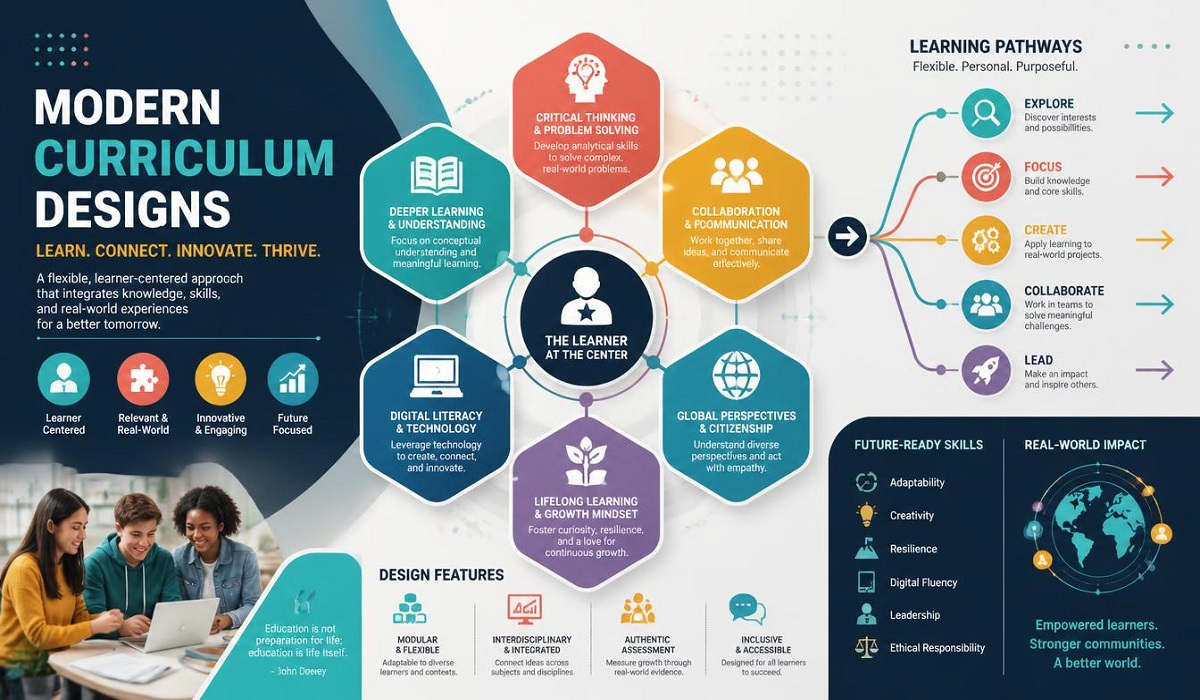
One of the biggest trends is the shift toward a competency-based curriculum (CBC). This design focuses less on how many hours a student sits in a class and more on what they can actually do with what they’ve learned. It emphasizes critical thinking, communication, and collaboration skills .
- Real-World Skills: Instead of just memorizing facts, we expect students to apply their knowledge to solve problems. For example, a country like Uganda is aligning its education system with competence-based education principles to ensure graduates are ready for society and the labor market .
- Moving Away from Rote Learning: In some parts of the world, such as Punjab in Pakistan, there is a conscious effort to reform primary education to replace rote memorization with concept-based learning . This is a global shift.
The Backward Design Model
Have you ever planned a trip by first deciding on your destination and then figuring out how to get there? That’s the idea behind the Backward Design model, also known as the “Understanding by Design” framework .
It works in three stages:
- Identify Desired Results: First, decide what you want students to know, understand, and be able to do by the end of the lesson, unit, or course.
- Determine Acceptable Evidence: Next, figure out how you will know if students have achieved those results. This involves creating assessments that truly measure understanding, not just recall.
- Plan Learning Experiences: Finally, plan the activities and instruction that will help students gain the knowledge and skills needed to succeed on those assessments.
This approach ensures that teaching remains purposeful and that every activity helps students reach a specific goal.
The Agile Backward Design (ABD)
Taking the Backward Design a step further, a newer model called Agile Backward Design (ABD) combines the structure of Backward Design with the flexibility of a “Agile” mindset from the software development world .
This model is built on principles like:
- Collaboration: Teachers and other stakeholders work together.
- Iteration: The curriculum does not remain fixed forever. Educators continuously review, test, and improve it based on feedback and results. This dynamic and responsive approach allows diverse groups to work together and meet a range of requirements through collaboration.
This is a great example of how curriculum designs are becoming more fluid and adaptable.
The CRISPA Approach
What if learning was more like an art? The CRISPA approach brings aesthetic experience into the classroom. CRISPA stands for Connections, Risk-Taking, Imagination, Sensory Experience, Perceptivity, and Active Engagement .
This design encourages teachers to create lessons that are not just about facts but also about experiences. It pushes students to:
- Make connections to their own lives.
- Take intellectual risks.
- Use their imagination.
- Engage their senses in the learning process.
This model positions teachers as active agents in curriculum design within the classroom context, giving them more flexibility and authorship .
A Decolonizing and Transcolonial Curriculum
A more radical and thought-provoking update is the idea of a decolonizing and transcolonial curriculum. This approach asks us to look at education from a completely different angle. Instead of organizing learning around traditional “subjects” inherited from colonial times, it suggests organizing it around human activities and possibilities .
This model proposes a curriculum based on broad human domains like:
- Language, Communication and Expression
- Scientific Inquiry and the Natural World
- Social, Economic and Political Life
- Environmental Understanding and Sustainability
The aim is to create a curriculum that is more culturally inclusive, intellectually coherent, and connected to the real conditions of human life. This challenges conventional assumptions about who designs curricula and what knowledge we consider important.
The Role of Technology and AI in Curriculum Designs
Technology is also playing a huge role in updating curriculum designs. Artificial Intelligence (AI) is no longer just a concept from science fiction; it is becoming a practical tool for educators.
AI as a Task-Bounded Collaborator
Some new frameworks are showing how AI can help teachers design curricula. One such framework is called Genesis. It positions Large Language Models (LLMs) as collaborators that support curriculum development activities .
- Reducing Workload: AI can help generate ideas for lesson plans, quizzes, or learning materials, reducing the design burden on teachers.
- Human Oversight: The key point is that AI is not the designer. Humans are still responsible for making the final decisions. The teacher acts as a critical evaluator, ensuring the AI’s output is accurate and educationally sound. Effective usage presupposes educators’ capacity for purposeful prompt engineering, critical evaluation, and systematic integration of LLM outputs.
AI for Personalization
Another exciting development is using AI to personalize curriculum designs. A study found that an AI-infused approach could improve educator creativity by 23% and confidence in decision-making by 19% .
AI can help analyze student data to identify their individual learning needs, preferences, and strengths. It can then help create a personalized learning pathway for each student, making the curriculum more relevant and effective.
Why These Updates Matter?
So, why is all this change necessary? What are the real benefits of these new curriculum designs?
Better Student Outcomes
The most important reason is that these new designs lead to better learning. Students benefit from a malleable, living curriculum that meets high expectations. When students actively engage and see the purpose of what they’re learning, they succeed more often.
Empowered Teachers
Modern curriculum designs also empower teachers. They give teachers tangible resources and goals, stimulate creativity, and enable self-reflection . Instead of just following a script, teachers become designers of learning experiences.
Preparation for the Future
The world is changing fast. The jobs of tomorrow will require critical thinking, problem-solving, and adaptability. By focusing on competencies and real-world skills, new curricula are better preparing students for their future careers .
Designing a Curriculum: A Process of Continuous Evaluation
A final important point about curriculum designs is that it’s not a one-time job. It is an ongoing and continuous activity and not a “tail-end-process” .
Curriculum evaluation is an integral and essential part of the whole process. It is the process of collecting, analyzing, and interpreting information to determine what is working, what is not, and why . Teachers, parents, administrators, and even the general public are all interested in this process because they want to be sure that students are being provided with a sound, effective education .
This process of planning and evaluation are complementary processes which occur almost simultaneously and continuously. Planning is made on the basis of evaluation and vice versa .
Conclusion: We Are Designing the Future of Education Today
The world of curriculum designs is evolving rapidly. We are moving away from a rigid, fact-based system of the past to a dynamic, student-centered approach for the future.
From competency-based learning and Backward Design to new ideas like the CRISPA approach and AI-augmented models, education is becoming more engaging, relevant, and effective. The focus is shifting from what students know to what they can do. It empowers teachers to be creators and prepares students for the challenges and opportunities of the 21st century. As educators continue refining and updating these educational blueprints, one thing stands clear: we are designing the future of learning right now.
FAQs, or frequently asked questions
1: What is the main difference between a traditional curriculum and a competency-based curriculum?
A traditional curriculum often focuses on covering a set amount of content through lectures and memorization. A competency-based curriculum (CBE) focuses on the outcome. It requires students to demonstrate that they have mastered specific skills and knowledge before moving on. It’s less about seat time and more about proving what you can do.
2: Why do educators consider “Backward Design” a more effective way to plan lessons?
Backward Design starts with the end in mind. By first identifying the desired learning goals, teachers can create assessments that truly measure understanding. This then guides the planning of instructional activities to ensure that every step is purposeful and helps students achieve those specific goals, making learning more focused and effective .
3: How does Artificial Intelligence (AI) help in curriculum design?
AI acts as a powerful assistant to educators. It can help by generating ideas for lessons and assessments, creating personalized learning pathways for individual students, and even predicting student outcomes. However, the final decisions and evaluation of AI-generated content remain the responsibility of a human teacher .
4: What is the significance of the “Agile Backward Design” model?
This model combines the structured planning of Backward Design with the flexibility of an Agile mindset. This means the curriculum is designed to be iterative and collaborative. It allows for continuous improvement based on feedback and changing needs, making it adaptable to new challenges and information .
5: Why do we need to update curriculum designs?
The world is changing rapidly, and our education system must keep up. New designs are needed to move away from rote memorization and passive learning. Modern curricula aim to develop critical thinking, problem-solving, and collaboration skills. They also aim to make learning more engaging, culturally relevant, and aligned with the demands of the 21st-century workforce