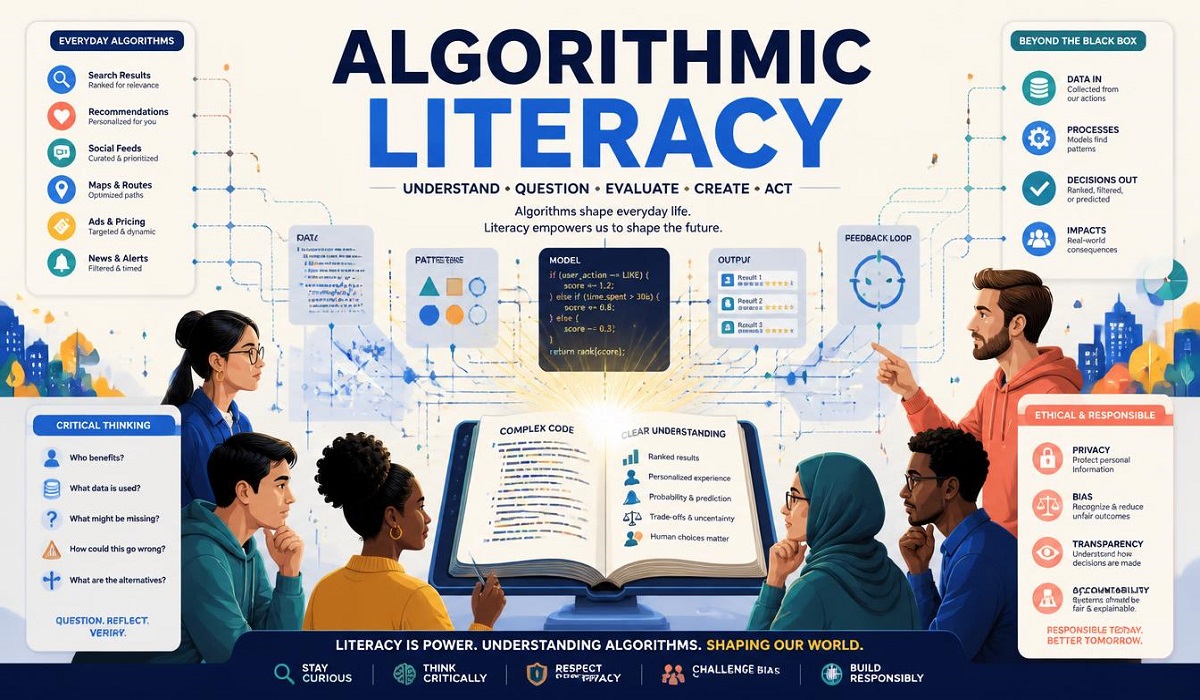
Algorithmic Literacy
Algorithmic Literacy: Imagine you have a three-year-old child playing with bricks on the floor. He takes the red square and sets it next to the blue square. Then he takes another red square and hesitates, and looks at you. You grin and nod your head. He gladly puts down the red square and picks up the next one.
This method seems routine. But it is a really deep cognitive event. Your youngster is picking up on a pattern, predicting what comes next and organizing items based on an internal rule. What he is doing is the most rudimentary sort of algorithmic reasoning.
In 2026 the subject of algorithmic literacy migrated from higher education and tech ethics to the domain of early childhood education. Now this may sound a bit ahead of its time, or even silly – why care about algorithmic literacy for toddlers? They can’t tie their shoelaces, let alone grasp recommendation algorithms.
But the reality is that algorithmic literacy means something else altogether for infants than it does for teens or adults. It’s not about learning programming, or how TikTok’s “For You” page works or critically analyzing material created by AI. For two to five year olds, algorithmic literacy is about developing the basic cognitive skills that will make them clear-headed consumers of algorithmic systems.
Thus, your youngster constructs the mental frameworks to grasp algorithms when he organizes blocks, follows procedures to prepare cookies or observes that you place the spoon where the fork should go. These frameworks will not emerge organically in further learning. They have to be built up in early life by means of solid, tactile, fun experiences.
Without screens, Without apps, Without any Technology,
This is what this post is all about: what algorithmic literacy is, why early childhood is such a key window for growing it, and how you can cultivate it in 2026, without screens, without apps, without any technology, via ordinary play.
What is Algorithmic Literacy — An Explanation for Non-Programmers?
The idea of algorithmic literacy has been around academics for a while. This was initially brought up in conversations about info lit and dig lit and is a person’s capacity to grasp how algorithms impact how information is presented, decisions are made and lived experiences. Another researcher characterized algorithmic literacy as “the skills to understand how algorithms work, what biases they may have, and how to respond to them.”
For adults, this generally means recognizing that your social media feed is not impartial, knowing how your data is used to forecast your behavior, and knowing that there are commercial logics and human designs behind the suggestions of “smart” systems.
With toddlers, the starting point of algorithmic literacy is a lot more rudimentary. It begins with knowing three things:
First, things happen in sequence. That’s the idea of the series. Socks before shoes, and brushing before rinsing. The order is important. alter the order, alter the result.
Second, objects obey rules. Now that is the way, red bricks and blue blocks alternate. Another guideline is to put all circles together and all squares together. Rules may be found, explained and even altered.
Third, you may detect and correct mistakes. If a step is not working you may go back, discover it and fix it. This is the basis of “debugging” thinking, and it’s the strongest aspect of algorithmic literacy.
These three concepts seem depressingly easy. But they are exactly the foundation of every subsequent algorithmic insight. By the time they are four, a youngster who has not consistently practiced sequencing, finding rules, and correcting mistakes will not have the cognitive capabilities to think about problems like “why is this video popping up” until they are ten.
Why the Toddler Needs More Attention to Algorithmic Literacy Than Ever, 2026?
You may think: my child is still little we will deal with it when he is older. Let him have his childood first.
The logic is good but it doesn’t take into account one important fact. The digital landscape in 2026 is very different from five years ago. Algorithms are no longer technical minutiae tucked away in the background. They influence everything kids see, from what is recommended on YouTube Kids to Spotify family playlists to smart-speaker responses to the sequence of information in “educational” applications.
Meanwhile, toddler screen time recommendations have gotten clearer and more stringent. According to pediatric standards in 2026, children under two still get no screen time alone, and children ages two to five get no more than an hour a day, with calm and predictable content and an adult watching with them.
The rules are based on a crucial understanding that the brains of toddlers are wired differently than those of adults. Fast-paced, social media-style films may influence how children focus attention. More significantly, a lot of screen time replaces activities that are vital for brain development: discussion, play, physical exercise, face-to-face engagement.
So, an intriguing contradiction happens. We put children in an environment without algorithms to shield them from screens. But this “protection” if not complemented, may leave kids unequipped when they go into the digital world.
The answer is not to expose kids to screens sooner. The answer is to create the cognitive underpinnings of algorithmic thinking off-screen, through play and daily contact. This way when they do start using platforms with algorithms – and they will – they already have the frameworks to think about these systems.
Algorithmic Literacy: Four Initial Aspects, Awareness, Understanding, Evaluation, Response
The academic study provides a valuable framework for algorithmic literacy, which is divided into four levels: awareness, knowledge, critical assessment, and reaction behavior .
The framework was developed for school-age children and teenagers but we may translate it into the toddler environment to understand what it implies developmentally.
Awareness: The sense that “something is going on”
For toddlers, awareness is not “knowing algorithms exist.” It’s starting to notice that things happen in sequence, that rules may be followed or disobeyed, and that certain outcomes follow specific acts. A youngster who says, “I put on socks first, then shoes” knows about sequencing. When he realizes today’s block arrangement is different from yesterday’s, he is exhibiting awareness of patterns.
This dimension is important: it is based on experience, not explanation. You can’t teach a 3 year old that “algorithms are everywhere”. But you can let him continually experience order, rules and results until these notions are assimilated.
Understanding: Figuring Out How It Happens
Understanding is when the youngster starts to foresee what will happen next, to state the rule, and even to make up his own rules. When a youngster says, “red, blue, red, blue, the next is red” he is indicating that he understands patterns. He shows an awareness of sequences by arranging graphic cards in the proper order for preparing cookies.
This level requires adult supervision. Not lecturing but asking: “What follows next?” “What occurred here?” “Can you explain me the rule you used?
Critical Evaluation: Realizing that ‘Something isn’t right’
Evaluation is the most important yet most often forgotten element of algorithmic literacy. For toddlers, it’s the capacity to catch errors. If you purposely place the spoon where the fork should be, and the youngster replies “No!” – that’s evaluation. When you change the sequence of the tale and the youngster responds, “No, brush teeth first, then get dressed” – that’s evaluation, too.
Algorithmic literacy also involves a subtler skill, the capacity to see when a rule, when implemented, generates an unjust or irrational result. Toddlers have a strong sense of “fairness.” Researchers have shown that toddlers are better able to grasp “fairness” than the abstract idea of “bias.” They can reason about unequal outcomes in realistic stories and role-play.
Response: Taking Action on It
Response behavior suggests that the youngster does not just see the problem but seeks to remedy it. He rearranges the pieces , modifies the processes for building the cookie , or says ” you should put it this way ” . This is an early type of debugging thinking and the most action-oriented portion of algorithmic literacy .
No Screens, No Apps: 7 Play Activities for Building Algorithmic Thinking
And now we get to the practical portion. None of the activities below require digital equipment, and most do not require additional supplies. These activities may be done at home, in a preschool or wherever children are. They’re not trying to “teach algorithms”. The aim is to create situations where algorithmic thinking comes naturally via play.
Activity 1: “Recipe” for Sequencing Daily Routines
Turn everyday activities your child engages in – getting dressed, washing hands, going outside, getting ready for bed – into chances to practice sequencing.
How to do it. First have your youngster show you his order for putting on a coat. First sleeve or hood? When do you get up? Then make a “recipe” that sets the sequence, using drawings or real things. 2. You may snap photos of your child accomplishing each step or sketch basic graphics and have them printed out for your youngster to organize.
This practice is a direct parallel to the “unplugged sequencing exercises” in research. Research in early childhood education supports the use of visuals or tangible items to co-create “recipes” to assist youngsters learn the causal logic of sequence.
Extension: Intentionally reverse the sequence of two stages. Ask your youngster, “If I put my hat on and then my coat, what do you think will happen?” Let him anticipate and try it.
2: Pathways on the ground
Draw a trail on the floor using tape or create a road out of blocks. Plunk a toy in at the beginning and one at the finish.
How to do it: Have your youngster stand at the beginning and explain how to get to the conclusion using words. “Take three steps forward, turn right, take two more steps.” At first you talk, your youngster performs. Then you swap places, your child walks and you talk. Intentionally make a mistake so your youngster can point out where you didn’t follow the directions.
This practice develops ideas of sequence, direction and distance. Research reveals that one successful way to make the transition is to let youngsters first explore a path physically and then have them repeat that same journey with a robot or other technology.
Activity 3: Pattern Sequences and “Rule Detective”
Gather up whatever tiny objects you can find in the house: buttons, spoons, pieces of fruit, colorful blocks, socks.
How to do it: Start a basic pattern, red, blue, red, blue, and have your youngster complete it. Once he is comfortable with the two element pattern, go on to three elements – big, medium, small, big, medium, tiny or complicated repeating patterns.
The essential step: ask your youngster to say the rule he is employing. “How did you know what comes next?” This question turns a basic sequencing exercise into an algorithmic thinking exercise. “Computational thinking is a fundamental part of abstract thinking. A youngster can conduct abstract thinking when he can express a rule.
Then, make an intentional mistake. Place an object in the middle that breaks the pattern. See if your youngster notices. Watch. If he does inquire how did he know The procedure is a simulation of how algorithmic systems pick up anomalies, and it offers youngsters practice in critical assessment in a natural way.
4: Machines for sorting and choice trees
Make a pile of mixed goods, mixtures of sizes, colors, shapes, or other features.
HOW TO DO IT: Tell your child he is creating a “sorting machine.” Set up one rule: “Is it red? Yes, put it here. No, put it there.” Your child does the sorting. Add a second rule: If it is red, is it soft? Yes, place it here. No, put it there.
You’ve just developed a two level decision tree with your child which is the basic logical framework of many categorization algorithms. And language development is naturally part of this exercise, for every question is a conditional, and the youngster has to comprehend the logic of “if… then…”.
5: The “Debugging” Game: Intentional Errors
This may be the most useful activity of all. Debugging – identifying mistakes, locating faults, repairing errors – is the single most transferable skill in algorithmic literacy.
How to accomplish it: Make intentional mistakes in your everyday work. Put the spoon where the fork should be during breakfast. When you read a familiar narrative, change a detail. Miss a step in following instructions.
When your youngster sees the mistake, your reaction is really important. Make a big out of the find. You spotted it! Great! Let’s see how to fix it.” You are teaching your child that mistakes are something to learn from, not be ashamed of. Research has shown that debugging thinking is strongly associated with the development of social-emotional abilities such as perseverance and teamwork.
6: Algorithms for Stories
Basically, stories are algorithms of happenings. A program is a sequence of graphic cards that can be “run.”
How to do it: Draw or print a set of basic drawings demonstrating a typical procedure – preparing a sandwich, washing your hands, getting ready to go out. Mix up the cards and let your youngster arrange them in the right sequence. Then let your youngster “run the program” by doing each step on the card in order.
Extension questions: “What if we didn’t do this step?” “Can we do step three before step one?” These types of questions expose the idea of dependencies, a sophisticated feature of algorithmic reasoning.
Activity 7: “Programming” the Body
Have your child’s estate be the executor. You tell him what to do he does it.
- How to accomplish it: Begin with simple commands such as “take one step forward,” “jump once,” “squat down.” Slowly make them more complicated — two-step sequences, then three. Establish conditions. “If I say red, you jump. If I say blue, you crouch.”
- Then change roles. Your kid calls the shots, you follow. Intentionally misinterpret unclear directions so that your youngster learns to express himself precisely. The command “walk two steps” is not the same as “walk two steps then stop”. This practice promotes algorithmic thinking and communication abilities.
When Screens Can’t Be Avoided: Supporting Algorithmic Literacy in Digital Settings?
It is not practical to completely ignore screens in 2026. Screens are everyplace. The key is not how to keep children away from algorithms, but how to make screen interaction an extension of computational literacy, not the reverse.
The answer from research is unambiguous: co-viewing and discourse are the key. The learning effect is radically different when an adult is there and watches content with a youngster. You might ask “What do you think will happen next?” “Why did he do that?” “If it was you, what would you do?”
These questions change passive consumption into active thought. They ask children to employ the abilities of sequencing, predicting and evaluating that they use in everyday life.
Choice of content also essential for two to five year olds. This age is more suited to slow, predictable material as opposed to rapid paced material with continually shifting scenarios. Simple stories, obvious emotional expressions, unhurried conversation – these are all elements that make content simpler for infants to digest and think about.
But most essential, think differently about screen time. By 2026, guidelines are not about “how many hours,” but pose a new question: what is screen time replacing?
So even very little screen time becomes an issue if it is at the expense of play, exercise, conversation, or sleep. If it’s a supplement after every other requirement has been addressed, and a conscious choice with an adult, then it’s neutral or even a little positive.
This idea is particularly well-suited for algorithmic literacy. A youngster who has had a rich off-screen experience of sequencing, pattern identification and debugging will have more cognitive resources to think about what he sees on screen. The youngster who has no such experience is more inclined to accept screen material at face value, to take it for granted.
What the New 2026 Guidelines Tell You (and Don’t)
The 2026 recommendations nevertheless highlight that for toddlers, face-to-face connection and play cannot be replaced by screen usage. 90 percent of brain development happens before age five. This crucial window demands communication, games, physical activity, and real-world experiences for youngsters.
Guidelines generally recommend “avoiding” AI toys and chatbots until there is more information on how they might impact infants. This is a sensible precaution. But “avoiding AI” isn’t the same as “avoiding AI literacy.” Algorithmic literacy doesn’t require AI equipment. It calls for exactly what the rules suggest: play, talk, guided investigation.
That’s why algorithmic literacy and screen time management are basically two sides of the same coin. Both are about helping kids focus amidst a sea of gadgets. Prioritize connections and experiences above technology and content. Both know that mental patterns established in early infancy remain longer than any particular technical competence.
Frequently Asked Questions
My child is two years old. Does he truly learn “algorithms”?
Yes, but not in the usual sense of “learning.” A two-year-old can’t grasp abstract ideas, but he may develop intuitions about sequencing and patterns via physical experience. The order in which we get dressed, the steps we take to eat, the sequence of sleep rituals are all seeds of algorithmic thinking. The trick is to make these encounters predictable, yet still allow for experimentation.
Should I get a coding robot or AI toy?
A: No. It is possible to build the fundamentals of algorithmic literacy totally without digital gadgets. In fact, research suggests that it’s better to start off with tangible, off-screen experiences and then move to digital resources when the youngster is ready. Coding robots can be an add-on, but not the starting point.
What if my child is already spending a lot of time on the screen?
Don’t worry, don’t chop it all off at once either it might bring backlash. Instead, begin co-viewing. When you watch content with your child, ask questions, point out patterns, talk about what can happen next. You are turning passive time in front of the screen into active thought exercise. With this increase, off-screen sequencing and pattern activities should be gradually increased. It can go either way.
Is algorithmic literacy the same as “coding”?
Nope. Coding is writing instructions in a certain language. Algorithmic literacy is more general – it’s knowing how instructions function, how they influence results, and how to judge their rationality. A youngster can have a good algorithmic literacy without creating a single line of code. Indeed, algorithmic literacy should precede any formal coding training in early infancy.
How can I know whether my child is developing these skills?
There will be signs. He may begin to make patterns for himself, and to make rules, he may begin to see “errors” in everyday life and enthusiastically point them out. He may start to use phrases such as “first… then…” to explain procedures. And he may also start using similar thinking in other situations, such as seeing something irrational in a tale or changing rules in a game. All these things are signs that algorithmic thinking is gaining steam.
Summary
Being able to read algorithms in 2026 sounds like a high-tech subject. But for toddlers it is all about the most fundamental human skills: seeing order, finding rules, spotting mistakes and having the confidence to put things right.
You can’t build those skills on displays. They are building with blocks with an adult, sequencing picture cards to bake cookies, traversing routes on the floor, and intentionally making errors in a safe space where it is okay to make a mistake.
As a teacher or parent, you are not there to teach algorithms. Your job is to design rich, fun experiences where algorithmic thinking will come easily. You don’t have to be a programr or computer specialist. What you need is time, attention and a desire to get on the floor with your child and say, “What happens next?
This may be the best online literacy present you offer your child in 2026. Not a screen, not an app. Not a smart toy. But a childhood completely played in, of sequences, of patterns and moments of “let’s try again.”