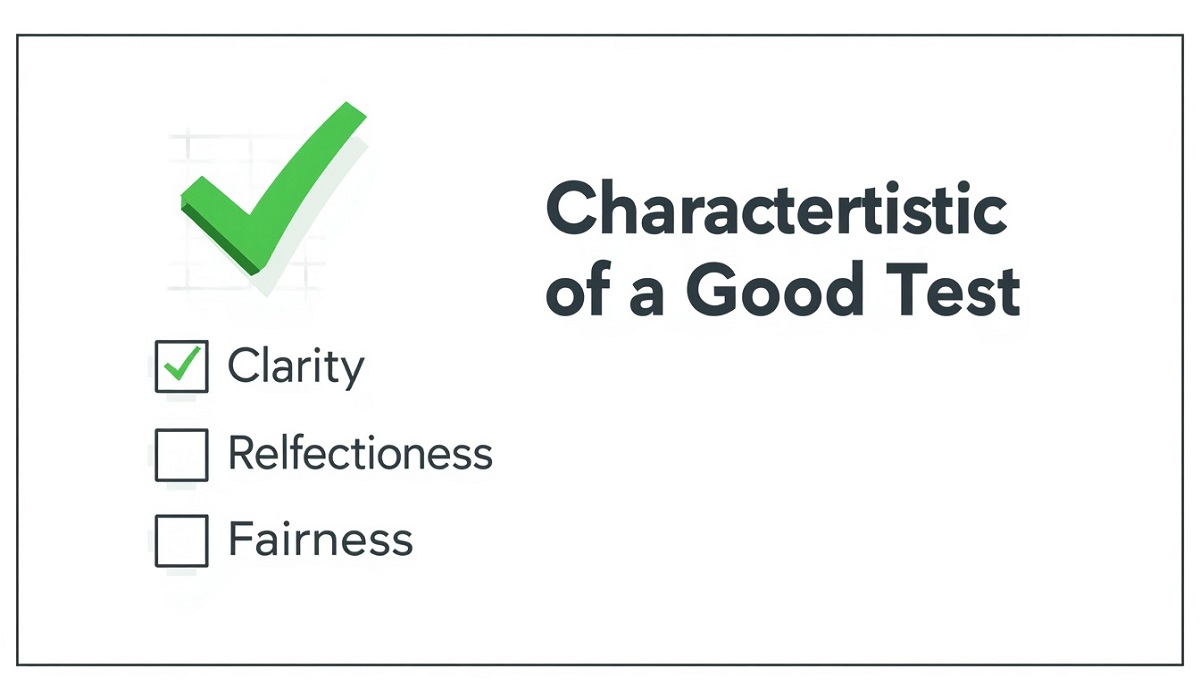
Characteristic of a Good Test
Characteristic of a Good Test: Have you ever taken a test that felt completely unfair? Maybe you studied hard, knew the material backward and forward, but when you saw the questions, you felt lost. The questions seemed to come from a different class altogether, or maybe the instructions were so confusing you didn’t even know what to do.
On the flip side, have you ever taken a test where everything just clicked? The questions matched what you learned, you had enough time, and you walked out feeling like your score actually showed what you knew.
The difference between these two experiences isn’t luck. It’s the difference between a well-designed test and a poor one. And at the heart of every well-designed test is validity—the most essential characteristic of a good test.
But a good test isn’t just about validity alone. Like a recipe that needs the right balance of ingredients, tests need several qualities working together. Understanding these characteristics helps teachers create better assessments and helps students know what to expect.
Let’s explore the one core characteristic that makes or breaks a test—validity—along with other essential qualities that make tests truly useful. We’ll use plenty of A Characteristic Of a Good Test with Examples so you can see these ideas in action.
What Is Validity? The Most Important Characteristic of a Good Test
The Simple Definition
Validity is simply this: A test is valid when it measures what it’s supposed to measure.
That sounds obvious, right? But it’s actually trickier than it seems. Here’s why: many tests claim to measure one thing but actually measure something else entirely.
For example, imagine you’re giving a math test. You want to check if students can solve word problems. But you write the problems using complex vocabulary that many students don’t understand. Now the test isn’t really measuring math skills—it’s measuring reading comprehension! That’s a validity problem.
Dr. Robert Ebel, a famous expert on testing, once said that tests aren’t simply valid or invalid. Instead, validity is a matter of degree—some tests are more valid than others for specific purposes.
Real-World Example of Validity
Think about the little girl in this example: A teacher meets a girl and wants to find a book at her reading level. The teacher gives her a word list test. The child reads down the list, getting a different number of words right each time she tries. One time she gets eight, next time ten, then seven. The test is inconsistent, so it’s hard to make a decision based on it. When the teacher gives her a third-grade book based on the test results, the child finds it boring and too easy. The test didn’t validly measure her reading ability.
This story shows that validity is about making accurate decisions based on test results. If a test helps you make good decisions, it has validity. If it leads you to wrong decisions, it lacks validity.
Types of Validity You Should Know
Experts generally talk about three main types of validity:
- Content Validity: Does the test cover the material that was actually taught? If you taught 10 chapters but only test on 1, that’s a problem. A valid test samples from the whole range of content.
- Criterion-Related Validity: Do test scores match up with real-world performance? For example, does a college entrance test predict how well students will actually do in college?
- Construct Validity: Does the test measure the underlying trait or ability it claims to measure? For an intelligence test, do the results match what psychological theory says about intelligence?
Reliability: The Consistency Factor
What Reliability Means
The second most important characteristic of a good test is reliability. A test is reliable when it gives consistent results.
Think of it like a bathroom scale. If you step on it three times in five minutes and get three wildly different weights, that scale is not reliable. You can’t trust it. The same goes for tests. A reliable test will give you similar scores if the same student takes it again (assuming they haven’t learned more material in between).
Why Reliability Matters
Reliability becomes especially important when a student’s score is close to the passing line. If a test is unreliable, chance alone could decide whether someone passes or fails. That’s not fair to anyone.
Example of Reliability in Action
Imagine two teachers grading the same essay. One gives it a 95, and the other gives it an 80. That’s a big difference! If the scoring depends that much on who does the grading, the test lacks reliability. This is why rubrics and clear scoring guidelines are so important. They help make grading more reliable.
How to Improve Reliability
Tests become more reliable when they have:
- More questions (like how research studies are stronger with more participants)
- Clear, unambiguous questions
- Objective scoring where the right answer isn’t up for debate
- Standardized conditions (quiet room, same instructions, enough time)
Practicality: The Real-World Factor
What Practicality Means
A test can be perfectly valid and reliable, but if it’s too hard to give or score, it’s not practical. Practicality is about ease of use.
A practical test:
- Is easy to administer
- Doesn’t take too much time to score
- Fits within the available resources
- Makes the best use of everyone’s time
Example of Practicality Issues
Think about oral exams. They can be excellent ways to assess speaking skills. But if you have a class of 35 students and each oral exam takes 15 minutes, that’s over 8 hours of testing! Plus, you’d need a quiet place for each student. That’s not practical for most classroom situations.
Finding the Balance
Sometimes teachers create elaborate assignments with complex rubrics. On paper, these look fantastic. But when you actually try to use them, they’re so time-consuming that they become a burden. Good test designers balance quality with practicality.
Fairness: Everyone Gets an Equal Chance
What Fairness Means
A fair test doesn’t advantage or disadvantage anyone based on things that aren’t relevant to what’s being tested.
For example, if a test is checking your knowledge of science, it shouldn’t require advanced reading skills that some students haven’t developed yet. The test should be in language that all students can understand.
Example of Fairness in Testing
Here’s a medical example: In radiology, a condition called “Wegener granulomatosis” was renamed “granulomatosis with polyangiitis.” A fair test should not penalize a doctor for knowing the old name, unless knowing the new name is specifically part of what’s being tested.
Fairness Challenges
Fairness isn’t always simple. Imagine you’re testing English language ability. Should the test be in English? Yes, because that’s what you’re testing. But if you’re testing math skills, the test should be in the student’s strongest language, or the language shouldn’t affect their math score.
Authenticity: Real-World Connection
What Authenticity Means
Authenticity is about how realistic the test is. Does it reflect real-world situations where the knowledge or skills would be used?
Example of Authenticity
Think about learning to ask for directions in another language. A test that asks students to write down “How do I get to the library?” is okay. A test that asks students to role-play asking a stranger for directions in a simulated city is more authentic. It’s closer to what they’d actually do.
Why Authenticity Matters
When tests feel real and meaningful, students are more motivated. They can see why what they’re learning matters. Authentic tests also provide better information about whether students can actually use their knowledge in the real world.
The Quality of Test Questions
Characteristics of a Good Test Question
Even if a test is generally valid and reliable, individual questions need to be well-designed too. Here’s what makes a good question:
- Clear instructions: Students should know exactly what to do.
- Appropriate difficulty: Questions should match the level of learning and go from easier to harder.
- Clear language: No unnecessary words or confusing phrases. Use language students are familiar with.
- No “trick” questions: Test what was taught, not what wasn’t.
Before and After Example
Here’s a real example from an ASCD article about improving test questions:
Original (Bad) Question:
“What is the perimeter of the figure below, which comprises a square and an adjoining triangle?”
Revised (Good) Question:
“What is the perimeter of this figure?”
The revised version is clearer and more readable. Students spend less time figuring out the question and more time showing what they know.
Question Types and Their Uses
Different types of questions work better for different purposes:
| Question Type | Best For | Challenges |
|---|---|---|
| Multiple Choice | Testing broad content, measuring higher-order thinking if written well | Hard to write good questions, can guess answers |
| True/False | Testing factual knowledge | Easy to guess, limited to recall |
| Matching | Testing associations between items | Hard to assess higher-level thinking |
| Short Answer | Testing recall, brief responses | Can be tricky to score fairly |
| Essay | Testing higher-order thinking, writing ability | Time-consuming to score, harder to make reliable |
The Bloom’s Taxonomy Connection
What Is Bloom’s Taxonomy?
Bloom’s Taxonomy is a framework for thinking about different levels of learning. Think of it like a staircase:
- Bottom step: Remembering facts
- Next step: Understanding ideas
- Middle step: Applying knowledge
- Higher step: Analyzing information
- Even higher: Evaluating
- Top step: Creating something new
Why This Matters for Tests
A good test doesn’t just ask students to remember facts. A valid test matches what was taught. If teachers wanted students to be able to analyze and evaluate, tests should ask them to analyze and evaluate, not just recall.
Example of Different Levels
Let’s say you’re teaching about osmosis in biology:
- Low level (Remember): “Define osmosis.”
- Medium level (Understand/Apply): “Give one example of osmosis from daily life.”
- Higher level (Analyze): “Why do potato chips wilt when kept in salt water?”
Each question is valid, but they test different levels of understanding. A good test matches its questions to the learning goals.
Washback: How Tests Affect Learning
What Is Washback?
Washback is the effect that tests have on teaching and learning. Good tests create positive washback—they encourage good teaching and deep learning. Bad tests create negative washback—they make teachers “teach to the test” and students memorize without understanding.
Example of Washback
If students know the history test will only ask for dates and names, they’ll memorize dates and names. If they know the test will ask them to explain why events happened and their impact, they’ll study differently. The test shapes how students learn and how teachers teach.
The Challenge
The danger is that a test can become so important that teachers spend all their time preparing for it instead of teaching the full curriculum. Good test design aims for positive washback, where teaching for the test is the same as good teaching.
Test Design: Step by Step
Experts have outlined a process for creating high-quality tests. Here are the key steps:
1. Identify Purpose and Content
First, decide what the test should measure. What were the learning objectives? What was taught? A test is only as valid as its foundation in learning objectives.
2. Choose the Right Question Types
Based on what you’re testing, choose questions that work well. For factual recall, you might use multiple choice. For analysis and evaluation, you might use essay questions.
3. Write Clear Questions
Use simple language. Avoid unnecessary words. Don’t use confusing negatives or “trick” wording.
4. Consider Readability
The language level of the test should match the students. If words in the test are too hard, you might end up measuring reading ability instead of content knowledge.
5. Plan the Layout
Tests should be easy to read. Use:
- Clear fonts like Arial or Times New Roman
- Adequate spacing
- Grouped similar question types
- Page numbers
- Enough space for answers
6. Create Scoring Guidelines
Especially for essay questions, develop clear rubrics so grading is fair and consistent.
7. Review and Revise
Go through the test one more time. Check for clarity, accuracy, and fairness.
Common Mistakes in Test Creation
1. Making Tests Too Long
Tests that are too long can be invalid because students get tired or rushed. A good test is appropriate in length for the allotted time.
2. Including “Tricky” Questions
Some teachers think trick questions separate the smart students from the rest. Actually, trick questions test who can figure out the trick, not who knows the material. They hurt test validity.
3. Using Unfamiliar Formats
If you always use multiple-choice questions and suddenly give an essay test, students might do poorly because they’re unfamiliar with the format, not because they lack knowledge. Test validity suffers.
4. Testing the Wrong Things
This is the biggest validity problem. If you taught students how to analyze poetry, your test should ask them to analyze poetry, not just remember facts about poets.
Real-World Examples of Good Test Design
Example 1: A Valid Math Test
Mr. Johnson teaches multiplication. His students learned:
- Memorizing multiplication facts
- Solving word problems with multiplication
- Explaining how multiplication works
A valid test would have questions on all three areas. An invalid test would only ask for memorized facts, ignoring the word problems and explanations.
Example 2: A Reliable Essay Grading System
Ms. Patel has three different classes writing essays on the same topic. She creates a detailed rubric:
- Thesis statement: 10 points
- Supporting evidence: 20 points
- Organization: 10 points
- Grammar and mechanics: 10 points
She grades all essays with this rubric. When she double-checks a few, her scores are consistent. That’s reliability.
Example 3: A Fair Test
A school district is testing science knowledge. They have many English language learners. Instead of using scientific reading passages that are hard to understand, they use pictures and diagrams. The test measures science knowledge, not reading ability. That’s fairness.
How Students Can Recognize Good Tests?
Students, here’s what to look for in a good test:
- Clear instructions that tell you exactly what to do
- Questions that match what you studied
- A reasonable length for the time given
- Questions in order of difficulty (easier to harder)
- No trick questions
- Enough space to write your answers
- Clear and readable text
If a test has these qualities, it’s more likely to measure what you actually know.
Conclusion: Putting It All Together
So, what is a characteristic of a good test with examples we can learn from?
The most important characteristic of a good test is validity—it measures what it’s supposed to measure. But validity doesn’t work alone. A good test must also be reliable (consistent results), practical (easy to use), and fair (equal for everyone). Quality questions, appropriate difficulty, and clear language all contribute to these goals.
When teachers create valid tests with clear instructions and appropriate questions, they’re doing more than just assigning grades. They’re helping students learn, they’re creating positive washback. They’re making education more fair and effective.
When students understand what makes a test good, they can study more effectively and even advocate for better assessments. Understanding testing isn’t just for teachers—it’s for everyone who wants learning to be meaningful.
The next time you encounter a test, whether as a teacher creating one or a student taking one, remember these characteristics. A good test doesn’t just ask questions. It helps people demonstrate what they know and can do. And that’s what education is really about.
Frequently Asked Questions
1. What is the most important characteristic of a good test?
Validity is generally considered the most important characteristic because if a test doesn’t measure what it’s supposed to measure, nothing else matters. A test can be reliable, practical, and fair, but if it’s not valid, it’s useless for its intended purpose.
2. What is the difference between validity and reliability?
Validity is about measuring what you intend to measure, while reliability is about consistency. Think of a thermometer: if it gives the same reading each time you check a cup of water, it’s reliable. But if the reading doesn’t actually match the water’s temperature, it’s not valid. A test can be reliable but not valid, but it cannot be valid without being reasonably reliable.
3. How can teachers improve the validity of their tests?
Teachers can improve validity by ensuring test questions align with learning objectives, covering the full range of taught material, using appropriate question types, avoiding confusing language or trick questions, and making sure the difficulty level matches what was taught. Professional development and peer review of tests can also help.
4. What makes a test question “fair”?
A fair test question doesn’t advantage or disadvantage students based on irrelevant factors like gender, race, cultural background, or language ability (unless the test is specifically measuring those things). It uses clear language, provides necessary context, and doesn’t include assumptions that only some students would know.
5. How many questions should a good test have?
There’s no perfect number, but generally, more questions improve reliability. However, the test shouldn’t be so long that students get tired or rushed. The length should be appropriate for the allotted time, and it should cover a representative sample of the material. A good rule of thumb is to have enough questions to cover the key learning objectives without overwhelming students.
Summary
This article explored the essential characteristics of a good test, with a special focus on the foundational concept of validity. We learned that validity—ensuring a test measures what it’s supposed to measure—is the most important characteristic, supported by reliability (consistency), practicality (ease of use), and fairness (equal treatment). The article examined how these qualities work together using real-world examples, including classroom scenarios and professional testing situations.
We discussed how different question types serve different purposes, the importance of writing clear and readable test items, and how Bloom’s Taxonomy helps match questions to learning levels. The concept of washback showed how tests influence teaching and learning beyond just giving scores. We also covered practical test design strategies and common mistakes to avoid.
By understanding what makes a good test, teachers can create better assessments, students can navigate testing more effectively, and everyone involved in education can work toward more meaningful and accurate measurement of learning.