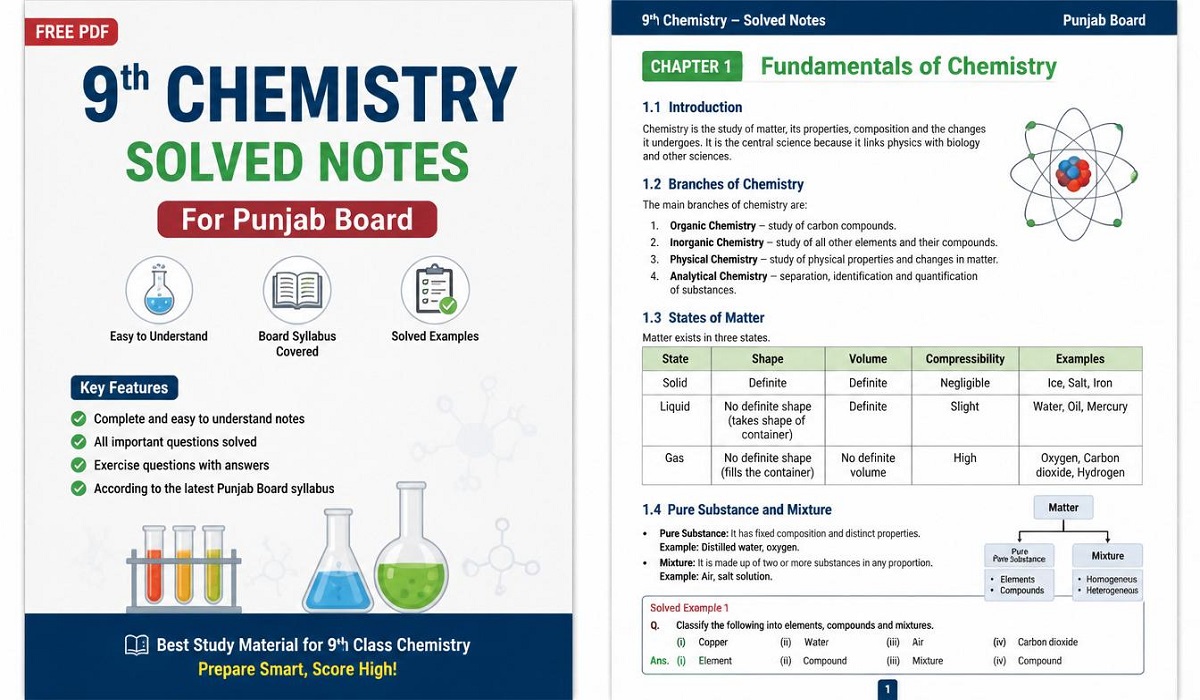
9th Chemistry Solved Notes
9th Chemistry Solved Notes: Chemistry is all around us. From the water we drink to the air we breathe, chemistry explains how things work. For 9th-grade students in Punjab, chemistry can sometimes feel like a difficult subject. But with the right Chemistry Class 9th Solved Notes, it becomes much easier.
These notes are designed to help you understand the basic concepts of chemistry in a simple way. Whether you are studying in English medium or Urdu medium, these notes will help you get good marks in your board exams. The best part is that you can download them for free in PDF format.
In this blog post, I will share complete Chemistry Class 9th Solved Notes for the Punjab Board. These notes follow the new syllabus for 2026. You will find solved MCQs, short questions, and long questions for all chapters. So, let’s dive in and explore these helpful notes.
Why Do You Need Chemistry Class 9th Solved Notes?
Students often ask me, “Why should I use solved notes?” Here are some simple reasons:
Easy Understanding: Chemistry has many difficult words and concepts. Solved notes explain these concepts in easy words. They break down big ideas into small, simple parts. Even if you find chemistry difficult, these notes will help you understand everything clearly.
Save Time: When you study, you don’t want to waste time searching for answers. The Chemistry Class 9th Solved Notes give you all the answers in one place. You don’t need to look through many books. Everything is organized chapter by chapter.
Exam Preparation: Board exams can be stressful. But when you practice with solved notes, you feel more confident. These notes include questions that often come in exams. You will know exactly what to expect.
Quick Revision: Before exams, you need to revise quickly. These notes help you do that. You can go through the important questions and answers in a short time. This is very helpful during exam week.
Self-Study: Sometimes you want to study at home without a teacher. These notes act like a personal tutor. You can check your answers and learn by yourself.
How These Notes Follow the Punjab Board Syllabus 2026?
The Punjab Board updates its syllabus from time to time. For the session 2026, there are some changes. These Chemistry Class 9th Solved Notes follow the new syllabus perfectly.
The Punjab Board books have different chapters. Each chapter covers a specific topic in chemistry. The solved notes follow the same order as the textbook. This makes it easy for students to study.
The syllabus includes:
- Fundamentals of Chemistry
- Structure of Atoms
- Periodic Table and Periodicity of Properties
- Structure of Molecules
- Physical States of Matter
- Solutions
- Electrochemistry
- Chemical Reactivity
These notes cover all these chapters in detail. You will find solved exercises for each chapter. The answers are written in a way that matches the board’s marking scheme.
Chapter-Wise Chemistry Class 9th Solved Notes
Let’s look at what each chapter covers. These notes include solved exercises for every chapter.
Chapter 1: Fundamentals of Chemistry
This is the first chapter of your chemistry book. It introduces you to the basic ideas of chemistry. You learn about:
- What chemistry is and why it is important
- Branches of chemistry like organic and inorganic chemistry
- What matter is and its different states
- Basic definitions like element, compound, and mixture
- Atoms and molecules
- Ions and their types
Chapter 1: Free Download in PDF Format
The solved notes for this chapter include all the important questions. The MCQs cover topics like the definition of chemistry and the branches of chemistry. Short questions explain concepts like the difference between an element and a compound. Long questions give detailed answers about the structure of matter.
These Chemistry Class 9th Solved Notes help you build a strong foundation for the rest of the course.
Chapter 2: Structure of Atoms
Atoms are the building blocks of everything. This chapter tells you what atoms are made of. You study:
- Rutherford’s experiment and his atomic model
- Bohr’s atomic model
- Subatomic particles: protons, electrons, and neutrons
- Atomic number and mass number
- Isotopes and their uses
- Electronic configuration
Chapter 2: Free Download in PDF Format
The solved notes explain these topics in simple words. You can learn about how scientists discovered the structure of atoms. The MCQs help you remember important facts. The short questions cover definitions and explanations.
Chapter 3: Periodic Table and Periodicity of Properties
The periodic table is like a map of all the elements. This chapter helps you read and understand it. You learn about:
- How the periodic table is arranged
- Groups and periods
- How properties of elements change in a period and group
- Metals, nonmetals, and metalloids
- Why elements in the same group behave similarly
Chapter 3: Free Download in PDF Format
The solved notes make this chapter easy to understand. You will find many practice questions. The long questions explain trends in properties like atomic size and electronegativity.
Chapter 4: Structure of Molecules
Molecules are formed when atoms join together. This chapter explains how this happens. You study:
- Types of chemical bonds: ionic and covalent
- Why atoms form bonds
- Properties of ionic and covalent compounds
- Lewis structures or electron dot formulas
- Polarity of bonds
- Intermolecular forces
Chapter 4: Free Download in PDF Format
The Chemistry Class 9th Solved Notes for this chapter are very helpful. They show you how to draw Lewis structures step by step. The MCQs test your understanding of different types of bonds.
Chapter 5: Physical States of Matter
Everything around us is in one of three states: solid, liquid, or gas. This chapter tells you why. You learn:
- Properties of solids, liquids, and gases
- Kinetic molecular theory
- How solids become liquids and liquids become gases
- Factors that affect the state of matter
- Gas laws like Boyle’s law and Charles’s law
Chapter 5: Free Download in PDF Format
The solved notes include many numerical problems. You can learn how to solve gas law problems step by step. This is very important for your exam.
Chapter 6: Solutions
A solution is a mixture of things. This chapter explains different types of solutions. You study:
- What a solution is and its components
- Types of solutions based on the state of the solute and solvent
- Concentration of solutions
- Molarity and its calculation
- Solubility and factors affecting it
- Colloids and suspensions
Chapter 6: Free Download in PDF Format
The notes give solved examples of molarity problems. You can practice these problems and check your answers. The MCQs cover important definitions and concepts.
Chapter 7: Electrochemistry
Electrochemistry is about electricity and chemicals. This chapter covers:
- What oxidation and reduction are
- Oxidation states of elements
- Electrochemical cells and their types
- Electrolytic cells
- Practical applications of electrochemistry
Chapter 7: Free Download in PDF Format
This chapter might seem difficult, but the Chemistry Class 9th Solved Notes make it simple. The answers are written clearly and include all the necessary points.
Chapter 8: Chemical Reactivity
This chapter tells you how different elements react. You learn about:
- Reactivity of different metals
- Nonmetals and their reactions
- Acids, bases, and salts
- Neutralization reactions
- Importance of chemical reactions in daily life
Chapter 8: Free Download in PDF Format
The solved notes for this chapter include many important questions. You will find detailed answers about different types of reactions.
Chapter 10: Acid, Base and Salt PDF
How to Use These Chemistry Class 9th Solved Notes
To get the best results from these notes, follow these simple tips:
Study Chapter by Chapter: Don’t jump around. Start from Chapter 1 and work your way through. This builds your understanding step by step.
Read the Textbook First: Before looking at solved notes, read the textbook chapter. Try to understand the concepts yourself. Then use the notes to check your understanding.
Practice Writing Answers: Don’t just read the answers. Write them down yourself. This helps you remember better. It also improves your writing speed for exams.
Solve MCQs First: Start with multiple choice questions. They are quick to do and help you test your basic knowledge. Then move to short questions and long questions.
Review Regularly: Don’t study once and forget. Review your notes regularly. This helps you remember things for a long time.
Use for Exam Preparation: In the final weeks before exams, use these notes for quick revision. Go through the important questions and make sure you can answer them all.
Benefits of Downloading These Chemistry Notes
There are many advantages to downloading these notes in PDF format:
- Access Anywhere: You can open the PDF on your phone, tablet, or computer. Study anytime and anywhere.
- No Internet Required: Once you download the PDF, you don’t need the internet to study.
- Print and Study: If you like studying from paper, you can print the PDF and make a book.
- Search Easily: With a PDF, you can search for specific topics quickly. No need to flip through pages.
- Share with Friends: You can easily share the PDF with your classmates.
- Save Money: These notes are completely free. You don’t need to buy expensive key books.
The Chemistry Class 9th Solved Notes PDF is a complete package for your exam preparation.
Important MCQs with Answers
Multiple choice questions are a big part of board exams. They are worth many marks. Here are some important MCQs from the syllabus:
- The branch of chemistry that deals with carbon compounds is called:
a) Inorganic chemistry
b) Organic chemistry
c) Physical chemistry
d) Biochemistry
Answer: b) Organic chemistry - The number of protons in an atom is called:
a) Mass number
b) Atomic number
c) Valency
d) Electronic configuration
Answer: b) Atomic number - Which state of matter has a definite shape and volume?
a) Solid
b) Liquid
c) Gas
d) Plasma
Answer: a) Solid - The formula of water is:
a) H2O
b) H2O2
c) HO2
d) HO
Answer: a) H2O - Which gas is used in balloons?
a) Hydrogen
b) Helium
c) Nitrogen
d) Oxygen
Answer: b) Helium
Short Questions and Answers
Short questions are very important in board exams. They test your understanding of basic concepts. Here are some examples:
Q: What is a mixture?
A: A mixture is a combination of two or more substances that are not chemically combined. The substances in a mixture keep their own properties. They can be separated by physical methods.
Q: What are isotopes?
A: Isotopes are atoms of the same element with the same number of protons but different numbers of neutrons. This means they have the same atomic number but different mass numbers. For example, carbon-12 and carbon-14 are isotopes of carbon.
Q: What is the difference between a compound and a mixture?
A: In a compound, elements are chemically combined in a fixed ratio. A compound has its own properties that are different from its elements. In a mixture, substances are not chemically combined. They can be in any proportion. The substances in a mixture keep their own properties.
Q: Why do atoms form bonds?
A: Atoms form bonds to become stable. Most atoms want to have a full outer shell of electrons. They gain, lose, or share electrons to achieve this stability. This is how chemical bonds are formed.
Q: What is molarity?
A: Molarity is the number of moles of a solute dissolved in one liter of solution. It is a way to measure the concentration of a solution. The unit of molarity is moles per liter (mol/L).
Long Questions with Detailed Answers
Long questions carry the most marks in board exams. Here is an example of a long question answer:
Q: Describe Rutherford’s atomic model. What were its main observations and conclusions?
Answer: Rutherford performed an experiment where he bombarded a thin gold foil with alpha particles. He made the following observations:
- Most of the alpha particles passed straight through the gold foil.
- Some alpha particles were slightly deflected from their path.
- A very few alpha particles (about 1 in 20,000) bounced back.
Conclusions
- The fact that most particles passed through the foil showed that atoms are mostly empty space.
- The deflection of some particles showed that atoms have a small, heavy, positively charged center. This is called the nucleus.
- The fact that very few particles bounced back showed that the nucleus is very small compared to the size of the atom.
Limitations: Rutherford’s model could not explain the stability of the atom. According to this model, electrons moving in a circular path should lose energy and fall into the nucleus. This did not happen in reality.
Tips for Chemistry Exam Success
Here are some exam tips to help you get the best marks:
Understand the Paper Pattern: Know how many MCQs, short questions, and long questions there are. This helps you prepare properly. The Punjab Board has a specific paper pattern for chemistry.
Practice Writing Answers: During the exam, you need to write quickly and clearly. Practice your answers before the exam. Time yourself to make sure you can finish on time.
Use Diagrams: In chemistry, you can use diagrams to explain your answers. For example, draw the structure of an atom. Draw Lewis structures for molecules. Diagrams help you get more marks.
Underline Key Points: In your written answers, underline important words and definitions. This helps the examiner see that you know the key points.
Read Questions Carefully: Don’t rush. Read each question carefully and understand what is being asked. If you don’t understand, read it again.
Start with What You Know: In the exam, start with the questions you are sure about. This builds your confidence. Then move to the more difficult questions.
Student Success Stories
Many students have used these Chemistry Class 9th Solved Notes and got great results in their board exams.
Ayesha, a student from Lahore, said: “I was afraid of chemistry. But these notes made everything simple. The short questions were easy to understand. I got an A+ grade in my board exam!”
Ali from Faisalabad said: “I used these notes for my 9th class chemistry exam. The MCQs and long questions were very helpful. The free PDF download made it easy to study on my phone. Thank you for sharing these notes!”
Muhammad from Rawalpindi shared: “These notes are like a key book. They have all the answers I needed. The format is simple and the language is easy. I recommend these notes to all 9th class students.”
Frequently Asked Questions (FAQs)
Q1: Are these Chemistry Class 9th Solved Notes according to the new Punjab Board syllabus for 2026?
Yes, these notes are updated for the 2026 session. They follow the new syllabus of the Punjab Board. All chapters from the textbook are covered, including the latest topics and exercises.
Q2: Can I download these notes for free?
Yes, these Chemistry Class 9th Solved Notes are completely free to download. You can get the PDF format without paying anything. There is no hidden cost or subscription required.
Q3: Are these notes available in Urdu medium as well?
Yes, the notes are available for both English medium and Urdu medium students. You can choose the medium that is best for you. This helps students who study in Urdu understand the concepts easily.
Q4: Do these notes include solved long questions?
Yes, the notes include solved long questions for all chapters. The long questions have detailed answers that follow the board marking scheme. These answers include all the key points that examiners look for.
Q5: How can I use these notes for exam preparation?
You can use these notes for daily study and for last-minute revision. Read the textbook chapter first, then use the notes to check your understanding. Practice writing the answers. In the final weeks before exams, use the notes for quick revision.
Summary
The Chemistry Class 9th Solved Notes are a complete resource for Punjab Board students. These notes make chemistry easy and understandable. They follow the new syllabus for the 2026 session. You can download the notes for free in PDF format.
The notes include MCQs, short questions, long questions, and numerical problems. All answers are written in simple and easy language. Whether you are in English medium or Urdu medium, these notes will help you get good marks.
Use these notes for your daily study and for exam preparation. They will save your time and make your learning easier. Many students have used these notes and achieved great results. Now it’s your turn to succeed in chemistry.
Remember, chemistry is not difficult if you study in the right way. These Chemistry Class 9th Solved Notes are your guide to success. Start using them today and see the difference in your results.