Cybersecurity Career Paths
Cybersecurity Career Paths: The world runs on computers. From our phones and cars to the hospitals we trust and the banks we use, almost everything is connected to the internet. This digital world is amazing, but it also has a dark side: cybercriminals. These are people who try to break into systems, steal data, and cause chaos.
Because of this, we need more good guys to fight the bad guys. That’s where cybersecurity comes in. It’s a field dedicated to protecting our digital world. Think of it like this: if technology is a city, cybersecurity professionals are the police, firefighters, and security guards. They keep everyone safe.
In 2026, the need for these digital heroes is bigger than ever. There are millions of open cybersecurity jobs worldwide, and companies are offering huge salaries to attract talent . The U.S. Bureau of Labor Statistics projects that jobs for information security analysts will grow by 29% from 2024 to 2034, which is much faster than average for most jobs . This isn’t just a job; it’s a stable, high-paying career with endless opportunities to learn and grow.
The best part? You don’t have to be a genius programmer to get started. There are many different paths in cybersecurity, each with its own unique focus. You can be a hacker who breaks into systems to find weaknesses (the good kind!), a detective who investigates digital crimes, or a policy expert who creates rules to keep data safe. There’s a perfect fit for all kinds of interests and skills.
This article is your complete guide to understanding the Top 10 Cybersecurity Career Path and Educational Opportunities 2026. We’ll explore the coolest jobs, how to get the training you need, and how to land your first role. Let’s dive in!
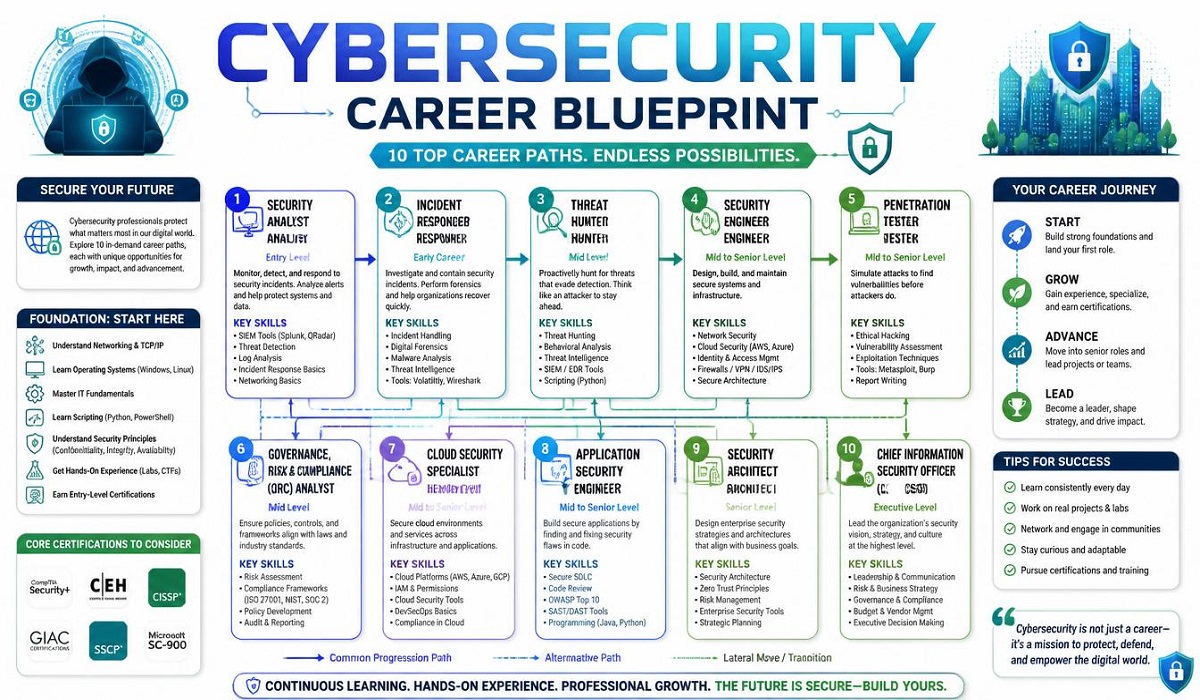
The Top 10 Cybersecurity Career Paths in 2026
Here are the most exciting and in-demand jobs you can pursue in cybersecurity right now. We’ve ranked them based on popularity, earning potential, and how important they are to companies.
1. Security Analyst (The First Line of Defense)
If you’re new to cybersecurity, this is one of the best places to start. A Security Analyst, often called a SOC (Security Operations Center) Analyst, is like a digital security guard . They constantly monitor a company’s networks for suspicious activity. When a potential threat is detected, they investigate it to see if it’s a false alarm or a real attack. If it’s real, they take the first steps to stop it and report the incident.
- What You’ll Do: Monitor security alerts, investigate phishing emails, analyze logs, and respond to incidents.
- Who It’s For: People who are good at paying attention to details, like solving puzzles, and can stay calm under pressure.
- Salary: In the U.S., you can expect to earn between $57,000 and $170,000 a year, depending on experience .
2. Ethical Hacker / Penetration Tester (The Good Guy Hacker)
Imagine getting paid to break into systems. That’s exactly what an Ethical Hacker, or Penetration Tester, does. Companies hire them to legally hack into their own systems to find weaknesses before real criminals can . They try to bypass security measures, exploit vulnerabilities, and then report their findings so the company can fix them.
- What You’ll Do: Run simulated attacks on networks and applications, test web security, and think like a criminal to find flaws.
- Who It’s For: Creative, out-of-the-box thinkers who love a challenge and are curious about how things work .
- Salary: Penetration testers are highly valued, with salaries ranging from $115,000 to $203,000 .
3. Cloud Security Engineer (The Cloud Protector)
More and more companies are moving their data and operations to the cloud (like Amazon Web Services, Microsoft Azure, and Google Cloud). This shift has made the role of a Cloud Security Engineer extremely hot . Their job is to secure cloud environments by setting up access controls, encrypting data, and monitoring for cloud-specific threats, like misconfigurations that could leave data exposed.
- What You’ll Do: Design secure cloud architectures, manage identity and access, and ensure data is protected in the cloud.
- Who It’s For: Tech-savvy individuals who love keeping up with the latest cloud technologies and services .
- Salary: Cloud Security Engineers have an average salary range of $149,000 to $242,000 per year, reflecting their high demand .
4. Security Architect (The Master Planner)
If you like the big picture, consider becoming a Security Architect. Instead of just finding and fixing vulnerabilities, these professionals design the entire security system from the ground up . They create security policies, plan disaster recovery, and guide the company’s long-term strategy. It’s a senior role that requires deep knowledge and experience.
- What You’ll Do: Design security frameworks, conduct threat modeling, review new technologies for security risks, and create security policies.
- Who It’s For: Strategic thinkers who can turn complex challenges into simple, elegant solutions .
- Salary: This is one of the highest-paying roles, with average salaries ranging from $177,000 to $286,000 per year .
5. Incident Responder (The Cyber Firefighter)
When a cyberattack happens, it’s panic time. That’s when Incident Responders step in. They are the “firefighters” of cybersecurity, rushing in to contain the damage, stop the attacker, and get systems back online . After the crisis is over, they investigate how the breach happened to prevent it from occurring again.
- What You’ll Do: Lead the response to a cyberattack, contain threats, analyze malware, and conduct post-incident investigations.
- Who It’s For: People who can stay calm and think clearly in a crisis, with excellent problem-solving skills .
- Salary: Cyber Incident Responders can earn between $78,000 and $184,000 annually .
6. Digital Forensics Analyst (The Cyber Detective)
Digital Forensics Analysts are like crime scene investigators, but for computers. They gather and analyze digital evidence from computers, phones, and networks to solve cybercrimes . They might be hired to investigate a data breach, track down a hacker, or recover deleted files for a legal case.
- What You’ll Do: Recover deleted data, analyze hard drives, follow digital trails to find evidence, and prepare reports for legal teams.
- Who It’s For: Detail-oriented individuals who are patient and have an investigative mindset.
- Salary: This is a specialized role, with salaries typically ranging from $80,000 to $185,000+.
7. Security Engineer (The System Builder)
Security Engineers are the builders of the cybersecurity world. While architects design the blueprint, engineers put it into action . They set up firewalls, install security software, and build security tools to protect the company’s systems. They work to automate security tasks and make the environment more difficult for attackers to penetrate.
- What You’ll Do: Install and configure security hardware and software, automate security processes, and integrate security into the company’s infrastructure.
- Who It’s For: Tech lovers who enjoy hands-on work building, configuring, and maintaining systems.
- Salary: Security Engineers earn a strong salary, with an average range of $128,000 to $202,000 .
8. AI/ML Security Specialist (The Future-Forward Defender)
As Artificial Intelligence (AI) becomes more powerful, it also becomes a target. AI/ML Security Specialists are experts at protecting AI and Machine Learning models from being tricked or hacked . They also use AI to create smarter security tools that can detect threats faster than traditional methods.
- What You’ll Do: Secure AI data pipelines, protect AI models from adversarial attacks, and develop AI-powered threat detection systems.
- Who It’s For: People with an interest in both cybersecurity and cutting-edge technology like AI and machine learning.
- Salary: This is a new and highly specialized field, commanding some of the top salaries, often exceeding $180,000.
9. GRC Specialist (The Policy Expert)
Governance, Risk, and Compliance (GRC) is for those who prefer a more strategic, business-focused role. GRC specialists make sure the company follows all the rules and regulations (like privacy laws) and manages its overall risk . They are the bridge between the technical security team and the company’s leadership, explaining risks in business terms.
- What You’ll Do: Write security policies, conduct risk assessments, ensure compliance with data privacy laws, and manage audits.
- Who It’s For: Excellent communicators who are good with documentation, policy, and risk assessment .
- Salary: GRC Analysts can make between $88,000 and $192,000 per year .
10. Cybercrime Investigator (The Law Enforcer)
This role is for those who want to take a stand against cybercrime at its source. Cybercrime Investigators often work for government agencies like the FBI or police departments . Their job is to track down cybercriminals, dismantle hacking rings, and help bring them to justice. It’s a career with a strong sense of purpose.
- What You’ll Do: Investigate major cybercrime cases, work with law enforcement, gather digital evidence for prosecution, and analyze criminal tactics.
- Who It’s For: Individuals passionate about justice and law, with a strong interest in computers and technology.
- Salary: Salaries for federal positions are highly competitive, often starting around $99,000 and going up from there .
Your Step-by-Step Educational Roadmap
So, you’ve found a career path that sounds exciting. How do you actually get there? Here is the step-by-step roadmap to build your skills and land your first job in 2026.
Step 1: Build a Strong Foundation
Before you can specialize, you need to understand the basics. A good foundation is like building a solid house—it makes everything else easier. You need to learn the fundamentals of technology:
- Networking: Understand how computers talk to each other. Learn concepts like IP addresses, routers, and firewalls.
- Operating Systems: Get comfortable with both Windows and Linux operating systems. Linux is particularly popular for cybersecurity professionals .
- IT Basics: Learn how computers work, how data is stored, and how hardware functions.
For complete beginners, there are excellent free and paid resources. For example, the CYBERWISER.eu Primer is a free introductory course funded by the European Union that covers basic concepts like phishing, ransomware, and password security . It’s a great zero-cost way to start.
Step 2: Get Formal Training (Degrees vs. Certifications)
Once you have a basic understanding, you need to deepen your knowledge. There are two main paths: getting a degree or earning certifications. Many successful professionals choose a mix of both.
Degree Programs
- Bachelor’s Degrees: A traditional 4-year degree in Cybersecurity, Computer Science, or Information Technology is a strong foundation. It provides you with a well-rounded education and is often required for management roles. In 2026, many universities are offering practice-oriented programs. For instance, the Indian Institutes of Technology (IIT) Madras and IIT Kanpur have launched a new Bachelor of Cybersecurity (B.Cyber.) program where students work on real-world projects for the final two years .
- Master’s Degrees: For those who want to advance, a Master’s degree can open doors to leadership and highly specialized technical roles. Universities like Curtin University in Australia offer a one-year Master of Cyber Security designed to upgrade your skillset with industry-inspired projects . Similarly, the European University Cyprus has an online Master’s in Cybersecurity that covers policy, risk management, and ethical hacking .
Certifications
Certifications are focused, shorter-term credentials that prove you have a specific skill. They are highly valued by employers and can be a faster path to a job .
- CompTIA Security+: This is considered the baseline cybersecurity certification for beginners. It covers core security concepts and is a great first step.
- Certified Ethical Hacker (CEH): This certification is well-known for anyone looking to become a penetration tester.
- Certified Information Systems Security Professional (CISSP): This is an advanced certification for experienced security professionals, such as security architects and managers.
- Cloud Certifications: For cloud security roles, look into AWS Certified Security or Microsoft Certified: Azure Security Engineer .
Step 3: Get Hands-On Experience
This is the most critical step. In cybersecurity, what you can do matters as much as what you know. Companies in 2026 are looking for practical skills .
- Set Up a Home Lab: This is one of the best and cheapest ways to get experience. You don’t need fancy equipment. You can use free software to create a simulated network on your own computer where you can practice your hacking and defending skills.
- Online Courses and Internships: Platforms like Coursera offer programs like the Cybersecurity Analyst Specialization where you learn to use real tools like SIEMs, perform ethical hacking, and detect threats . Look for internships or entry-level IT jobs to get real-world professional experience.
- Capture The Flag (CTF) Competitions: CTFs are competitions where you solve security-related puzzles and challenges. They are a fun and challenging way to test your skills against others.
Step 4: Choose Your Path
By now, you will have a good idea of what you enjoy most. Is it being on offense (Red Team), defense (Blue Team), or somewhere in between (Purple Team)?
- The Red Team focuses on attacking systems (Penetration Tester, Ethical Hacker) to find vulnerabilities .
- The Blue Team focuses on defending systems (Security Analyst, Incident Responder) to detect and stop attacks .
- The Purple Team combines both, working to improve the blue team’s defense by using the red team’s attack techniques. The industry is trending towards this hybrid approach .
If you are a complete beginner, the best place to start is in a SOC (Security Operations Center) role. It gives you frontline experience and a fantastic basis for moving into a more specialized field later .
FAQs About Starting a Career in Cybersecurity
1. Do I need a degree in computer science to get a cybersecurity job?
No, you don’t. While a degree is helpful and can open more doors, it’s not the only way in. Many employers value industry certifications like CompTIA Security+ and practical, hands-on experience more than a specific degree . Building a home lab, participating in CTF competitions, and completing online courses can give you the skills you need to get an entry-level job.
2. Is cybersecurity hard to learn?
It can be challenging, but it’s also very rewarding. It requires a willingness to learn new things and a problem-solving mindset. The good news is that there are many resources to help you start, and you don’t need to be a genius. You just need to be curious and persistent. You can begin with easy-to-understand concepts and then build your knowledge step by step.
3. What is the best cybersecurity job for a complete beginner?
The best job for a beginner is often a Security Analyst or SOC Analyst . These roles are designed to teach you the ropes of monitoring networks, identifying threats, and responding to incidents. They give you a strong foundation of knowledge that will help you move into more specialized and better-paying roles later.
4. How important are certifications?
Certifications are very important . They are a way to prove to employers that you have a specific set of knowledge and skills, even if you don’t have a degree. They are often considered a faster and more targeted way to build a career in cybersecurity. For many tech companies, a combination of relevant certifications and practical experience is more important than a formal degree.
5. Are cybersecurity jobs safe from AI automation?
Yes! In fact, AI is creating new jobs in the field, like the AI Security Specialist. While AI can automate some simple, repetitive tasks, cybersecurity requires human judgment, creativity, and critical thinking. Roles like incident response, threat hunting, and security architecture, which involve complex decision-making, are very difficult to automate . These jobs are not just safe; they are growing.
Summary: A Future-Proof Career Awaits
Cybersecurity in 2026 is not just a job—it’s a mission. It’s a field where you can make a real difference by protecting people, businesses, and even whole countries from digital harm. With millions of open positions, generous salaries, and a huge variety of roles to choose from, it is one of the most exciting and stable career paths in the world.
The journey starts with one step. Begin by learning the basics, get your hands dirty with some practical projects, and decide which of the many paths—like becoming an Ethical Hacker, a Cloud Security Engineer, or a Digital Forensics Analyst—speaks to you. By following the educational roadmap in this guide, you can build a fulfilling and future-proof career as a digital defender. Your future in cybersecurity starts now.