Education and Economic Productivity
Education and Economic Productivity: Imagine two countries. One has a lot of natural resources like oil, gold, and fertile land. The other has very few natural resources; it’s small and has a tough climate. Which country do you think will be richer and more successful? If you guessed the one with natural resources, you’d be wrong in many cases.
What if I told you that a country’s most powerful economic superpower isn’t oil, gold, or even land? It’s the brains and skills of its people. This is called human capital, and it is the true engine of economic growth.
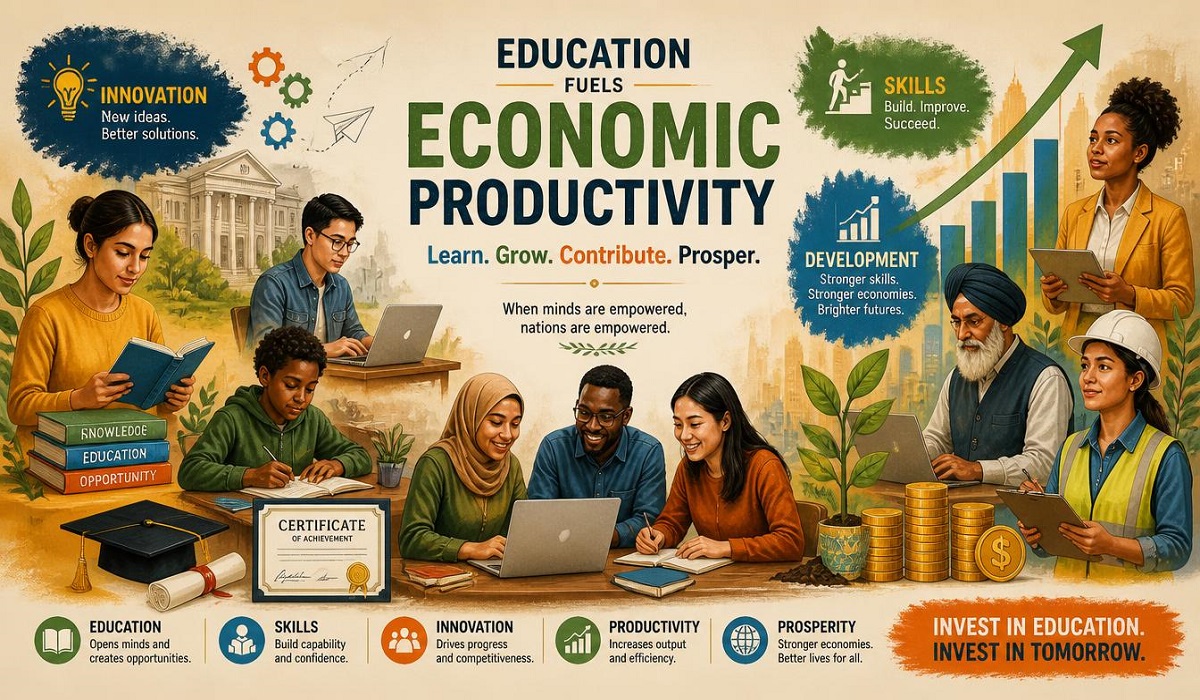
When people are educated and have good skills, they are more productive at their jobs. They can invent new things, solve problems, and run businesses better. This direct link between how well a country educates its people and how productive and wealthy its economy is, is a powerful concept known as Education and Economic Productivity. It’s a global rule of thumb that the smartest countries are often the wealthiest.
One extra year of schooling can boost a person’s income by nearly 10% . That means more money for the individual to spend, save, and invest, which in turn helps the whole economy grow. In fact, better education has helped reduce global poverty by 40% since 1980 . This article will break down, in simple and easy-to-understand language, exactly how education and economic productivity are linked, why it matters for everyone, and what countries can do to make it work.
What is Economic Productivity, Really?
Before we go further, let’s make sure we understand what “productivity” means. It’s a word economists love, but it’s not as complicated as it sounds.
Productivity is Working Smarter, Not Harder
At its most basic, productivity is a measure of how much output you get from a certain input. In an economy, it’s about how much stuff you can produce with the time and resources you have. Think of a baker. If they can bake 50 loaves of bread in an hour, they are more productive than a baker who can only bake 20 loaves in an hour. They are working smarter, not just harder.
For a whole country, productivity is the key to a better standard of living. A country’s total output is called its Gross Domestic Product, or GDP. When productivity goes up, GDP goes up. This means there is more wealth in the country to pay for better roads, hospitals, and schools.
The Workforce is the Engine
The workforce is the engine of this productivity. But not just any workforce—a skilled, educated workforce. A country with many people who can only do simple, manual jobs will be less productive than a country with a workforce of engineers, doctors, and tech entrepreneurs. An uneducated person might build a table with basic tools. An educated person might design a machine that builds 100 tables in the same time. That is the power of education. This is why the connection between Education and Economic Productivity is so important for any country’s long-term success.
The Direct Link: How Education Boosts Productivity?
So, how exactly does learning make an economy more productive? Let’s look at the direct ways.
Building the Human Capital Stock
Think of “human capital” as the collective knowledge, skills, and health of a country’s people . It’s like a big bank account, but instead of money, it’s filled with skills and brainpower. When you invest in education, you are adding more deposits to this human capital account. A larger, higher-quality human capital stock directly leads to higher economic productivity . Companies can’t operate and innovate without skilled workers. This is the core of the Education and Economic Productivity relationship.
More Innovation and Technological Progress
Imagine a world without smartphones, the internet, or modern medicine. Where do these things come from? They are the result of innovation, and innovation comes from educated minds. People who understand math, science, and engineering are the ones who invent new technologies. These new technologies make all of us more productive. A new farming tool invented by an agricultural scientist can help a farmer grow more food than ever before. A new computer program invented by a software engineer can help a business manage its work faster.
Attracting Foreign Investment
When multinational companies decide where to build their factories or offices, they do their homework. They look for a country with a skilled workforce. They don’t want to set up shop in a country where they can’t find enough people who can operate advanced machinery, speak their language, or manage complex projects. A country with strong education and high economic productivity is a magnet for foreign investment, which brings more jobs and money into the country.
Reducing Poverty and Inequality
Education is a powerful tool for breaking the cycle of poverty. It provides people with the skills they need to get better-paying jobs and escape low-skill, low-wage work . When more people have access to quality education, the wealth of a nation is shared more widely. This leads to a more stable and prosperous society, where everyone can contribute to the economy. In fact, it’s not just about fairness; research shows that reducing income inequality itself boosts productivity and economic growth .
The Role of Early Childhood Education
If education is an investment, the best time to start is as early as possible.
Brain Building Before Age Five
The human brain develops faster in the first five years of life than at any other time. This is when children build the foundational cognitive, social, and emotional skills they’ll use for the rest of their lives. Investing in high-quality early childhood education and care (ECEC) is one of the smartest things a country can do.
Huge Returns for Disadvantaged Children
Participation in early childhood programs is particularly important for children from disadvantaged backgrounds. It helps level the playing field, ensuring that all kids start school ready to learn. This “head start” has a massive impact later in life .
The OECD Study: A 2.9% Productivity Gain
Research by the OECD has shown that if countries with low participation in early childhood education could raise it to a 90% coverage rate, they could gain huge long-run productivity boosts. For example, Turkey could see a gain of up to 2.9% in its long-run productivity, Switzerland up to 1.8%, and the United States could benefit by about 1.5% . This shows that the foundation of the Education and Economic Productivity link starts before a child even enters primary school.
Education Spending: Is It Worth the Money?
Some people might say, “Education is expensive! Can we really afford to spend so much on schools?” The real question is: can we afford not to?
An Investment, Not a Cost
Think of education as an investment, not just a cost. When you buy a new machine for a factory, you think of it as an investment that will pay for itself over time by producing more goods. The same is true for education. The money spent on a child’s schooling isn’t gone—it’s an investment that will pay back many times over through their future work and contributions to the economy.
The 15-20% Return Rate
A major international study by ZEW Mannheim and the World Inequality Lab found that investing in public education yields an average annual return on productivity of around 10%. For some countries, particularly poorer ones, the returns can be as high as 15 to 20% . That is an incredible return on investment. Few other public spending programs can guarantee such high returns.
The High Cost of Not Investing
The flip side of this is the enormous cost of failing to invest in education. Today, 272 million children and youth are out of school. The cost to the global economy is estimated at a staggering $10 trillion per year . This is money lost in future wages, innovation, and economic growth. When a country neglects its education system, it is essentially choosing to stay poor.
Skills Mismatch: Why Just Going to School Isn’t Enough?
Going to school is a great start, but it’s not always a guarantee of a good job and a productive economy. This is because of a problem called “skills mismatch.”
The Skills Gap in the Modern Economy
A “skills mismatch” happens when the skills people learn in school don’t match the skills employers need. The world is changing so fast. New technologies like Artificial Intelligence and automation are constantly reshaping the job market. Many of the jobs that will be in demand in 10 years don’t even exist today .
The Need for Critical Thinking and Problem-Solving
This is why modern education can’t just be about memorizing facts for a test. It needs to focus on teaching skills that are harder for machines to replace: critical thinking, problem-solving, creativity, communication, and socio-emotional skills . These “21st-century skills” help people adapt to change and learn new things throughout their lives.
Aligning Curricula with the Job Market
Governments and schools need to work with businesses to understand what skills the future labor market will need. This means updating school and university curricula so that they are relevant and practical. For example, aligning tertiary education with labor market needs helps ensure that graduates don’t leave university only to find that there are no jobs available for their area of study . By closing this skills gap, a country can maximize the positive impact of Education on Economic Productivity.
How Top Countries Are Getting It Right?
So, what does success look like? Let’s look at two examples of countries that have used education as a powerful engine of economic growth.
Malaysia’s Economic Survey
Malaysia is a great example. The country has experienced strong and resilient economic growth in recent years. The OECD has praised Malaysia’s progress and suggests that to sustain this growth, they need to boost productivity and improve education. Their strategy includes focusing on reforms at all levels of education, from free preschool to improving teacher performance and aligning university courses with what employers actually need . This shows a top-down national commitment to the link between Education and Economic Productivity.
Vietnam’s Success Story
Vietnam is one of the most remarkable success stories of the last few decades. Its economy has grown at an incredible rate of 6–7% annually. How did they do it? One of the biggest factors was a sustained investment in education. By creating a pipeline of skilled workers, Vietnam was able to attract foreign investment and build a productive workforce that fuels innovation and growth . This transformation demonstrates that with the right strategy, any country can use education to drive economic transformation .
Pakistan’s Path Forward: The Missing Link
The case for education is so strong that many countries are putting it at the center of their national economic plans.
Pakistan’s Vision 2025
Pakistan has recognized that its economic future depends on its people. The country has a very young population, which is a huge opportunity. Pakistan’s “Vision 2025” and its newer development plan, “URAAN Pakistan,” both identify human and social development as central to sustained economic growth .
The Challenge: Enrollment, Quality, and Gender Gaps
However, Pakistan faces serious challenges. There are many children out of school, and the quality of education is inconsistent. There are also significant gaps in learning between boys and girls and between different regions. The plan “URAAN Pakistan” aims to tackle these issues, but success will require a massive and sustained effort . The potential payoff is enormous.
The Workforce Needed for Future Exports
Pakistan’s traditional exports are things like textiles. To move forward, Pakistan must move up the value chain. Instead of just exporting raw cotton, it needs to build the skills to export high-quality finished garments, IT services, and advanced agricultural products. This requires a workforce trained in digital and STEM skills, quality control, and advanced agronomy. As Pakistan Today reported, “Pakistan cannot achieve a competitive edge based on low-skill, low-value production” . The future economy must be powered by skilled, educated people.
A Simple Guide for Parents and Students
At this point, you might be asking, “What does this mean for me and my family?” Here is a simple guide to understanding your role in the Education and Economic Productivity cycle.
Education as a Generational Investment
- Start Early: The foundation of success is built in early childhood. If you have young children, talk to them, read to them, and help them explore the world.
- Stay in School: The longer you stay in school, the more you will learn, and the more you will earn over your lifetime. Don’t drop out.
- Focus on Quality: It’s not just about attendance. Focus on really learning. Understand the “why” behind things, not just memorizing facts.
- Learn Practical Skills: Try to connect what you learn in school to the real world. If you are learning math, think about how it’s used in business, design, or computer programming.
- Develop Soft Skills: Make sure you are building skills like teamwork, communication, and the ability to solve problems. These are what employers value most.
- Lifelong Learning: The learning doesn’t stop when you leave school or university. The world changes fast, and you need to keep learning new skills to stay relevant. This is often called “lifelong learning” .
Conclusion: The Smartest Investment a Country Can Make
The evidence is clear and overwhelming: education is not just a good thing to have; it is the single smartest investment a country can make to secure a prosperous, productive, and equitable future. The link between Education and Economic Productivity is undeniable.
Investing in education creates a virtuous cycle: better education leads to a more skilled workforce, which leads to higher productivity and more innovation. This attracts investment, creates better jobs, and reduces poverty. This, in turn, generates more tax revenue, which can be reinvested in education, creating an even smarter workforce for the next generation.
For every child that is educated, a nation is building its future economic strength. For every teacher that inspires a student, a country is creating the innovators, thinkers, and leaders of tomorrow. As the World Bank and the OECD show, countries that invest in their people are the ones that thrive in the 21st century.
It’s time to see education not as an expense, but as the most powerful engine of human progress and economic prosperity. The future will not be built by a country with the most oil; it will be built by the one with the most brains.
Frequently Asked Questions (FAQs)
1. What is the simple link between education and economic productivity?
The link is simple: educated people are more skilled and can do their jobs better, faster, and more efficiently. They also invent new things and solve problems, which helps the whole economy grow. More education leads to a more productive workforce and a wealthier country.
2. How does poverty affect a child’s ability to learn?
Poverty creates huge barriers to learning. A child who is hungry or has to work to support their family will find it much harder to focus in school. They often lack learning resources at home, like books or internet access. That’s why programs like free school meals and targeted support for disadvantaged students are crucial. Addressing poverty and inequality is a major part of the Education and Economic Productivity story .
3. Why is early childhood education so important for the economy?
The human brain develops most rapidly in the first five years of life. Early childhood education builds the foundational social, emotional, and cognitive skills children need to succeed. Studies show that investments in early education provide huge returns in future productivity and reduce inequality by giving every child a fair start .
4. What is a “skills mismatch” and why is it bad for the economy?
A skills mismatch happens when the skills people learn in school don’t match the skills that employers actually need. This means many people struggle to find good jobs, and businesses can’t find the skilled workers they need to be productive. Wasting this talent is a huge drag on economic growth.
5. Is it really a good return on investment to spend money on education?
Absolutely. While it costs money to build schools and pay teachers, the economic returns are huge. Studies show that the return on public education spending can be 10%, 15%, or even 20% per year . This is much higher than the return on many other types of investments, making it the best investment a country can make for its future.
Summary
This article explains the powerful link between Education and Economic Productivity. It shows that investing in schools and training is the best way to build a skilled, innovative workforce. This leads to higher productivity, more jobs, less poverty, and a richer, more stable country. It covers everything from why preschool matters to how countries like Vietnam and Malaysia are using education to transform their economies, and it offers clear takeaways for families and nations.