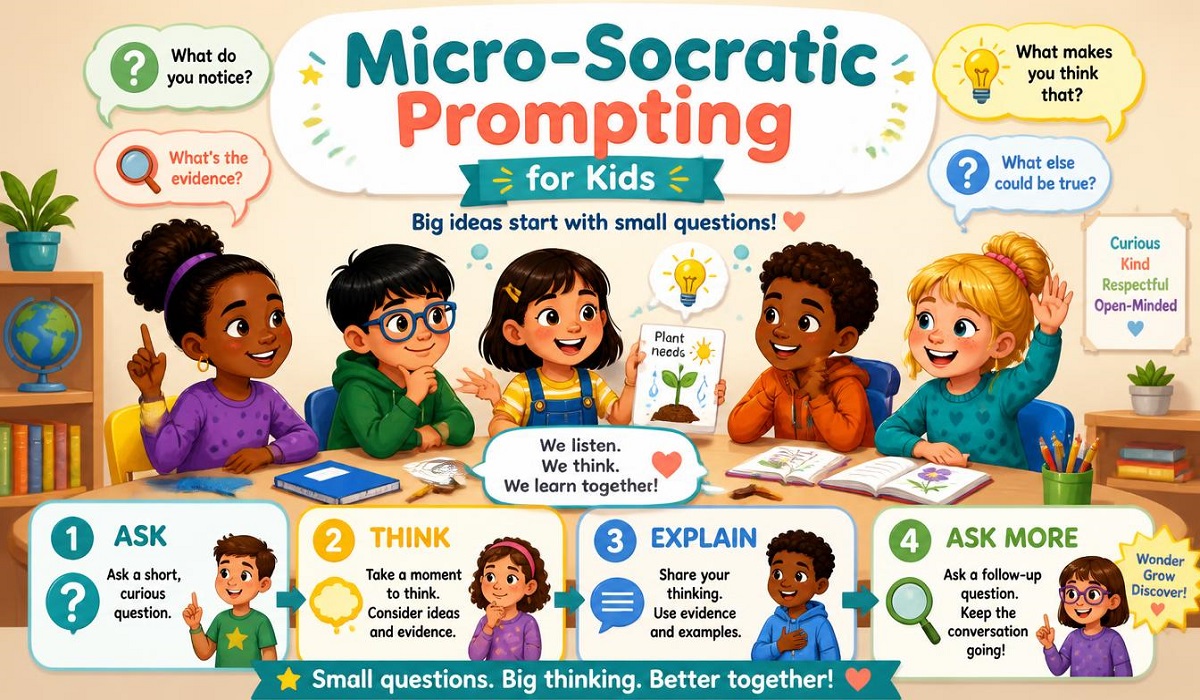
Micro-Socratic Prompting for Kids
Micro-Socratic Prompting for Kids: Have you ever asked a youngster a question and gotten a blank look in return? You know the sensation. “You ask them, ‘What did you learn in school today?’ and they say, ‘Nothing.’ It’s frustrating, isn’t it?
Now imagine inverting that situation. You offer a question that opens a door instead of shutting down the conversation. That’s the power of Micro-Socratic Prompting for kids.
This strategy is not difficult. You don’t need to have a degree in philosophy. It only asks brief, targeted questions to let kids think for themselves. This strategy was utilized thousands of years ago by the ancient Greek philosopher Socrates. He raised questions that made individuals evaluate their own ideas. Today, parents and teachers may use the same approach in little, everyday situations.
This tutorial will take you through all you need to know. We’ll examine what Micro-Socratic Prompting for Kids is, why it works, and how you can start to use it immediately. Whether you’re a parent, a teacher, or a caregiver, this strategy will revolutionize the way you communicate to children. Get ready to inspire curiosity and improve life-long thinking skills.
What Is Micro-Socratic Prompting for Kids?
Let’s unpack the sentence. “Micro” indicates tiny or short. “Socratic” refers to the approach of inquiry employed by Socrates. To prompt is to give a cue or nudge. All of this adds up to Micro-Socratic Prompting for Kids, the art of guiding youngsters to their own solutions by utilizing brief, deliberate questions.
This is not a lecture. It is not to provide information. Rather, it is about encouraging a youngster to find concepts for themselves. The adult is a guide, not a teacher with all the answers.
Let’s put it this way. A youngster confesses, “I am bad at math.” The usual reaction would be “No, you are not. You just need to practice.” That is comforting, but it does not assist the child think. A Micro-Socratic prompt would be, “What makes you feel that way?” or “Can you tell me about a time math felt hard?” These kind of inquiries encourage the youngster to reflect about their own thinking.
The Birth of Socratic Method
Socrates was an ancient Greek man. Books he did not write. He wandered across Athens, asking people questions. “Generals,” he said, “what is courage?” He asked politicians: what is justice. In these dialogs he proved that many people did not properly comprehend their own convictions.
His technique is based on one basic idea: the truth dwells within each person. A good inquiry can help a person locate it. This is a good concept for youngsters. They are not empty vessels to be filled. They are intellectuals, thinkers who can ponder and reflect.
Why Micro Is Important?
Traditional Socratic dialogs can be lengthy and passionate. They are suitable for adults in a university environment. But kids have short attention spans. They require fast, fun interactions. That’s where the “micro” element comes in.
It takes a few seconds to do a Micro-Socratic prompt. You may use it while driving, cooking, walking. You do not require a unique lesson plan. And you only need a keen mind and a willingness to inquire.
For example, your youngster says, “That movie was boring.” You may add, “What would have made it more exciting?” That is a micro-prompt. It takes five seconds. Yet it allows your youngster to study and imagine.
The fundamental principles
Micro-Socratic Prompting for Kids is based on a few simple beliefs:
- Kids can think profoundly. They are not too young to argue with.
- Answers are weak; questions are strong. A good inquiry starts a trip.
- The aim is comprehension, not victory. It’s not about being correct. It’s about ideas.
- “Little moments count. You don’t need to have hour-long chats. Short conversations become into routines over time.
These principles govern all interactions. When you accept them, you make everyday discussions chances for development.
The Science of Micro-Socratic Prompting for Children
You may be wondering if this strategy is evidence based. The answer is Yes . Scientists studying learning and brain development have identified actual benefits from questioning strategies such as Micro-Socratic Prompting for Kids.
How the Brain Answers Questions?
When you pose a question to a youngster, their brain starts working. It looks for links, it brings recollections. It generates fresh thoughts. This procedure enhances the neuronal circuits. Basically, asking questions makes the brain more powerful.
In contrast, passive listening does virtually little. When children learn knowledge, their brains do not have to work hard. They will remember it for a test, but they won’t comprehend it.
Micro-Socratic stimuli urge the brain to work. This creates what experts term a “desirable difficulty.” It’s hard enough to encourage learning, but not so hard that you get frustrated.
The Function of Metacognition
Metacognition is knowing about knowing. It is a fancy name for a really simple concept. When a youngster answers a question such, “How did you know that?” they are engaging in metacognition. They’re becoming conscious of their own cognitive process.
Studies demonstrate that students with good metacognitive skills fare better in school. They are better at planning, monitoring and reviewing their job. Micro-Socratic Prompting for Kids is a natural technique to develop these abilities.
Language Growth
Questions also help improve linguistic abilities. If you ask a youngster to express his ideas, he has to find the correct words. They try putting their thoughts in order They acquire new vocabulary. As time passes they learn to communicate thoughts.
This is especially true with young children. They have sponge-like minds. Every discussion is an opportunity to learn. Thought-provoking questions provide students meaningful linguistic experiences.
Benefits to Emotions
Micro-Socratic Prompting for Kids is also helpful for emotional development. To ask a youngster for his or her opinion is to indicate that you care about what the child thinks. This increases confidence and self-esteem. It also improves your connection. The child feels heard and valued.
It also helps youngsters to regulate emotions. If a youngster is sad, you might ask, “What made you feel that way?” or “What would help you feel better?” These inquiries help children work through their feelings. They learn to give feelings a name and discover answers.
The reason every parent and teacher should use Micro-Socratic prompting with kids
We know the science, so let’s explore the practical benefits. What are the benefits of Micro-Socratic Prompting for Kids in your everyday life? Here’s why:
It Develops Critical Thinking Skills
Critical thinking is the capacity to examine, assess and make decisions. It is among the most critical abilities for success in life. But many schools don’t teach it explicitly.
Micro-Socratic prompts fill this void. When you ask “Why do you think that is true?” or “What evidence do you have?” you are teaching critical thinking. You’re raising your youngster to challenge assumptions and to seek proof.
Say a youngster states, “Everyone at school has a phone.” A micro-prompt would be, “Is that really everyone? How could we find out?” This pushes them to look at the assertion. They understand that assertions are not necessarily facts.
It Promotes Independence
Kids who learn by asking questions become autonomous thinkers. They don’t have to ask other people for answers. They trust they will work it out.
This freedom continues until maturity. Adults prompted to think on their own become better problem solvers. They have greater creativity. They are less inclined to follow the herd.
It improves the communication
Micro-Socratic Prompting for Kids enhances two-way communication. Children learn to speak articulately. Parents learn to listen more intently. And that is what a stronger relationship delivers.
Asking questions is a way to show you are interested. You are not just waiting for your chance to speak. You are really interested in what your youngster thinks. This fosters trust and transparency.
It Makes Learning Fun!
Old-fashioned teaching can be a chore. “Sit. Listen. Memorize.” Micro-Socratic prompts seem like fun. These are games of the mind. Children like the challenge of working things out.
This entertaining factor keeps kids interested. They want to know more. They pose their own inquiries. Learning is a passion for life.
It Gets Children Ready For The Future
The world is changing quickly. Some jobs that are here today may not be here tomorrow. What helps youngsters succeed? Ability to think, adapt and solve issues. Micro-Socratic Prompting for Kids trains just these abilities.
Questions help your child prepare for a future that requires more than answers. They will have to learn the appropriate questions . They’ll have to be on their toes. This strategy provides them with the tools.
How to Start Micro-Socratic Prompting for Kids Today?
You don’t need particular training to start. No pricey materials needed. It just requires the desire to ask and listen. This is a step-by-step tutorial to get you started.
Step 1: Get Small
Don’t attempt to alter all the conversations at once. Choose one moment every day. Time for dinner, maybe. Time for bed, maybe. Maybe it’s the drive to school.
At that point, ask one intelligent inquiry. Stay simple. For instance:
- “What was the best part of your day?”
- “Why do you think it happened?”
- “How did that feel?
These little inquiries plant seeds. They develop into more profound talks over time.
2: Hear without judging
The most critical element of Micro-Socratic Prompting for Kids is listening. When your youngster responds don’t interrupt. Do not edit. Don’t judge. Just listen.
You may nod your head, or say, “I see.” You can ask questions to follow up such, “Tell me more.” The idea is that you establish a secure environment for your child to feel free to communicate.
3: Ask open ended questions
Closed questions are one word replies. “How was your day?” invites “Yes” or “No.” Open-ended inquiries elicit lengthy replies. They begin with words like “what,” “how,” “why,” or “tell me about.
Here are several instances :
- “What made you smile today?”
- “How did you solve that problem?”
- “Why do you think that character did that?”
- “Tell me about something you learnt.
These questions invite a more in-depth discussion.
4: Follow the child’s lead
Micro-Socratic Prompting for Kids is not about you taking over the discussion. It’s about following your child’s interests. If they want to discuss about dinosaurs inquire about dinosaurs. If they wanna chat about video games, talk to them about video games.
They feel appreciated when you care about their world. They are more likely to participate. Learning is a natural process.
Step 5: Now wait
Change doesn’t happen overnight. Your youngster may not be accustomed to being questioned. In the beginning, they could provide brief responses. That’s all right. Keep asking questions. Stay tuned. They’ll open up eventually.
Remember, you’re not looking for the “right” response. The point is to make you think. Even a simple “I don’t know” might be a good beginning point. You may say, ‘That’s OK. What can we do to find out?’
Micro-Socratic Prompting for Kids in Action Examples
Here are some real world examples: In these examples we demonstrate how Micro-Socratic Prompting for Kids works in diverse contexts.
Example 1 The Bedtime Conversation
- Child “I don’t want to go school tomorrow.”
- Traditional Response: “You gotta go. Everybody’s gotta go.”
- Micro-Socratic Response: “What makes you feel that way?”
- Child: “I don’t like my teacher.
- Micro-Socratic Response: “What do you dislike about your teacher?
- Child: “She always tells us what to do.
- Micro-Socratic Response: “What else do you want her to do?”
This conversation might continue. The child could remark they desire more leisure time. You could say, “How can you ask for that?” The youngster learns to see issues and think about solutions.
2. Homework Difficulty
- Kid: “This maths problem is impossible.
- Traditional Response: “Not impossible. Just try harder.
- Micro-Socratic Response: “What’s impossible about that?”
- Child: “I don’t know how to start.
- Micro-Socratic Response: “First thing you notice about the problem?”
- Child: “There is a plus sign and 2 digits.”
- Micro-Socratic Response: What could you do with that data?
The youngster slowly begins to break the difficulty down. They make their own path. They have the satisfaction of having done so.
3: The Ethical Dilemma
- Child: “My friend told the teacher a lie.”
- Traditional Response: “Lying is bad. Go tell the teacher.”
- Micro-Socratic Response: “How did you feel when that happened?”
- Child: I felt strange.
- Micro-Socratic Response: “Why do you think you felt strange?”
- Child: “Cause I know lying is a bad thing.
- Micro-Socratic Response: “What do you think your friend ought to do?”
- Child: “Tell the truth, maybe?”
- Micro-Socratic Response: “If you were your friend, what would you do?
This discourse helps examine values in the youngster. They are not just instructed what is proper. They find it out on their own.
4: The Creative Project
- Child: “I have to make a drawing for school but I don’t know what to draw.”
- Standard reply: Paint a landscape. Easy.
- Micro-Socratic Response: “What do you like to think about?”
- Child: “The space.
- Micro-Socratic Response: “What do you like best about space?”
- “The stars,” the child said.
- Micro-Socratic Response: “What would a star look like if you could touch it?”
The child’s imagination is soaring. They begin to sketch. The project takes on a personal meaning.
Example 5. The Sibling Feud
- Child: “My brother took my toy.”
- Standard Reply: “Share. He is your brother.”
- Micro‐Socratic Response: “And what was your feeling about that?”
- Child: “Angry.”
- Micro-Socratic Reply: “What do you want him to do?”
- Child: “Ask me first.”
- Micro-Socratic Response: “How did you know you could say it to him?
- Child: “I could say, ‘Please ask first before you take my things.
- Micro-Socratic Response: “What if he doesn’t listen?”
- Child: “I could get help from an adult.
This is teaching conflict resolution skills. The youngster learns to articulate feelings and to find answers.
Common Errors to Avoid
Micro-Socratic Prompting for Kids is a wonderful tool, but it’s simple to go wrong. Here are some frequent dangers and ways to prevent them.
Mistake #1: Asking Too Many Questions
If you ask question after question, your youngster will feel like he is being probed. They’re going to shut down. The answer is balance. Ask a question. Hear. Let the conversation breathe. “You don’t have to fill the silence.”
2: Helping the Child Arrive to the Answer
It’s not about steering your youngster to the ‘right’ answer. The idea is to get them thinking. If you say, “Do not you think it would be better to share?” you are not actually asking. You’re telling me. Do you think you could tell me what this is about?
Error 3: Evaluating the answer
If your child answers in a way you don’t agree with, don’t criticize. Rather, ask what they mean. That’s interesting. Why do you think that?” This keeps the conversation safe and open.
4: Not Listening
Asking questions is the other half of the deal. The other half is listening. If you ask a question and then look at your phone, you’re sending the wrong signal. Pay attention. Let your child know that their thoughts matter.
Mistake 5: Quitting Too Early
Some kids take time to warm up. They may not be accustomed to being questioned. Be patient. Keep asking. Keep listening. Over time, they will respond.
Micro-Socratic Prompting for Kids in the Classroom
Micro-Socratic Prompting for Kids: Teachers can also use Micro-Socratic Prompting for Kids. It works in any subject and any grade level. Here is how.
In Reading Class
- Instead of asking, “What happened in the story?” try:
- “Why do you think the character made that choice?”
- “How would you feel if you were in that situation?”
- “What do you think will happen next? Why?”
- These questions foster comprehension and empathy.
Science Class
- Instead of asking, “What is the definition of gravity?” try:
- “What do you notice about how things fall?”
- “Why do you think that happens?”
- “How could we test that idea?”
These questions encourage curiosity and scientific thinking.
Math Class
- Instead of asking, “What is the answer?” try:
- “How did you figure that out?”
- “Is there another way to solve this?”
- “What happens if we change this number?”
These questions help develop problem-solving abilities.
Social Studies
- Rather than asking, “When did the war end?” try:
- “What do you believe began the war?
- What do you imagine they were feeling then?
- What might have stopped it?
These questions foster historical thinking and empathy.
Art Class.
- Instead of asking, “What did you draw?” try:
- “What prompted you to do this?”
- “How did you pick your colors?”
- What do you want people to feel when they see this?”
These questions help with creativity and self-expression.
Creating a Culture of Questioning at Home
Micro-Socratic Prompting for Kids is most effective when it becomes a habit. Here are some ideas to help you establish a culture of inquiry in your family.
Create a “Question of the Day”
Write a question each day on a whiteboard or piece of paper. It may be funny or it could be serious. For instance:
- “What superpower would you choose if you could have any? Why?
- What are you thankful for today?
- “Who is the one person, in all history, you’d most like to meet?”
Talk about the question during supper or sleep. This simple practice develops family bonding and cognitive abilities.
Curious model
Children learn by seeing. If you want people to be intrigued, act curious.” Say your questions aloud. “I wonder why the sky is blue.” “I wonder how this machine works.” Let them witness you exploring and learning.
Prompt Questions
If your youngster asks you a question, don’t immediately offer them the answer. Turn it around. That’s a terrific question. What do you think?” This shows them their questions are important. It also teaches children how to think on their own.
Celebrate Thinking
Praise your youngster for thinking, not for being correct. I liked how you expressed your concept.” “That was a great solution to tackle that problem.” This stresses the worth of the process, not the product.
Have Fun
Questioning doesn’t have to be a major matter. Turn it into a game. “There’s something that starts with the letter B. Can you figure out what it is?” “What would your pet say if animals could talk?” Fun questions keep kids interested and thrilled.
The Long-Term Effects of Micro-Socratic Prompting on Children
Use Micro-Socratic Prompting for Kids regularly and you will see: The benefits build up over time. What to expect.
Critical Thinking More
When we ask insightful questions of children we make them better thinkers. They learn to think, assess and analyze. They do not believe concepts on faith. And they ask questions and look for evidence.
Enhanced Communication Skills
These youngsters are taught to express themselves clearly. They can speak their mind, they can hear each other. They can have significant talks.
Higher Confidence
Children are confident when they feel heard and acknowledged. They feel they can work it out. They are not frightened to attempt new things.
Deeper Relationships
Micro-Socratic Prompting for Kids develops connection. You demonstrate love and respect by asking questions and listening. Your youngster feels heard and understood. The relationship between you strengthens.
A Life-Long Love of Learning
Children learn by asking questions and that is how they develop a passion of learning. They wonder about the world, they are seeking fresh knowledge. They are still growing.
Micro-Socratic Prompting for Kids: Frequently Asked Questions
What’s the optimal age to start Micro-Socratic Prompting for Kids?
You can begin as early as preschool. Even young toddlers may respond to simple inquiries like “What do you think?” or “How does that make you feel?” The questions should be age-appropriate. For toddlers, stay really simple. For older children, you may ask harder questions.
How is this different than simply asking my kid questions?
Micro-Socratic Prompting for Kids is different in its purpose. You are not quizzing your child with questions. Your ask is to help them think. It’s not the answer. It’s the process. You’re helping them to find the ideas themselves.
What if my child refuses to answer?
That is fine. Don’t push it. Some children take a while to warm up. The atmosphere is relaxed. Ask questions playfully. If they still do not want to answer, let it go. Try again another time. The aim is connection, not conformity.
Can I use this strategy with teenagers?
Absolutely. Teenagers gain substantially from Micro-Socratic Prompting for Kids. They are forming their own personalities and beliefs. Asking insightful questions helps people explore their views. It also maintains the channels of communication open during a period when many kids draw away.
How often should I utilize Micro-Socratic Prompting for Kids?
You may use it every day. Even one or two inquiries a day can make a difference. The key is consistency. Develop this habit. Over time it will come up naturally in your talks.
Summary: Micro-Socratic Prompting for Kids
Micro-Socratic Prompting for Kids is an easy and powerful technique. It asks brief, insightful questions that inspire youngsters to think for themselves. This technique improves critical thinking, communication skills and confidence. It also builds relationships and a passion of learning.”
No specific training or resources necessary. You have to be prepared to ask and listen. Begin with little steps. Ask one question per day. Take your cues from your youngster. Have patience. The advantages will show themselves in time.
Whether you are a parent, teacher or caregiver, this technique can change the way you engage with children. It transforms simple moments into opportunity for growth. It helps youngsters grow to be curious, autonomous thinkers ready for the future.
So the next time you’re talking to a youngster, consider asking a question instead of offering an answer. You might be shocked with what you uncover. This is the power of Micro-Socratic Prompting for Kids. Use it wisely.