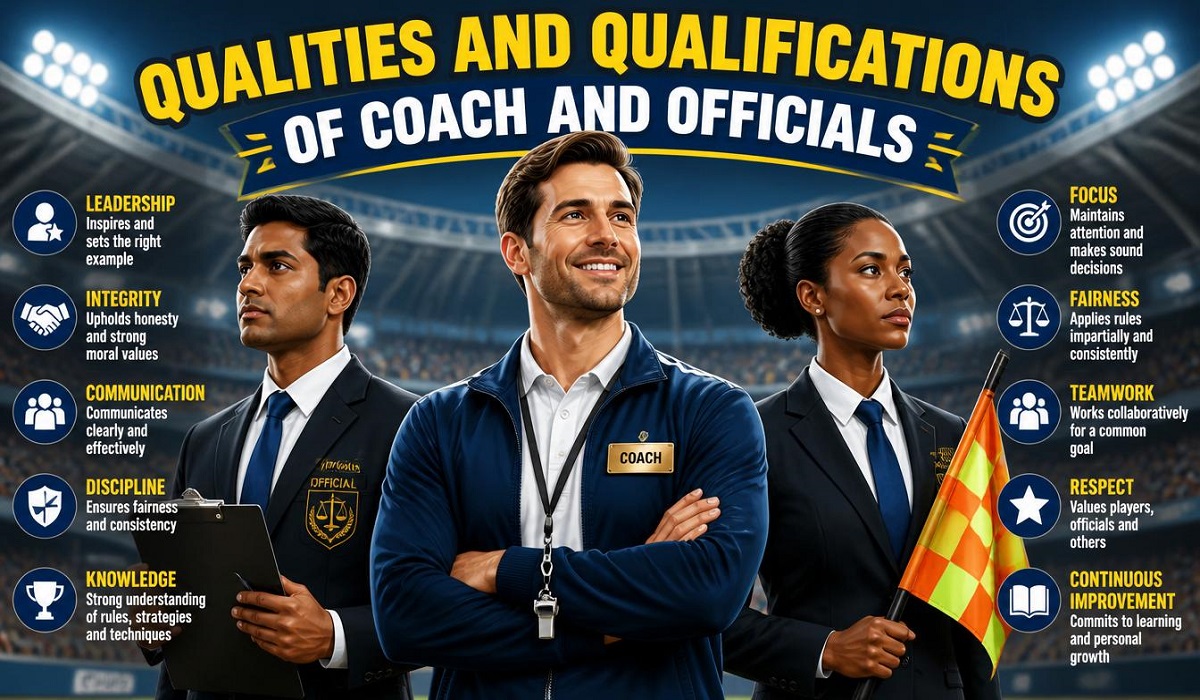
Qualities and Qualifications of Coach
Qualities and Qualifications of Coach: Sports are a massive part of our world. They bring people together, teach valuable life lessons, and showcase incredible human achievement. At the heart of every game, whether it’s a local youth soccer match or the World Cup, are two essential groups of people: the coaches and the officials.
Think about your favorite sports memory. Maybe it is a last-second goal, a game-winning play, or a perfect penalty call. Behind that memory, a coach likely crafted the winning strategy, and an official worked to ensure the game was fair and safe. The qualities and qualifications of coach and official staff are the backbone of organized sports.
These roles are often misunderstood. Many people think a coach is just someone who yells instructions, and an official is just someone who blows a whistle. But in reality, both positions require a specific blend of knowledge, skill, and personal character. They must be leaders, teachers, rule-enforcers, and motivators all rolled into one.
This article will serve as a complete guide. We will explore the journey to becoming a coach and an official. We will look at the official certifications needed, the “people skills” required, and how these roles are changing in the modern sports world. By the end, you will have a clear understanding of what it truly takes to be the person with the clipboard or the whistle.
What is the Role of a Sports Coach?
A sports coach is much more than a team manager or a cheerleader. A coach is a teacher, a mentor, and a strategist. Their main goal is to help athletes and teams reach their full potential. This can mean winning games, but at its core, good coaching is about helping people improve.
According to career guides, a coach’s tasks are varied. They “coaches teams or individuals by demonstrating techniques and directing training and exercise sessions.” But it goes much deeper. Coaches are responsible for:
- Skill Development: Teaching the fundamental skills of the sport, from proper throwing technique to complex tactical plays. They analyze players’ performances to find areas for improvement .
- Strategic Planning: Developing game plans and strategies to outmaneuver opponents. This includes studying the opposition and deciding on formations and tactics .
- Team Management: Building a strong team culture. This involves managing player discipline, recruiting new talent, and working with other staff like physiotherapists .
- Safety and Administration: Ensuring the training environment is safe and that equipment is in good condition. They also handle administrative tasks like arranging travel and accommodation for matches .
- Mental and Emotional Support: Motivating players and helping them build confidence and resilience. A good coach believes that “the individual always has the answer to their own challenges, but understands that they may need help to find the solution.”
A coach is the architect of the team’s performance. Their vision, planning, and ability to connect with athletes are the foundation of any successful sports program.
What is the Role of a Sports Official?
If a coach is the architect, an official is the judge and the guardian of the game. The primary role of a sports official—which includes referees, umpires, and judges—is to ensure that “the rules or laws of the game they’re officiating are being adhered to by participants.”
Their job is to make split-second decisions that affect the flow and outcome of a game. This requires deep rule knowledge and the ability to apply it under pressure. Officials have several key responsibilities:
- Rule Enforcement: This is the most visible part of their job. They must interpret and enforce the rules, calling fouls, penalties, and violations as they happen .
- Game Management: They manage the game’s flow, keeping time, making sure players are in the correct positions, and ensuring the game progresses smoothly .
- Communication: Officials communicate clearly with players, coaches, and other officials. They must explain calls decisively and maintain authority while remaining professional .
- Safety: They are responsible for the safety of the players on the field. If conditions are unsafe, or if players are in danger, it is the official’s job to intervene .
- Integrity: The official is the impartial judge. They protect the integrity of the sport by ensuring fair play and holding everyone accountable to the same standards.
The role requires a strong personality. An official must be confident, unflappable, and respected by players and coaches alike. The official is the guardian of the sport’s spirit and rules.
The Must-Have Qualities: What Makes a Good Coach or Official?
Technical knowledge is essential, but it is not enough. To truly succeed, a person must possess specific personal qualities. The qualities and qualifications of coach and official roles are deeply connected; they both require a foundation of strong character and soft skills.
1. Communication Skills
This is the number one requirement for both roles. According to career data, “Speaking,” “Active Listening,” and “Learning Strategies” are top skills for sports professionals .
- For a Coach: You must explain complex strategies in simple terms. You must give feedback that is constructive, not destructive. You must motivate a team and listen to their concerns.
- For an Official: You must communicate calls clearly and confidently. You need to de-escalate arguments and explain rulings without getting drawn into a shouting match. Good communication can prevent small disagreements from becoming major disruptions.
2. Decision-Making and Judgment
Making split-second decisions is the hallmark of these roles. A coach must decide which player to substitute or whether to change tactics during a game. An official must decide if a tackle was legal or if a ball was in bounds. Both roles demand quick thinking, confidence, and a “fair but firm” attitude.
3. Leadership and Authority
Both coaches and officials are leaders. A coach leads by commanding respect and inspiring the team to follow a plan. An official leads by commanding authority on the field to ensure the game is played by the rules. This isn’t about being bossy; it is about being confident and taking responsibility .
4. Integrity and Ethics
The sports world is full of pressure to win. Coaches and officials must have strong moral principles. Coaches must resist the temptation to cheat, and officials must remain impartial. As seen in updated coaching standards, “Ethics, safety, and inclusivity” are increasingly critical .
5. Adaptability and Resilience
You cannot be a coach or official without facing criticism. A coach may be blamed for a loss, and an official may be blamed for a controversial call. You must be resilient, able to bounce back from mistakes, and adapt to the changing dynamics of a game or a season.
6. Continuous Learning
The rules of sports change, and coaching strategies evolve. A good coach or official is always learning. They attend clinics, study new techniques, and are open to feedback. The best professionals are lifelong students of their sport .
The Official Paperwork: Certifications and Qualifications
To get a job in coaching or officiating, you need more than just qualities; you need credentials. The specific qualifications of coach and official vary depending on the sport, the level of play, and the country. However, here is a general roadmap.
How to Become a Coach: The Certification Ladder?
The path to becoming a coach is usually structured and often follows a national or international framework.
- Foundation Level: This is the starting point for most coaches. It involves basic courses in coaching philosophy, sport science (like nutrition and strength training), and how to plan a safe practice. For example, the National Federation of State High School Associations (NFHS) in the US offers online courses for many sports .
- Intermediate Level: Coaches at this level often work with competitive youth teams. Certification requires more advanced knowledge of tactics and skill development. A college program or a certification from a national governing body is often required.
- Advanced/Elite Level: This is the highest level, for coaches working with professionals, national teams, or Division I college athletes. These programs are highly rigorous and focus on performance analysis and high-level strategy. In India, a recent task force has recommended a “tiered national coaching pathway covering Grassroots, Intermediate, Elite and National Team coaches.”
- Licensing: Many major leagues and governing bodies require licenses. For instance, a job ad for a youth soccer coach in the MLS explicitly requires a “US Soccer D license coach or equivalent (minimum).” In Uganda, coaches need a CAF C Coaching Diploma and a certain level of experience to work in youth football academies .
How to Become an Official: The Licensing Process?
Like coaches, officials must earn their stripes through certification programs. In fact, many colleges offer courses “designed to help individuals become educated on how to become a sport official,” covering rules, qualifications, and certifications .
The process is often standardized:
- Education: Officials start by taking a course on the rules of their sport. This is often done through local or national sporting bodies (e.g., the US Soccer Learning Center for soccer referees) .
- Training and Mentorship: New officials often work alongside experienced ones. They learn how to manage a game, position themselves on the field, and handle game situations.
- Physical Fitness: Officiating is physically demanding. Many sports, especially at high levels, require officials to pass a physical fitness test. For example, soccer referees at a higher level must pass the “FIFA Women’s Referee Sprint and Interval Test,” with set times for sprints . This is a crucial part of the qualifications of coach and official at the elite level.
- Practical Assessment: A new official is often assessed during a live game. An evaluator watches their performance, decision-making, and game management.
- Recertification: Officials must usually recertify regularly (often annually) to stay current with rule changes .
The Rise of Specialized Education
The education of coaches and officials is a growing field. It is not just about the rules anymore, but also about the human element.
- Ethics Training: There is a huge push for more ethics education. The International Coaching Federation (ICF) now requires “a minimum of three (3) hours of coaching ethics education” in its accredited programs .
- Mentor Coaching: The coaching profession itself is getting more sophisticated. New accreditations are being introduced for “Mentor Coaches” and “Coaching Supervisors” to ensure that professional coaches themselves are receiving high-quality guidance and development .
- Safeguarding: In many places, it is becoming mandatory for people working with minors to pass a “safeguarding” course to protect children from abuse and neglect .
Qualities and Qualifications for Different Career Levels
The demands of a job change drastically depending on the level. Here’s a comparison of what is expected at different stages of a career in sports.
1. The Youth/Grassroots Level
This is where most coaches and officials start. This level is as much about development as it is about competition.
- Qualities: Patience, empathy, and a love for teaching. The ability to explain simple concepts to young kids is vital.
- Qualifications: Often the minimum level. A general first-aid certificate and a basic coaching or officiating certification are usually enough.
- Focus: The primary focus is on participation, safety, and having fun. The official is there to ensure a safe environment, not just to enforce rules .
2. The Competitive Amateur/High School Level
Here, the stakes get a bit higher. Winning becomes more important, and the competition is more serious.
- Qualities: Strong tactical knowledge, effective communication, and the ability to handle pressure. Officials need to be “firm, fair, and consistent.”
- Qualifications: Specific coaching licenses (like the US Soccer “D” license) and state-level officiating certifications are now required. National governing bodies often provide the curriculum .
- Focus: Developing players for the next level and winning games. Officials are expected to know the rules deeply and manage the game with authority .
3. The Elite/International Level
This is the top of the pyramid. This includes professional leagues, the Olympics, and World Cups. It is a high-pressure, high-stakes environment.
- Qualities: Mental toughness, resilience, and elite decision-making skills. The ability to make correct decisions with thousands of people watching on TV.
- Qualifications: The highest level of certification. For coaches, this often means international licensing. For officials, it means being nominated by their national federation to a list recognized by a global body like FIFA or FIBA .
- The International Pathway: Becoming an international official is a long process. A federation must “nominate a candidate for the FIFA list.” The candidate must meet rigorous requirements (e.g., for FIFA, being at least 25 years old and having “at least two years of experience at the highest national level” ) and pass a fitness test .
The Changing Game: Trends and Updates in 2026
The sports industry is not static. The qualities and qualifications of coach and official are constantly evolving to meet new challenges and leverage new technology.
1. The Focus on “Soft Skills”
In the past, a coach was expected to be a dictator, and an official was expected to be a robot. That is no longer the case. There is a huge emphasis on emotional intelligence, communication, and mentorship. Coaches are expected to support the mental health of their athletes. Officials are expected to be good at de-escalating conflict.
2. Professionalism and Specialization
Organizations are professionalizing their coaching and officiating staff.
- Mentor Coaching: As mentioned, professional coaching is now a career that requires its own mentorship. The ICF is introducing a “Mentor Coach Specialization (MCS)” to ensure that people who coach coaches are themselves highly qualified .
- Tiered Pathways: Countries are creating formal, structured pathways for career development. The Task Force in India is establishing a “National Coach Accreditation Board (NCAB)” to set national standards and create a clear path from grassroots to elite .
3. Technology and Video Review
Technology is changing how officials work. Video Assistant Referees (VAR) in soccer and instant replay in other sports are now common. Officials must now work with technology. For international federations, there is a push for more transparent and traceable ways to certify officials, using digital platforms to track test results and performance evaluations .
4. Inclusivity and Safety
Sports are becoming more aware of their social responsibility. This is reflected in qualifications.
- Safeguarding: Mandatory background checks and safeguarding courses are being required for anyone working with minors .
- Inclusivity: There is a growing push to ensure that sports are inclusive of all races, genders, and backgrounds. This requires training for both coaches and officials on how to create a welcoming environment .
Personal Journey: How to Start a Career in Coaching or Officiating
If you are inspired to get into coaching or officiating, here is a simple step-by-step guide to help you start your journey.
Step 1: Find Your Sport and Your Niche
Pick a sport you love and are knowledgeable about. Do you want to coach a youth soccer team, or do you dream of being an umpire for baseball? Identifying your sport is the first step.
Step 2: Research Your Local Certification Process
Reach out to your sport’s national or regional governing body. For example, if you want to coach soccer in the US, check out US Soccer’s coaching courses. If you want to be a referee, look into your state’s high school athletic association. The rules and requirements differ in every country, but most have a clear pathway.
Step 3: Start at the Bottom and Get Hands-On Experience
Volunteer to help at a local club. Every official started by officiating lower-level games. This “on-the-job” training is how you learn the ropes. You can’t just study for this; you need to experience the pressure. Many college courses also include a “practicum” where you get on-the-job experience with an experienced mentor .
Step 4: Commit to Lifelong Learning
Once you are in, realize that you are never “done.” Rule changes happen. Tactics change. Sign up for courses. Read rule books. Go to workshops. The best coaches and officials are the ones who are always looking to improve .
Step 5: Cultivate the “Soft Skills”
While you are learning the rules, practice your communication. Can you explain a complex idea simply? Can you give a criticism without being mean? Work on your ability to stay calm under pressure. These skills will set you apart from people who only know the rulebook.
The Qualities and Qualifications of Coach and Official: A Summary
To be a coach or an official is to be a steward of the game. It is a demanding job that requires technical skill, personal integrity, and a willingness to learn. The qualities and qualifications of coach and official can be summed up in three key areas:
1. The Professional Qualifications
- Education: Formal training, courses, and degrees.
- Certification: Licensing through national and international governing bodies.
- Specialization: Advanced credentials for specific age groups or skill levels.
- Physical Fitness: Passing fitness tests for high-level officiating.
2. The Personal Qualities
- Character: Integrity, ethics, and respect for others .
- Communication: Clear, confident, and active listening .
- Leadership: The ability to command respect, not just expect it .
- Resilience: Handling pressure, criticism, and mistakes gracefully.
3. The Professional Approach
- Continuous Learning: Embracing new technology and updating knowledge .
- Inclusivity: Creating a safe space for all players .
- Mentorship: Being part of a system that develops the next generation of leaders.
Whether you are holding the whistle as an official or the clipboard as a coach, your role is essential to the spirit of competition. By focusing on developing both the hard skills (qualifications) and the soft skills (qualities), you can build a successful and impactful career in sports.
Frequently Asked Questions (FAQs)
1. What is the first certification I should get to become a coach?
Most people start with a “Foundation” or “Level 1” coaching course offered by their sport’s national governing body. These are usually entry-level courses that cover coaching philosophy, safety, and basic sport-specific skills. Many high school associations and colleges also offer certificate programs aligned with the National Standards for Sport Coaches .
2. Do I need to be a former professional athlete to be a good official or coach?
No! While playing experience can be helpful, it is not required to be a good coach or official. Many excellent coaches and officials didn’t play at a high level but have great communication skills, strategic understanding of the game, and the ability to teach or enforce rules effectively.
3. How do sports officials get selected for international competitions like the World Cup?
Officials do not apply directly. They are nominated by their national federation. For example, FIFA requires that a candidate be at least a certain age and have experience at the highest national level. The national federation is responsible for proving the official’s competence and fitness before submitting their name to the international body .
4. What is the difference between a mentor coach and a head coach?
A head coach is responsible for the team’s performance and game strategy. A mentor coach, a growing area of professionalism, does not work with the team directly. Instead, they work with the head coach to help them improve their coaching skills. It’s a form of professional development for the coach themselves .
5. Are there physical fitness requirements for sports officials?
Yes, for many sports, especially at higher levels. Fitness is a critical qualification. For example, a professional soccer referee must pass a strict sprint and interval test. A basketball official in FIBA also has a standardized physical test. It is essential to keep up with the pace of the game