Study Tips for High School Students
Study Tips for High School Students: Let’s be real. When you hear the word “studying,” what comes to mind? Maybe it’s boring textbooks, endless highlighter pens, or pulling an all-nighter fueled by energy drinks and panic. For many high school students, studying feels like a punishment. It’s something you have to do, not something you want to do.
But what if I told you it doesn’t have to be that way? What if you could learn how to study in a way that actually works, saves you time, and helps you remember information for more than just the next day? This article is here to change the way you think about hitting the books. We’re going to break down effective study tips for high school students so you can work smarter, not harder, and maybe even enjoy the process a little bit.
Learning how to learn is a superpower. It’s not just about getting good grades (though that’s a nice bonus). It’s about building skills you’ll use for the rest of your life. Think of this as your personal guide to becoming a study pro.
The Science of “Sticky” Learning
Before we dive into the “how,” let’s talk about the “why.” Why do some study methods work better than others? It all comes down to how our brains are wired.
Ditching the Cram: Why Spaced Practice Works
You might think that cramming the night before a big test is the only way to go. It feels like you’re getting it all in your head at once. But the truth is, this is one of the worst ways to study. Research shows that “there is very rapid forgetting when students cram” . It’s like trying to fill a leaky bucket with water. You might pour a lot in, but it quickly drains out.
The secret weapon is something called spaced practice. This means spreading your study sessions out over several days or weeks. In one study, middle school students who solved math problems over three weeks scored a whopping 21 percentage points higher than students who did all the problems in one sitting . By revisiting information over time, you’re telling your brain, “Hey, this is important! Keep it!” This is one of the most powerful study tips for high school students who want to make their knowledge stick.
Building Stronger Brain Connections
Think of your brain like a forest. The first time you learn something, you’re creating a small path. The more you walk that path (by reviewing the information), the clearer and wider it becomes. This is how memory works. Every time you practice recalling information, you strengthen the connections between brain cells . That’s why active study methods, where you force your brain to work, are so much more effective than just passively reading or staring at a page.
Create Your Winning Game Plan
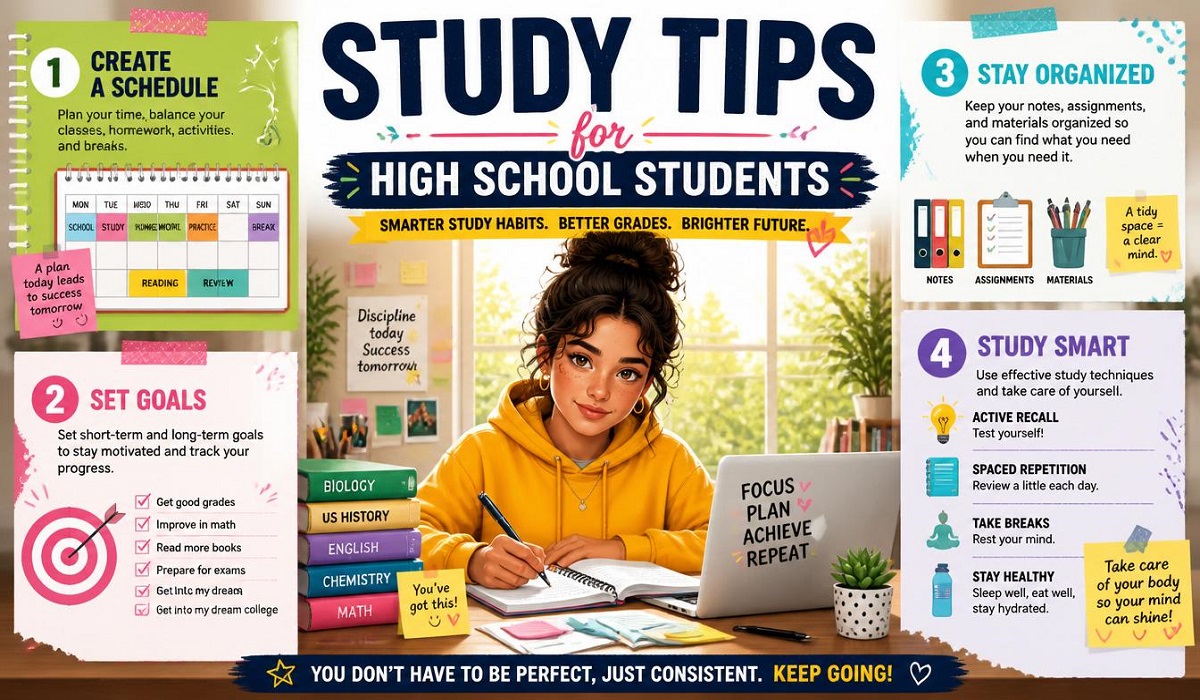
A study plan is like a roadmap. It helps you know exactly what you need to do and when, so you don’t feel lost or overwhelmed. A planner is “essential to keeping your child organized” . This applies to you, too! Learning to use a planner isn’t just about writing down test dates. It’s about blocking out specific times to study and chipping away at big assignments .
Setting Up Your Study Zone
Where you study is almost as important as how you study. Your environment can make it easy to focus or set you up for failure.
- Ditch the Distractions: This is the number one rule. Your phone is your biggest enemy. Did you know that simply having your phone on your desk can decrease your performance, even if you’re not looking at it? . It’s a huge distraction. When it’s time to study, put your phone in another room or turn it on “Do Not Disturb.”
- Find Your Spot: Look for a quiet, well-lit area . It could be a desk in your room, a corner of the library, or even a quiet coffee shop if that’s your vibe. The key is to find a place where you can focus.
- Keep it Stocked: Make sure you have all your supplies—pens, pencils, paper, highlighters, and your textbook—ready to go . Getting up to find a pencil is a perfect way to lose your focus.
The Power of the Pomodoro
Have you ever tried to study for hours on end and felt your brain just shut down? Our brains aren’t built for that kind of long, intense focus. The Pomodoro Technique is a game-changer. It’s simple: set a timer for 25 minutes and study with total focus. When the timer goes off, take a 5-minute break .
This method is great for a few reasons. First, it’s easier to stay focused for 25 minutes than for three hours. Second, those short breaks give your brain a chance to rest and process what you’ve just learned . It’s like hitting the reset button, and it is one of the most effective study tips for high school students to prevent burnout.
Active Study Techniques That Actually Work
Okay, so you have your space and your plan. Now, how do you actually study? You need to move from passive reading to active learning. Active learning is like going to the gym for your brain. It’s hard work, but it’s what builds muscle.
1. Test Yourself (Don’t Just Reread)
This is arguably the most important technique on this list. Many students think they’re studying by simply re-reading their notes or the textbook. But this is a huge mistake. It creates the “illusion of learning” . You feel like you know the material because it looks familiar, but when you need to recall it on a test, you blank.
The solution is retrieval practice. This means forcing yourself to pull information out of your brain without looking at your notes.
- The “Brain Dump”: After you finish a section, close your book and write down everything you remember .
- Flashcards: These are great for memorizing vocabulary, dates, and formulas. A 2011 study found that continuing to review flashcards until you get them correct 4-5 times in a row can boost retention by 40% .
- Practice Questions: Answer the questions at the end of the chapter or create your own.
2. Teach Someone Else
Want to know if you truly understand something? Try to explain it to someone else. In a 2024 study, students who explained a concept to a classmate performed 50 percent better on a test than those who just re-studied the material . This is because you can’t teach something you don’t understand. The act of explaining forces you to organize your thoughts and find any gaps in your knowledge.
Don’t have a real person around? You can explain it out loud to yourself, or even to a rubber duck! This is a great way to solidify your learning .
3. Take Better Notes
Note-taking is a skill. Many students try to write down everything the teacher says. This makes your notes messy and hard to study from. Instead, try to focus on the meaning and write down the main ideas in your own words . Think of your notes not as a finished transcript but as a “living document” . This means you should go back and refine them after class, filling in gaps and adding your own thoughts. This process of rewriting and adding detail is studying in itself .
4. Make It Visual
Your brain loves pictures. Instead of just writing lines of text, try to organize your thoughts visually. Mind maps are a fantastic way to do this. You start with the main idea in the center and draw branches to show related topics and subtopics . This helps you see how different concepts connect to each other. You can also use diagrams, charts, and color-coding to make your notes more engaging and memorable .
5. Get Tech-Smart
Technology isn’t the enemy; it’s a tool. You can use it to enhance your studying. Instead of getting distracted by social media, use it to your advantage.
- Study Apps: Use apps like Quizlet to create digital flashcards .
- AI Assistants: You can use AI to check your reasoning, create practice quizzes, or help you understand a difficult concept. As one student said, he uses AI to check for missing arguments in his essays .
- Online Tutorials: If you’re confused about a topic, watch a video on YouTube or Khan Academy to get a different explanation .
Study Tips for High School Students on the Go
You’re busy. Between classes, homework, extracurriculars, and your social life, it can feel impossible to find time to study. The key is to be efficient and make the most of your time, even in small pockets.
The Power of Small Study Sessions
You don’t always need a two-hour block to study. A 15-minute review session while waiting for a ride or during lunch can be incredibly valuable. These “micro-studying” sessions are great for reviewing flashcards or summarizing key points from a class. It’s a smart way to use the study tips for high school students to fit into a busy schedule.
Study Groups: Yay or Nay?
Study groups can be a fantastic way to learn, but they can also be a huge waste of time. A good study group is small, focused, and structured. The best way to use a study group is to study first on your own, and then get together to test each other and discuss the material. Explaining concepts to your study buddies is one of the best ways to learn .
Maintaining Balance: Fueling Your Brain
You can’t study well if you’re exhausted and hungry. Your brain is a muscle, and it needs fuel to work.
The Power of Sleep
This is non-negotiable. Getting a good night’s sleep is crucial for memory consolidation. While you sleep, your brain processes all the information you learned during the day, moving it from short-term to long-term memory . Pulling an all-nighter is one of the worst things you can do for your grade because you are literally preventing your brain from storing what you have studied.
The Reset Button
Don’t forget to take care of yourself. Make sure you take breaks, eat healthy food, and get some exercise. These are all important study tips for high school students to maintain energy levels and mental well-being. Remember, stepping away from the activity is not stepping away from it at all . Your brain is often still working on problems in the background while you’re relaxing.
FAQ
1. Is it better to study at night or in the morning?
There’s no “right” answer. The best time to study is when you feel most alert and focused. Some people are early birds, others are night owls. Experiment to see what works best for you and try to stick to a consistent schedule .
2. How long should I study each day?
It depends on your grade level and the upcoming tests. A good starting point is to aim for 1 to 2 hours per subject each week for older students, but this is just a guide . Using a planner to break down your tasks can help you figure out exactly how much time you need.
3. What should I do if I get distracted easily?
First, recognize that everyone gets distracted. The key is to minimize it. This means putting your phone away, finding a quiet space, and using techniques like the Pomodoro method (25 minutes of focus, 5-minute break) to train your brain to concentrate .
4. How can I get better at taking notes?
Instead of trying to write everything down, focus on the main ideas and write them in your own words. This means you’re actively thinking about the information. After class, go back and refine your notes, adding arrows, questions, or diagrams to connect ideas .
5. Is it okay to listen to music while I study?
It depends on the music and the person. Music with lyrics can be highly distracting because your brain is processing the words. If you need background noise, try instrumental or classical music. Some people find complete silence best.
Summary
Mastering effective study tips for high school students is about making a simple shift: from passive reading to active learning. It’s not about working longer, but working smarter. By ditching the cram session, creating a focused study space, using your time wisely, and engaging in powerful techniques like self-testing, you can transform your grades and your stress levels. You are capable of amazing things, and by learning how to learn, you are setting yourself up for success in high school and far beyond.