SWOT Analysis in 2026
SWOT Analysis in 2026: Imagine trying to navigate a ship through a storm without a map, compass, or any idea of where the rocks are. That’s what running a business or planning a career can feel like without a clear understanding of your situation. The world in 2026 is more unpredictable than ever. Geopolitical tensions, rapid technological changes, and economic shifts are creating a landscape that’s “non-linear, accelerated, volatile, and interconnected”—what experts call the “NAVI world” . The old rules of business are being rewritten daily, with tariffs, trade wars, and new regulations emerging constantly .
So, how do you make smart choices when everything is in flux? You need a tool that helps you see the big picture clearly. That’s where a Strengths, Weaknesses, Opportunities and Threat (SWOT) Analysis comes in .
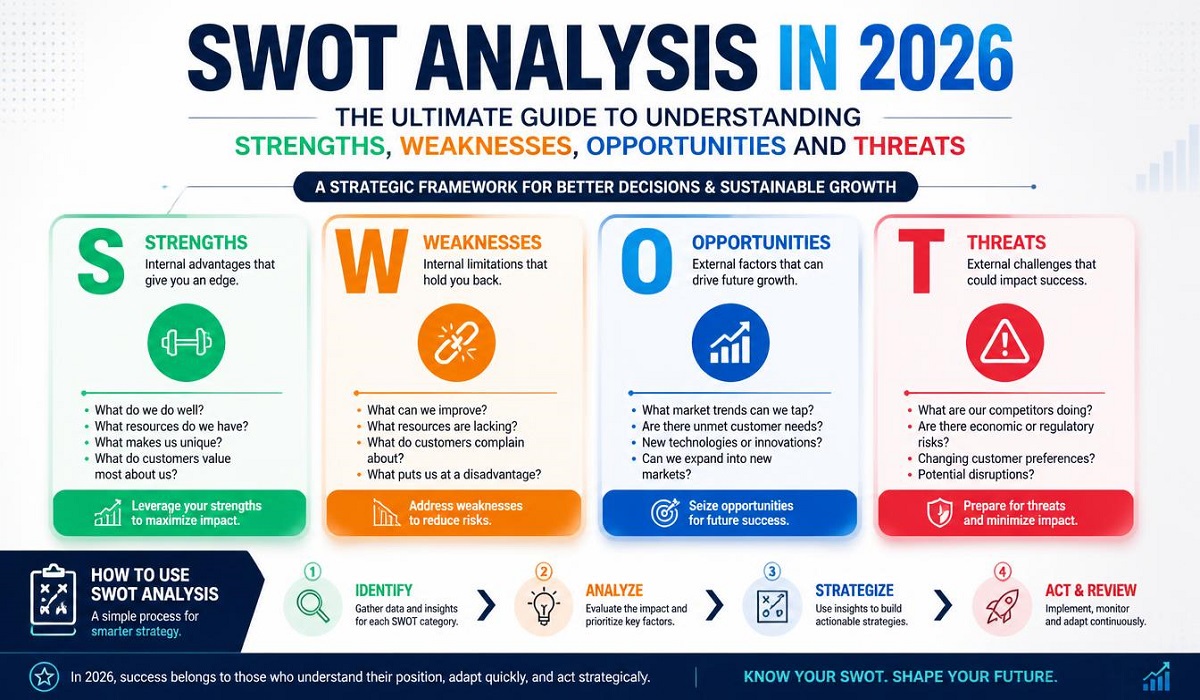
A SWOT analysis is a powerful and simple tool used for strategic planning. It helps you take a “strategic reality check” by looking at four key areas :
- Strengths: What your business or project does well (Internal).
- Weaknesses: What you need to improve or where you lack resources (Internal).
- Opportunities: What’s happening outside your business that you can take advantage of (External).
- Threats: What external risks could cause problems for you (External).
Think of it as a way to finally cut through the noise and focus on what truly matters . Whether you’re a small coffee shop owner, a leader in a multinational corporation, or a student planning your career, this 2026 SWOT analysis guide is your starting point for smarter, sharper decision-making .
This guide will walk you through every part of a Strengths, Weaknesses, Opportunities and Threat (SWOT) Analysis. We’ll use simple, 8th-grade-level language, provide up-to-date examples, and show you how to turn your analysis into action.
What is a SWOT Analysis? (The Basics)
At its core, a SWOT analysis is a planning tool that helps you match your organization’s goals and capabilities to the environment it operates in . It’s a way to organize your thoughts and information so you can create a practical plan for the future.
The power of a SWOT analysis lies in its simplicity. It forces you to look at both the inside of your organization (things you mostly control) and the outside world (things you don’t control) . By doing this, you can create strategies that are realistic and responsive to the world around you.
What does SWOT stand for?
You’ll often see this laid out in a 2×2 grid, or a “SWOT matrix,” which helps you visualize how these different factors relate to each other .
The Four Components of a SWOT Analysis
Let’s dive deeper into each of the four parts. We’ll look at what they are, why they matter, and what questions you should be asking.
1. Strengths (Internal Positive Factors)
Strengths are your competitive advantages. They are the internal characteristics that give you an edge and are already working well for you . These are your “superpowers.” They come from your people, your brand, your location, your technology, or any other asset you possess.
Why are Strengths important?
Knowing your strengths lets you use them to grab opportunities. If you know you have a great team, you can use them to launch a new project. If you have a strong brand, you can use it to enter a new market.
Key Questions to Ask:
- What do we do well? What do we do best?
- What’s unique about our organization?
- What do our customers like most about us?
- What are our best assets (people, brand, technology)?
Real-World Examples for 2026:
- Skilled Workforce: You have a team with specialized skills in AI or data analysis that your competitors lack.
- Strong Financial Resources: You have the cash to invest in new tech or ride out an economic downturn .
- Loyal Customer Base: Your customers keep coming back and are resistant to competitor offers.
- Innovation and Technical Expertise: Your R&D team is discovering new processes or technologies .
- Prime Location: Your store is on a busy street with lots of foot traffic .
2. Weaknesses (Internal Negative Factors)
Weaknesses are the internal limitations that hold you back. They are the things you do poorly or the areas where you’re vulnerable . This is not about being negative; it’s about being honest. You can’t fix a problem you don’t know exists.
Why are Weaknesses important?
Identifying weaknesses is the first step to improving them. It prevents you from making mistakes and helps you stop problems from getting worse .
Key Questions to Ask:
- What are we doing poorly? What needs improvement?
- What are our competitors doing better than us?
- What resources are we missing (money, skills, technology)?
Real-World Examples for 2026:
- Lack of Funding: You don’t have enough money to invest in necessary upgrades or marketing .
- Skill Gaps: Your team lacks experience in critical areas, like digital marketing or managing new technology .
- Outdated Technology: You’re using old systems that slow you down and make you less efficient .
- High Operating Costs: It costs you too much to make your product or deliver your service .
- Poor Brand Awareness: Not enough people know who you are or what you do .
3. Opportunities (External Positive Factors)
Opportunities are external conditions or trends that you could use to your advantage . These are things happening in the wider world that you can “catch” like a wave to ride forward. While you can’t control them, you can position yourself to benefit.
Why are Opportunities important?
Spotting opportunities early can help you grow faster and stay ahead of the competition. It helps you turn weaknesses into strengths by using outside resources .
Key Questions to Ask:
- What market trends are starting up?
- Are there new technologies we can use?
- Are there unmet customer needs we can satisfy?
- Is the government offering any new incentives or support?
Real-World Examples for 2026:
- Growing Demand for Sustainable Products: More people want eco-friendly options, so you can create “greener” products .
- AI and Technology Advances: New tools can help you automate tasks and work more efficiently .
- Market Expansion: You can sell your product in new countries or to new customer groups .
- Government Incentives: The government offers tax breaks for companies that use renewable energy.
- Rise of Sovereign AI: Countries are investing heavily in their own AI capabilities, creating a market for AI services and infrastructure .
4. Threats (External Negative Factors)
Threats are external risks that could cause problems for your business . These are the storms on the horizon. You can’t stop them, but you can prepare for them and try to minimize the damage.
Why are Threats important?
If you know what the risks are, you can plan for them. This could mean creating a backup plan, setting aside emergency funds, or pivoting your strategy.
Key Questions to Ask:
- What are our competitors doing that worries us?
- What new regulations are coming that could hurt us?
- Is the economy slowing down? What about inflation?
- Are there supply chain issues we need to worry about?
Real-World Examples for 2026:
- Increased Competition: A new competitor is entering the market with a better product or lower prices .
- Economic Downturn: People have less money to spend, so demand falls .
- Geopolitical Instability: Trade wars, tariffs, and sanctions disrupt your supply chain .
- Stricter Regulations: New environmental or safety rules make it more expensive to operate .
- Cyber Threats: AI-driven cyberattacks are becoming more common and sophisticated .
How to Conduct a SWOT Analysis in 2026: A Step-by-Step Guide
Doing a SWOT analysis doesn’t have to be complicated. Follow these five simple steps to make sure you get the most out of it.
Step 1: Gather Your Team
Don’t do this in a vacuum. The best SWOT analyses involve people from different parts of the business, like sales, marketing, operations, and even finance. They will all see different things. This is a great way to get a complete picture of your situation .
Step 2: Brainstorm (and Be Honest)
For each of the four quadrants, brainstorm a list of factors. Use the questions listed above to guide you. The most important part of this step is to be brutally honest. Don’t sugarcoat your weaknesses or ignore your threats because they’re uncomfortable. If you’re not honest, the whole exercise is a waste of time .
Step 3: Fill Out the SWOT Matrix
Take your lists and put them into the classic 2×2 grid. This helps you see the connections between internal and external factors.
Here’s a blank template to get you started:
| Strengths (Internal) | Weaknesses (Internal) |
|---|---|
| What do you do well? | What needs improvement? |
| 1. Skilled and experienced team. | 1. Limited marketing budget. |
| 2. Strong customer loyalty. | 2. Reliance on a single supplier. |
| 3. Prime location. | 3. High staff turnover. |
| Opportunities (External) | Threats (External) |
| What trends can you leverage? | What risks are out there? |
| 1. Growing demand for sustainable products. | 1. New competitor opening nearby. |
| 2. New social media platform for marketing. | 2. Increasing costs of raw materials. |
| 3. Government grants for new technology. | 3. New government regulations. |
Step 4: Turn Your SWOT into Action (The TOWS Matrix)
This is the step most people miss, and it’s the most important one! A list of strengths, weaknesses, opportunities, and threats is just data. The real value comes when you turn that data into a plan.
This is done by using a tool called the TOWS Matrix. A TOWS Matrix helps you create four types of strategies:
- S-O Strategies (Maxi-Maxi): Use your Strengths to take advantage of Opportunities. These are your best, most exciting moves.
- S-T Strategies (Maxi-Mini): Use your Strengths to minimize or avoid Threats.
- W-O Strategies (Mini-Maxi): Work on improving your Weaknesses to better capture Opportunities.
- W-T Strategies (Mini-Mini): Improve your Weaknesses to avoid Threats. This is about survival and defense .
Here’s an example to make this clearer:
Scenario: You have a small coffee shop.
- Strength: High-quality, locally sourced coffee.
- Opportunity: Growing trend of people wanting to order online for delivery.
- S-O Strategy: Use your strength (great coffee) to capture the opportunity (online delivery). You can create a great delivery menu and market your unique coffee to people ordering from home.
Scenario: A big, new competitor is opening across the street (Threat).
- Strength: You have a loyal group of local customers.
- S-T Strategy: Use your strength (loyal customers) to counter the threat (new competitor). You can launch a special “locals only” loyalty program or host community events.
Step 5: Prioritize and Implement
You’ve got a list of strategies, but you can’t do everything at once. Now, prioritize. Which S-O strategies will give you the biggest return? Which W-T strategies are critical for your survival? Choose the top three to five and create a concrete action plan for them .
Real-World SWOT Example: A Small Business in 2026
Let’s look at a detailed example to see how this all comes together. Imagine you’re planning to open a local bakery in a busy town.
Strengths (Internal)
- Experienced head baker: Owns 10+ years of experience from a top bakery .
- High-quality, locally sourced ingredients: A good reputation for quality from day one.
- Prime location: Situated on a busy high street with high foot traffic .
- Strong community ties: The owner grew up in the town and has a large personal network.
Weaknesses (Internal)
- Limited startup capital: Only have enough money to cover basic costs, no room for error .
- No formal marketing experience: The owner doesn’t know how to run ads or manage social media effectively.
- Small team: Only three employees, which limits how much they can produce.
- Dependence on a single supplier: All flour comes from one local mill.
Opportunities (External)
- Growing demand for gluten-free and vegan options: A major trend in the food industry .
- Online delivery partnerships: Apps like UberEats are popular, offering a new sales channel .
- “Shop Local” movement: People are actively choosing local businesses over big chains.
- Social media (Instagram/TikTok): A powerful way to showcase products for free .
Threats (External)
- Rising costs of ingredients: Inflation is causing flour, butter, and sugar prices to increase .
- Large chain competitor: A big supermarket chain is opening a café just two blocks away.
- Economic uncertainty: People might cut back on “luxury” items like bakery goods in a recession.
Turning Insights into Action (TOWS Matrix)
| Strategy Type | Description | Actionable Strategy |
|---|---|---|
| S-O Strategy | Use Strengths to catch Opportunities. | Action: Use the baker’s experience (S) and the “Shop Local” trend (O) to host free baking workshops in the shop, building community and brand love. |
| S-T Strategy | Use Strengths to counter Threats. | Action: Counter the new chain competitor (T) by leveraging the bakery’s unique, high-quality local ingredients (S) and launching a “Taste the Difference” campaign. |
| W-O Strategy | Fix Weaknesses to leverage Opportunities. | Action: Don’t have marketing experience (W)? Partner with a local food influencer (O) to do a review on Instagram/TikTok to promote the shop. |
| W-T Strategy | Reduce Weaknesses and avoid Threats. | Action: To avoid rising ingredient costs (T), partner with a second supplier now (W), protecting against supply shortages and locking in competitive prices. |
Why SWOT Matters More Than Ever in 2026?
The world of 2026 is tough. We’re seeing “geopolitics of scarcity,” where countries and companies fight to control resources like critical minerals, water, and energy . The rules of business are being rewritten by tariffs and tech wars . In this environment, a clear-headed strategy isn’t a luxury—it’s a necessity.
Even critics of SWOT admit its biggest weakness: it feels like “strategy without actually being strategy,” and often leads to a document that collects dust . But that’s a problem with execution, not the tool itself. The solution is to use SWOT as a diagnostic, not a checklist . Before you pick the framework, you must pick the challenge. SWOT is your starting point to answer the most critical question: “What’s the one challenge keeping us from reaching our ambition?” .
By using SWOT as a launchpad for action (the TOWS Matrix), you avoid the common pitfall of just creating a list. It becomes your map for navigating the complex and volatile economic landscape of 2026 . For instance, understanding threats like “state interventionism” and “geoeconomic coercion” helps you plan for a world of tariffs and trade wars .
Summary
In a world where global disruption has become the norm, the simple SWOT analysis remains one of the most reliable strategic tools available for 2026. Here are the key takeaways:
- SWOT stands for Strengths, Weaknesses, Opportunities, and Threats and is a strategic planning framework used to evaluate your current position .
- It works by analyzing internal factors (strengths and weaknesses) and external factors (opportunities and threats) .
- Use the TOWS Matrix to turn your analysis into strategic actions, linking internal capabilities with external realities .
- Be honest in your assessment and avoid vague lists; focus on specific, evidence-based observations .
- The global business environment in 2026 is defined by geopolitical uncertainty, economic volatility, and rapid technological change. SWOT is the perfect tool to help you navigate this new reality .
A SWOT analysis provides the clarity needed to make smarter, more informed decisions. It stops you from reacting to problems and helps you proactively build a strategy for success.
Frequently Asked Questions (FAQs) on SWOT Analysis
1. Is a SWOT analysis the same as a PESTLE analysis?
No, they are different tools that serve different purposes, though they are often used together. A SWOT analysis looks at both internal and external factors. A PESTLE analysis focuses only on external factors like Political, Economic, Social, Technological, Legal, and Environmental issues. PESTLE is often used to help identify the Opportunities and Threats part of a SWOT.
2. How often should I do a SWOT analysis?
There’s no hard rule, but you should treat it as a living document, not a one-time project. It’s a good practice to do a major SWOT review annually during your strategic planning cycle. However, you should also consider a mini-review if your business or industry experiences a major change (like a competitor entering the market or a new regulation being passed).
3. Can I do a SWOT analysis for myself (personal career planning)?
Absolutely! A personal SWOT analysis is a fantastic tool for career planning. Your Strengths are your skills and experience. Your Weaknesses are the skills you need to develop. Opportunities are in-demand roles or new industries. Threats could be automation making your job obsolete or heavy competition in your field. It helps you create a plan for your professional growth.
4. What is the biggest mistake people make when doing a SWOT analysis?
The biggest mistake is not taking action after the analysis is complete. Many people end up with a list of factors but fail to turn that list into a concrete plan. This is why it’s so important to use the TOWS Matrix to create strategies based on your SWOT. As one expert said, “SWOT tries to answer everything. Which means it answers nothing well” if you don’t use it to drive specific action .
5. Are there different types of SWOT analyses?
While the basic framework is the same, you can apply it in different contexts. For example, you can do a SWOT for your entire company, a specific project, a new product launch, or even for a competitor to understand their position. Some organizations also use an integrated approach, combining SWOT with other tools like SOAR (Strengths, Opportunities, Aspirations, Results) to make it more forward-looking and action-oriented.