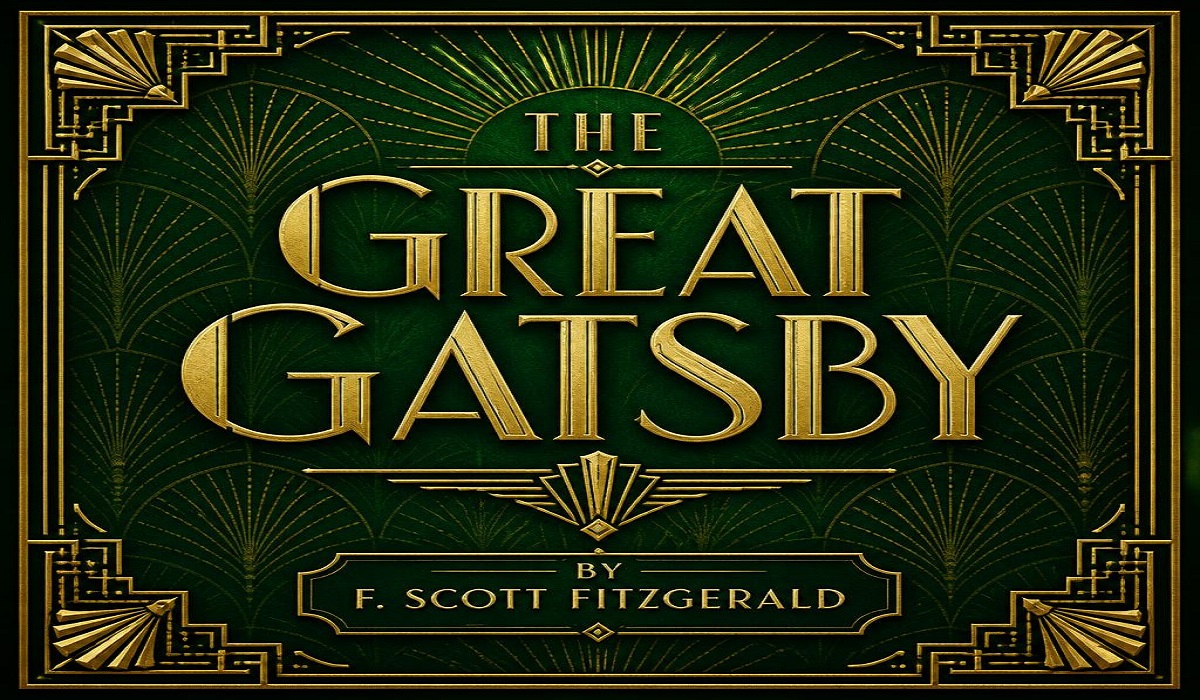
The Great Gatsby
The Great Gatsby: There are novels you read once and you’re finished. But The Great Gatsby is not one of them.
It is a short book, comprising around 180 pages. You can read it in a weekend. But once you’ve done it, it’s in your brain. Fitzgerald’s elegant prose tells a narrative of love, money and dreams. The narrative is set in America 100 years ago, yet what it says is still true today.
This is what many people call “the Great American Novel.” I don’t award that title lightly. It catches the spirit of an age well, but it also touches something in human nature that never changes – clutching onto the past, coveting prosperity, the sorrow of a dream coming apart.
Introduction: The Jazz Age and the American Dream
What Was the Jazz Age?
First you have to grasp what epoch the book comes from. For you to comprehend the novel.
World War I had just recently concluded. The American economy was in full swing. People had money in their pockets and proceeded to spend like nuts. This time was known as the “Jazz Age” or the “Roaring Twenties.” The phrase “Jazz Age” was originated by Fitzgerald himself.
At the same time America was under Prohibition. Selling alcohol was illegal. But the law really just made a lot of speculators rich by selling illegal wine. This is where Gatsby’s money came from.
What is the American Dream?
The “American Dream” is a concept that if you work hard, anybody can prosper. It doesn’t matter where you came from, you can make a better life by your own work.
Sounds lovely, doesn’t it?
But Fitzgerald poses a pointed issue in this book: Is the American Dream really fair to everyone? When you claw your way to the top, will those at the top accept you?
Novel “The Great Gatsby” Text Book Free Download in PDF Format
Main Characters
Nick Carraway (The Narrator)
Nick is the narrator. He’s traveled from the Midwest to New York, to make something of himself in the metropolis. He has a little house out on Long Island, just near to Gatsby’s place. Nick is Daisy’s cousin and a former Yale classmate of Tom’s. He thinks that he is an honest and tolerant guy.
Jay Gatsby
The protagonist is Gatsby. He lives in a magnificent home and hosts elaborate parties every week. But nobody knows who he is, or where his money is coming from. Gatsby is young and enigmatic, and his heart is set on one thing: to earn Daisy’s affection once more. He sacrifices everything to this end.
Daisy Buchanans’
Daisy, Nick’s cousin and Gatsby’s sweetheart of five years ago. She is gorgeous, rich, and speaks softly. She is married to Tom Buchanan and resides in East Egg. Daisy is everything Gatsby dreams of, riches, position and love.
Tom Buchanan
Daisy is the wife of Tom. He is immensely affluent. Physically powerful and arrogant. Tom was a football standout at Yale. He had a woman, Myrtle Wilson. Tom is the old aristocracy, born to money and power, who looks down on the “nouveau riche.”
Jordan Baker (Baker, Jordan)
Jordan is a teenage golfer and Nick’s love interest in the novel. She is independent, a bit cynical, and Daisy’s buddy.
Myrtle and George Wilson
Myrtle is Tom’s mistress. She wants to go away from her miserable existence. Her husband George has a garage, in one of the dead spots of the neighborhood—a place to put ash and smoke. These two characters are fighting for the lower class.
No Major Spoilers Story Recap
Nick Takes a Trip to Long Island
The narrative opens with Nick’s narration. In the summer of 1922 he leases a tiny cottage in West Egg, Long Island. His neighbor is a big home owned by a man called jay Gatsby. Nick doesn’t know anything about him.
The Parties Gatsby Throws Up
Gatsby throws big parties every week. Music, alcohol, people from everyplace – yet Gatsby himself is rarely seen. Nick subsequently gets an invitation and meets Gatsby for the first time. Gatsby is very youthful. He calls Nick ‘old sport’ as the two served together in the same division throughout the war.
Gatsby’s Appeal
Nick finds out from Jordan Baker that Gatsby and Daisy had been in love five years before. Back then, Gatsby was a poor officer and Daisy was from a rich family. Daisy married the affluent Tom when Gatsby went away to serve. Gatsby purchased his estate on West Egg so that he could see the green light from Daisy’s pier across the water. He wants Nick to set up a meeting so he may meet with Daisy again.
Reunion and strife
Nick asks Daisy over for tea, but not to inform her that Gatsby would be there. Their previous flame flames fast once they meet. They begin meeting one another in secret. Gradually Tom feels something is awry. Tom, Gatsby, Daisy, Nick and Jordan go to New York together, where Tom and Gatsby have a passionate altercation. Tom explains the source of Gatsby’s wealth- bootlegging and other unlawful ways. Daisy hesitated.
The Tragedy
On the way home Daisy is driving Gatsby’s automobile and runs over and kills Tom’s mistress, Myrtle. Gatsby takes the blame for Daisy’s sake. But Tom says the automobile belongs to Gatsby, Myrtle’s husband. George suspects that Gatsby murdered his wife and rushes to Gatsby’s home and shoots him dead, then kills himself.
The End
Hardly anybody attends Gatsby’s funeral, Nick discovers, once Gatsby is dead. Everyone that showed up at his gatherings is gone. Daisy and Tom go away without saying anything. Nick tires of life in the East and finally returns to the Midwest. At the end of the story Nick thinks of the green light Gatsby had believed in, the fantasy that constantly recedes.
Explaining the Key Themes
Disillusionment with the American Dream
This is the basic subject of the book.
Gatsby thinks that if he becomes affluent enough he may win Daisy back. He thinks money can buy anything, including the past. But in the end, he is defeated. Not because he is not rich enough, but because he can never be “that kind of peoples”. Daisy and Tom are in a restricted society and no matter how hard Gatsby tries he can’t get in.
What Fitzgerald wants to tell us is: the American Dream is not so wonderful as it looks. The dream was never an issue for those born with affluence. But for those ascending from the bottom, the dream may stay only a dream.
You can’t go back to the past
What is so tragic about Gatsby is his fixation with the past.
He wants to hear Daisy say ‘I never loved Tom’. He wants to go back five years, to when they first met. But that can’t be. What’s done is done. You can’t alter the past. But it is too late by the time Gatsby figures this out.
Privilege and class
This book provides a profound exposure of class concerns in American culture.
Tom and Daisy are “old money” – their money is inherited, not earned. Gatsby is “new money” – he built his own riches. But in our culture, money doesn’t do it. You need background, family name and the “right” social ties too. Tom and Daisy, when they smash things, may escape from it all, insulated by their wealth. Gatsby pays with his life.
Green Light Symbolism
The chief emblem in the book is the green light at the end of Daisy’s dock.
To Gatsby the green light is a symbol of his dream, Daisy, and everything she symbolizes. Every nite he extends out his hand to the green light, as if by touching it he might make his fantasy come true. But the green light is always across the lake, always out of reach. That is the nature of dreams, they are constantly ahead of you and you can never catch up.
Why This Book is Still Relevant Today?
You could say, a book published in 1925 – what has it to do with me?
A lot actually.
First, there has always been a vogue for talk about class. There are still individuals like Tom and Daisy in the world today, born with riches and privilege. And there are still individuals like Gatsby – trying hard to change their fate, only to find out that certain doors don’t open with money alone.
Second, disillusioning of dreams is a common event. We all have something that we want very much and would do anything for it. But sometimes acquiring it doesn’t imply happiness. Gatsby gained Daisy (for a while) but did he get happiness? No. Because the true question was never “can I get it” but “what happens after I get it.”
Thirdly, some credit must be given to Fitzgerald’s own writing. His language is clear, attractive and lyrical. It is regarded one of the greatest statements in American literature, the concluding line of the book: “So we beat on, boats against the current, borne back ceaselessly into the past.”
How to Get a Free PDF Version?
The Great Gatsby is public domain in the United States. That means you may legally download it and read it for free.
Internet Archive
Internet Archive has an HTML version of this book. You may visit their website and find the entry “The Great Gatsby (text) F. Scott Fitzgerald” where you can get a PDF file.
Project Gutenberg™
Project Gutenberg also has the whole text of this book available as a free download. It is available mostly in HTML and text forms, but may be viewed directly in your browser or saved as a PDF using your browser’s print feature.
Search How To
If you want to get a pdf , you may search ” The Great Gatsby pdf public domain ” or ” The Great Gatsby Internet Archive ” in a search engine . Choose reputable sources and stay away from sites that can be infected with malware.
FAQs
What are the age ranges for this book?
The book is intended for high school and higher. The language is not difficult to comprehend, but the subjects are rather profound, handling love, betrayal, violence, and complicated societal concerns. It is on several American high school mandatory reading lists.
How lengthy is the book? How much time does it take to read?
The book is around 180 pages long, with 47,000 words in the original English. The average reader will finish in roughly 4 to 6 hours. If you read half an hour a day you can go through it in a week.
“Do I need to know American history beforehand to understand it?
Nope. You will have a greater appreciation of the narrative if you know about the Jazz Age and the American Dream but the book is good enough to stand on its own. Fitzgerald is a highly lucid narrator, and you don’t need any ‘preparation’ to enjoy the narrative.
How is the book different from the cinema versions?
This novel has been made into movies a lot . Versions in 1974 and 2013 . The 2013 version contains Leonardo DiCaprio, and is more opulent visually. Movies cannot entirely do justice to the brilliance of Fitzgerald’s words, the subtle point of view. I would advise reading the book second and then viewing the movie.
Why do they call it the Great American Novel?
The title is a form of acknowledgment. It conveys something vital about the American experience. Its look at dreams, class, money and love touches on some of the central inconsistencies of American culture. There are numerous candidates for the title of “the Great American Novel,” but The Great Gatsby is the one that gets discussed most often.
Abstract
The Great Gatsby is a relatively short novel, yet it’s about very enormous topics.
It’s about how much you can give for a dream.” It also adds that sometimes a dream is merely an illusion and the more you follow it the farther it gets. It speaks about the power of money, and the limits of money. It talks about the beauty of love and the fragility of love.
Fitzgerald was only 29 when he penned this novel. He put all his paradoxes and uncertainties about riches and love and success into it. Perhaps that’s why this novel feels so genuine and so memorable.
Whether you’re reading this book for the first time in a high school classroom or opening it again as an adult, you’ll find something fresh. Gatsby’s narrative is, in a way, everyone’s story. We all want something, don’t we? We’re all looking for something. And what Fitzgerald would have us know is: sometimes the most important thing is not whether you can acquire it, but what type of person you become in the quest.
If you haven’t read this book, now’s the time. it’s free, it’s brief and it’s worth it. And if you have read it previously perhaps read it again. For like any great book, The Great Gatsby offers new discoveries every time you return to it.