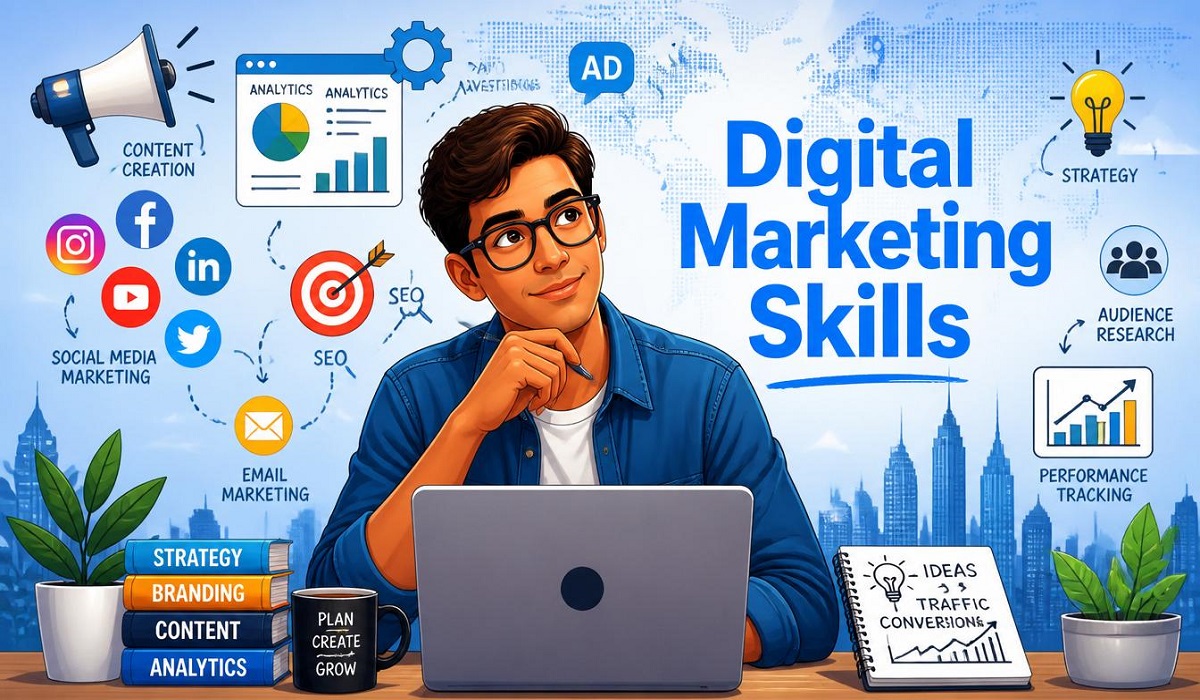
Digital Marketing Skills
Digital Marketing Skills: The world of digital marketing is changing faster than ever. Remember when having a Facebook page and sending out emails was enough? Those days are gone. Now, the most in-demand digital marketing skills in 2026 are totally different from what they were just a few years ago .
It’s not that the old stuff doesn’t matter. You still need to understand basics like SEO (Search Engine Optimization) and social media. But now, you also need to know how to talk to AI, understand complicated data, and create experiences that feel personal to each customer.
Think of it like this: ten years ago, being a digital marketer was like being a chef who only knew how to make one dish. Now, you need to know how to run the whole kitchen, manage the supplies, and create a menu that people rave about. The skills that will get you hired in 2026 show that marketing is no longer just about being creative. It’s about being smart, strategic, and using technology to get real results .
In this guide, we’ll explore the top digital marketing skills that employers are desperately looking for. We’ll explain what each skill is, why it matters, and most importantly, how you can learn it and show it off to get the job or grow your business.
1. Performance Analysis: The Skill That Pays the Bills
Let’s be honest: businesses don’t spend money on marketing just to be nice. They spend money to get more customers and make more money. That’s why performance analysis is now the number one most in-demand digital marketing skill in 2026 .
What Exactly Is Performance Analysis?
Performance analysis means looking at all the numbers from your marketing campaigns and figuring out what they actually mean. It’s not just about knowing that 1,000 people visited your website yesterday. It’s about knowing why they visited, what they did when they got there, and how you can get them to come back and buy something.
Many people can run a report and see the numbers . But the real skill is taking that information and making smart decisions. It’s about connecting the dots between what you do (like posting on Instagram) and what the business gets out of it (like more sales).
Why Is It So Important in 2026?
Marketing budgets are getting tighter. Companies want to know exactly where their money is going and if it’s working. In the past, marketers could get away with saying, “We’re building brand awareness!” without much proof. Today, that doesn’t cut it.
Performance analysis is how marketers prove they are making a difference. If you can say, “This campaign cost $1,000 and brought in $5,000 in sales,” you will always have a job. If you can’t do that, you are a liability .
How to Build This Skill?
- Learn Google Analytics 4 (GA4): This is the main tool for tracking website traffic. You don’t need to be a tech genius, but you need to know how to find information like where your visitors come from and what pages they look at .
- Understand Key Metrics: Know the difference between “vanity metrics” like likes and followers and “real metrics” like conversion rate (the percentage of people who actually do what you want) and return on ad spend (ROAS) .
- Practice Telling Stories with Data: Look at a set of marketing numbers and write a short report. What’s the one big takeaway? What should the business do next? The ability to turn data into a clear action plan is what makes you valuable.
2. AI Literacy: Your New Superpower
Everywhere you look, people are talking about AI. In digital marketing, the buzz is huge. But according to the most in-demand digital marketing skills in 2026 lists, just knowing what AI is isn’t enough. You need AI literacy.
What Does AI Literacy Mean in Marketing?
AI literacy is the ability to use AI tools the right way to make your work better and faster. It’s not about using ChatGPT to write all your content. That’s a part of it, but it’s so much more. AI literacy means knowing when to use AI, how to give it good instructions, and how to fix what it gives you .
Why Employers Want This Skill?
Employers are looking at AI as a tool to do more with less . Marketers who can use AI are simply more productive. AI literacy means:
- You’re not afraid of new tech: You can adapt and find ways to work smarter.
- You can scale your work: Instead of spending hours writing one blog post, you can use AI to create outlines and drafts for ten.
- You know its limits: AI can be wrong, or it can create content that sounds generic. A truly literate marketer knows when the AI’s work is good enough and when it needs a human touch .
How to Build AI Literacy?
- Start with the Basics: Spend time with free tools like ChatGPT, Claude, or Google’s Gemini. Just play around with them. See what they’re good at and where they stumble.
- Learn Prompt Engineering: This is a fancy way of saying “learning how to talk to AI to get what you want.” A bad prompt gives you a bad answer. A good prompt is clear and specific. For example, instead of saying “Write a social media post,” say “Write an Instagram caption about our new sneakers. Target people who love running. Keep the tone exciting and use emojis. Use a call to action like ‘Shop Now.'”
- Explore Workflow Automation: Look at how AI can connect different apps. For example, you can use AI to automatically organize leads from a Facebook ad into a spreadsheet. This saves you time on boring tasks so you can focus on strategy .
3. Social Media Branding and Community Engagement
Here’s a question for you: Which is more important in the most in-demand digital marketing skills in 2026, knowing how to use TikTok or knowing how to build a brand? The answer is the second one.
The Shift from Posting to Branding
In the past, you could just post content and hope for the best. But in 2026, everyone is posting content. Social media is a crowded place. Social media branding is a top skill because it’s about making your brand stand out and be memorable .
Branding isn’t just about a logo or colors. On social media, it’s about the personality you show. It’s the voice you use in your captions. It’s how you respond to comments, it’s the type of content you share. A great social media marketer makes a brand feel like a real person that you actually like .
The Power of Community Engagement
Branding is what attracts people, but community engagement is what keeps them. You can’t just broadcast your messages and walk away. You have to interact.
- Engagement: You’re talking to people, not at them. You are answering questions and responding to DMs.
- Community Building: You are bringing people together. You are making them feel like they are part of a special group.
In 2026, with more AI-generated content floating around, “human” interaction feels more valuable than ever. Brands that build a real community of fans have a huge advantage because their customers become their biggest promoters .
How to Build These Skills?
- Understand Different Platforms: Know how to post on different apps. TikTok and LinkedIn are completely different. TikTok is for raw, fun videos. LinkedIn is for smart, professional insights. You have to tailor your content for each one .
- Create a Brand Voice Guide: For practice, pick a brand you like or create a fake one. Write down its personality, its voice (is it funny? serious? helpful?), and the kind of language it uses.
- Practice Community Management: If you can, volunteer to help a small business with their social media. Spend time every day replying to people, asking questions in your posts, and fostering conversation.
- Learn Visual Storytelling: Canva has AI tools that make it easy to create professional-looking images and videos. Creating content that looks good and tells a story is a crucial part of branding .
4. SEO That Looks to the Future (GEO)
Search Engine Optimization is no longer just about trying to rank #1 on Google for a specific keyword. That’s still important! But the world of search is changing. Now, people are starting to use AI search engines like Perplexity. This is where GEO (Generative Engine Optimization) comes in .
What is GEO?
GEO is the practice of optimizing your content so it gets “cited” or mentioned in AI-generated search answers. Imagine you ask an AI tool, “What are the best digital marketing skills to learn?” The AI will produce a paragraph answer. If your content is optimized for GEO, the AI might use one of your articles as a source in its answer .
This is a huge shift. In the past, you wanted people to click on your link. In the future, you might get “cited” by AI tools, which will drive traffic and authority to your site.
How SEO Works Today?
SEO is still a massive part of the most in-demand digital marketing skills in 2026. It’s the best way to get free traffic. SEO involves:
- Keyword Research: Finding out what people are searching for .
- On-Page Optimization: Making sure your website is easy to read and understand.
- Technical SEO: Making sure your website is fast and works well on mobile phones .
- Backlinks: Getting links from other trusted websites to show you are an expert .
How to Build Skills in SEO and GEO?
- Learn the SEO Basics: Free courses from Google or HubSpot are a great start.
- Use SEO Tools: Try free versions or trials of tools like Semrush or Ahrefs. This will help you learn how to find keywords and analyze competition .
- Study AI Search Behavior: Think about how people ask questions to AI assistants. They often use long, natural-sounding questions. Create content that answers those questions in detail and clearly mentions the sources of your information.
- Focus on High-Quality Content: The best way to be cited by AI is to be the best and most trusted source on a topic. Your content must be accurate, helpful, and written by a real human who knows their stuff .
5. Paid Advertising and Performance Marketing
While organic marketing is great, sometimes you need to get results fast. That is the job of paid advertising. In 2026, this skill is more important and more complex than ever.
What Does PPC Involve?
Paid ads work on a model called PPC (Pay-Per-Click). You only pay when someone clicks on your ad. The ads you see at the top of Google search results or in your Instagram feed are all part of paid advertising .
This includes:
- Google Ads: Running ads in Google search results.
- Paid Social: Running ads on Facebook, Instagram, LinkedIn, TikTok, and other apps .
The New Focus on Performance
Performance marketing is the next step in paid advertising. It’s a term used to describe a highly data-driven approach to paid ads. It’s not about just getting a lot of clicks. And it’s about getting conversions (sales or leads) and tracking that ROI .
Modern paid advertising requires constant testing. You might set up five different ads to test which one works best. You have to manage budgets carefully and understand how the platforms’ algorithms work.
How to Learn Paid Advertising?
- Get Certified: Google and Meta (Facebook) offer free certification courses. This is a great way to learn the basics and show employers you know what you’re doing .
- Run a Campaign: Start small. Put a small budget, like $5 a day, into a Facebook Ad for a product you like or a page you run. You will learn so much more by actually doing it .
- Understand Attribution: This is the hard part of figuring out which ad actually led to a sale. Sometimes a customer clicks on a Google Ad and then buys later through an email. You need to be able to untangle this.
6. Email Marketing and Marketing Automation
Every digital marketer says that email is dead, but the top experts know that email is still the channel that makes the most money for businesses. Why? Because you own the list. You can reach your audience anytime without paying for an ad. It’s a key pillar of the most in-demand digital marketing skills in 2026.
Why Marketing Automation is the Game Changer?
We don’t send one email to everyone anymore. That’s just noise. Instead, you use marketing automation to send the right emails at the right time.
For example, if someone downloads a guide from your website, you can set up an automated sequence to send them follow-up emails over the next week. This way, you’re nurturing them and guiding them toward a purchase .
Why Employers Want This Skill?
Employers love automation because it saves money and generates a huge return. Plus, it builds customer loyalty. A welcome email that is sent automatically to a new subscriber makes the customer feel valued. A cart abandonment email sent when someone leaves items in their shopping cart can bring back a lot of lost sales .
How to Build This Skill?
- Learn a Tool: Start with something like Mailchimp, which is free for smaller lists. Watch tutorials on how to set up a simple welcome sequence.
- Focus on Copywriting: Your email content must be good. Write in a personal, conversational style. Learn how to write a good subject line. That is what decides if someone opens the email.
- Segment Your Lists: Split your email list into groups. People who are just discovering you shouldn’t get the same emails as loyal customers who buy from you every month.
7. First-Party Data Strategy and Project Management
There are two more big themes in the most in-demand digital marketing skills in 2026 that are very important. These are first-party data strategy and project management.
First-Party Data Strategy
This is about collecting and using data that comes directly from your customers. Because of new privacy rules, it’s getting harder to follow people around the internet with ads. Now, you have to encourage people to share their info with you directly. This could be by signing up for a newsletter, creating an account, or participating in a poll .
Why it matters: It helps you target people effectively while also respecting their privacy.
Project Management
Marketing campaigns in 2026 are complicated. You have designers, writers, and strategists all working on different things. People who can organize all this, keep the project on schedule, and communicate well are very valuable. It’s about making sure a campaign actually launches on time and doesn’t fall apart .
Summary: Wrapping It All Up
The most in-demand digital marketing skills in 2026 are changing how we work. Marketers are no longer just “writers” or “posters.” They are data analysts, AI experts, brand builders, and project managers all rolled into one. The world of digital marketing is becoming more complex, but that’s actually a great opportunity. There is more room than ever to become an expert and be super valuable to a business.
To succeed, you don’t need to master all of these skills at once. Start with the basics and choose one area to focus on. If you’re a natural communicator, start with social media branding. If you love numbers, jump into performance analysis. The key is to keep learning and be willing to adapt.
The future of marketing belongs to the people who are willing to learn new things and use new tools, but never forget the basic rule: it’s all about connecting with real people.
Frequently Asked Questions (FAQs)
1. What is the single most important digital marketing skill to learn in 2026?
The most important skill is a combination of two things: Performance Analysis and AI Literacy. Performance analysis proves your value, and AI literacy makes you efficient. They are the “hard skills” that employers prize the most .
2. Do I need to know how to code to be a digital marketer in 2026?
No, you generally don’t need to know how to code. The goal is to use existing digital platforms. However, familiarity with basic HTML for email marketing or data analysis tools like SQL (a database language) can help you stand out, especially in analytics-focused roles .
3. Is a college degree required to get a job in digital marketing?
No. The industry is much more focused on skills and “new-collar” roles. Hiring managers care more about your certifications, portfolio, and practical experience. A degree can help, but it’s not as important as proven capability .
4. How long does it take to learn these digital marketing skills?
With consistent daily practice, most people can build a solid foundation in 3 to 5 months. This is after learning core concepts (1 month), practicing with AI tools (1 month), and building real projects (1-2 months). .
5. How can I get experience if I don’t have a job?
You can get experience for free. Practice by managing social media for a friend’s small business. Start a blog or a themed Instagram account. Run a small Google Ads campaign with a tiny budget. This project work creates a portfolio that proves your skills to an employer.