FBISE Changed Passing Marks & New Grading System 2026
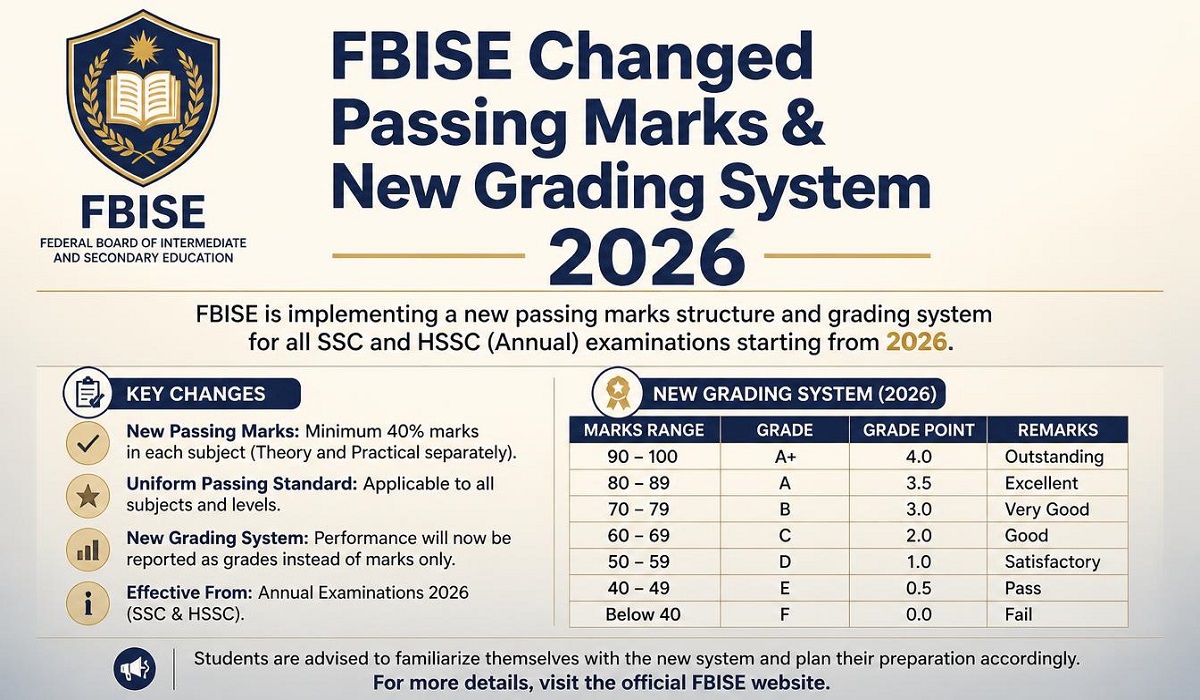
FBISE Changed Passing Marks & New Grading System 2026: The year 2026 marks a significant turning point for students under the Federal Board of Intermediate and Secondary Education (FBISE). For decades, the education system in Pakistan operated with a familiar rhythm: score 33% to pass, and receive one of five grades. However, as the world progresses and academic standards evolve, the Federal Board has taken a major step to align its assessment with international benchmarks. The FBISE changed passing marks and introduced a new grading system effective in 2026, fundamentally altering how it evaluates student performance. This comprehensive guide will explain every detail of this landmark reform, ensuring you understand exactly what these changes mean for your academic journey.
What is the FBISE New Grading System?
The FBISE has replaced its old five-grade structure (A, B, C, D, E) with a detailed 10-tier grading scale. This new system provides a more accurate reflection of a student’s knowledge and effort. Instead of broad categories, the new system uses specific percentage ranges to assign grades, reducing the chance of misrepresentation of a student’s true potential . The goal is to move away from rote memorization and towards a more performance-based evaluation, encouraging students to aim for deeper understanding .
The Major Shift: Passing Marks Raised from 33% to 40%
For years, the minimum passing requirement in FBISE was 33%. Under the new FBISE policy, the board raised this threshold to 40%. This change, effective from the 2026 annual examinations, means that students must now secure at least 40% marks in each subject to pass . This decision was made following recommendations from the Inter-Board Coordination Commission (IBCC) and is part of a broader effort to improve academic standards across the country .
This move, while challenging, pushes students to strive for higher achievement. As one education expert noted, it may not significantly affect high-performing students but will increase pressure on those who previously relied on the bare minimum to pass .
The New FBISE 10-Grade Scale (Percentage & GPA)
Here is the complete breakdown of the FBISE New Grading System 2026. This table shows the grade, percentage range, performance description, and the new 5.0 GPA scale for easy understanding. For Class 9 students receiving results in 2026, this is the system that will be used .
| Letter Grade | Percentage Range | Description | 5.0 Scale (GPA) |
|---|---|---|---|
| A++ | 95% – 100% | Exceptional | 5.0 |
| A+ | 90% – 94% | Outstanding | 4.7 |
| A | 85% – 89% | Excellent | 4.3 |
| B++ | 80% – 84% | Very Good | 4.0 |
| B+ | 75% – 79% | Good | 3.7 |
| B | 70% – 74% | Fairly Good | 3.3 |
| C | 60% – 69% | Above Average | 3.0 |
| D | 50% – 59% | Average | 2.0 |
| E | 40% – 49% | Below Average | 1.0 |
| U | Less Than 40% | Unsatisfactory | 0.0 |
Why FBISE Changed Passing Marks and the Grading System
The decision to overhaul the system was not made lightly. The FBISE cited several key reasons for this reform, aiming to create a fairer and more internationally recognized education system.
1. Aligning with International Standards
One of the primary goals is to bring Pakistan’s education system in line with global benchmarks. By using a more detailed grading scale and a higher passing threshold, Pakistani students will be on a more level playing field with their international counterparts when applying for higher education or jobs abroad .
2. Reducing Exam Stress and Promoting Understanding
Critics often criticized the old system for promoting rote learning—memorizing facts to pass without truly understanding the subject. The new system, with its distinct performance descriptors, aims to shift the focus from mere marks to actual comprehension and skill development .
3. Improving Assessment Transparency
The new 10-tier system offers a more nuanced and transparent evaluation. It provides a clearer picture of where a student stands academically, helping both students and teachers identify areas of strength and weakness more effectively .
Important: Implementation Timeline
You must understand that the board is implementing this change in phases. While officials made the announcement in 2025, they are staggering the rollout:
- Effective from 2026: The new FBISE New Grading System and 40% passing marks apply to SSC Part I (9th Class) and HSSC Part I (11th Class) students taking their first annual exams in 2026 .
- Effective from 2027: The same system will be extended to SSC Part II (10th Class) and HSSC Part II (12th Class) students from their first annual exams in 2027 .
Consequences of Scoring Below 40% (Grade ‘U’)
Students who fail to reach the 40% threshold in a subject will receive a ‘U’ grade, which stands for ‘Unsatisfactory’ . Under the new rules, this is the equivalent of failing. However, there is a provision for students to reappear in the examination for the subject(s) they could not pass, provided they meet other stipulated conditions .
How This Affects Students in 2026?
If you are a student in Class 9 or 11 this year, your result card will look different from your seniors’. Instead of the old five-grade system, your result will feature one of the new ten grades and will reflect the new 40% passing requirement. It is a time for students, teachers, and parents to adapt to this new academic landscape .
Conclusion
The FBISE New Grading System 2026 is a historic and transformative step for education in Pakistan. By raising the passing marks to 40% and introducing a detailed 10-grade scale, the Federal Board is signaling a commitment to higher academic standards and international alignment. This reform encourages students to aim for excellence and rewards a deeper understanding of their subjects. While the change may seem daunting initially, it ultimately seeks to empower students to become more knowledgeable and competitive on a global stage. Understanding these changes is the first step toward succeeding in this new era of academic evaluation.
Frequently Asked Questions (FAQs)
1. What is the new passing percentage for FBISE in 2026?
The FBISE has raised the passing marks from 33% to 40% for all subjects. This change is effective from the first annual examinations of 2026 for 9th and 11th class students .
2. Does the new grading system apply to the 2026 Class 10 exams?
No. For 2026, the new system only applies to SSC Part-I (9th class) and HSSC Part-I (11th class). It will be implemented for Class 10 (SSC-II) and Class 12 (HSSC-II) students from the 2027 annual examinations .
3. What does the ‘U’ grade mean in the FBISE New Grading System 2026?
The ‘U’ grade stands for ‘Unsatisfactory’. The board awards it to students who score below 40% in a subject. It essentially replaces the old ‘Fail’ or ‘E’ grade .
4. Why did FBISE change the grading system?
The changes were made to improve academic standards, align Pakistan’s education system with international norms, promote a deeper understanding of subjects rather than rote memorization, and bring more transparency and fairness to student evaluations .
5. How does the new FBISE system calculate GPA?
The new FBISE system uses a 5.0 GPA scale where each grade corresponds to a specific GPA value. For instance, an ‘A++’ (Exceptional) is a 5.0 GPA, while an ‘E’ (Below Average) is a 1.0 GPA. A ‘U’ grade yields a 0.0 GPA