Hyper-Localized Indigenous Pedagogies
Hyper-Localized Indigenous Pedagogies: Across the globe, education institutions are confronting a hidden catastrophe. Many indigenous children are in schools where the language, examples and knowledge systems are not connected to their everyday experiences. They turn away, they fall behind, they lose contact with the wisdom that has been carried in their communities for centuries.
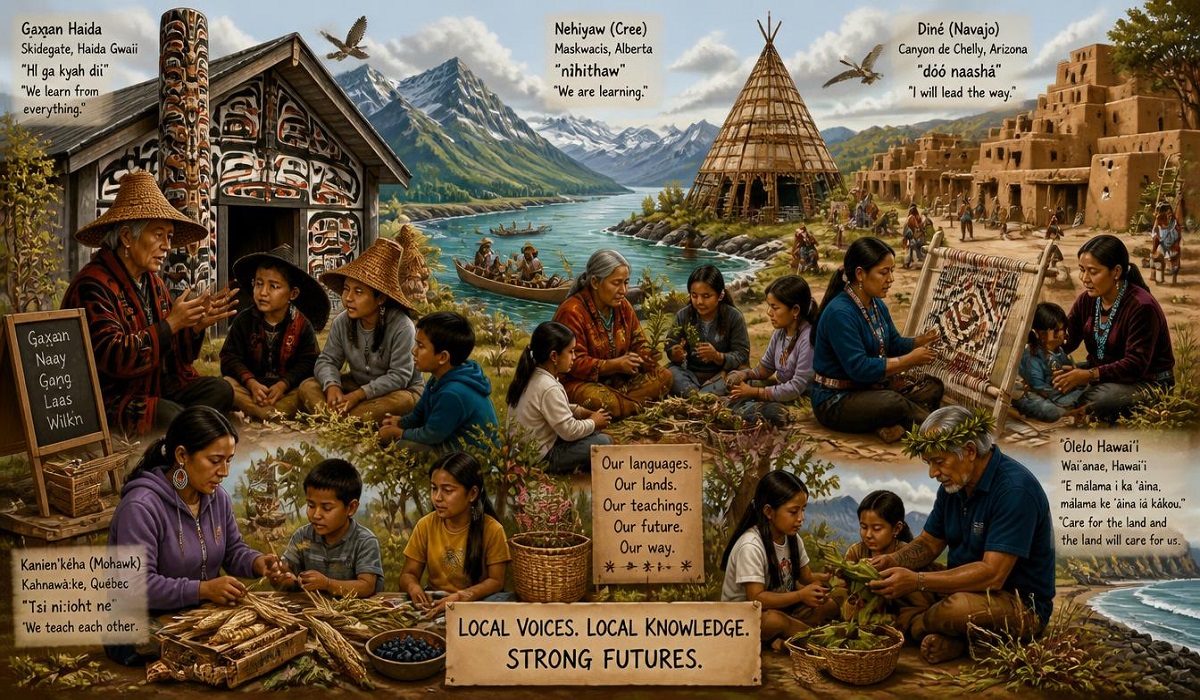
Hyper-localized indigenous pedagogies are a potent answer to this dilemma. Rather than infuse indigenous knowledge as a minor part of an existing curriculum, these initiatives put native culture, language, land and community at the core of learning. They re-connect the education with the real life situation of the pupils.
In this piece, we will investigate what hyper-localized Indigenous pedagogies are, why they matter in 2026, and how educators and communities may implement them. You’ll learn about the genuine skill shortages these methods are addressing, the challenges to overcome, and tangible strategies to construct learning that really belongs to its community.
Hyper-Localized Indigenous Pedagogies?
Hyper-local indigenous pedagogies are educational approaches that situate every aspect of learning in the distinctive site, culture, language, and ecological environment of an indigenous community. The word is a blend of three ideas:
Hyper-localized implies the learning content is directly related to the current surroundings. It does not depend on remote instances or generic textbooks. Instead, it draws inspiration from the plants, animals, tales, places, and people kids meet every day.
Indigenous indicates that the information originates from indigenous peoples themselves. It respects their world views, their means of passing on information and their freedom to pick what their children learn.
Pedagogies is the word for the ways and means that instructors utilize. These are not lesson plans. They are methods of thinking about how people learn, who knows things, and what success is.
In reality, hyper-localized indigenous pedagogies may look like a science lesson where students learn about local medicinal plants from a community elder, rather than reading about rainforests in some other nation. Or a math lesson where students measure and map out traditional fishing areas, instead of solving abstract problems about trains. Or a language class where children write stories in their mother tongue about a nearby river their families have known for centuries.
The major distinction from standard education is that the community controls the material and the method. Teachers are not outside experts imposing a standard curriculum, they are partners and facilitators.
Why skill gaps need a new approach?
The phrase “skill gaps” is one you typically see used when talking about workforce readiness. “There’s talk about the gap between what schools teach and what employers need,” he said. But there’s another skill gap that receives far less attention: the gap between what indigenous students learn in school and what they need to thrive in their own communities.
The Dual Nature of the Skill Gap
First, the cultural and linguistic skills gap. Learning is affected when schools teach in languages that children do not speak at home. The Global Education Monitoring team at UNESCO says 40 percent of the world’s population does not have access to education in a language they speak or understand. In certain low- and middle-income nations, that number is as high as 90 percent. Indigenous learners who are not taught in their mother tongue are at a huge disadvantage from the first day of school.
Second, the skills gap in practical skills. Many indigenous communities want young individuals who can manage land, water and natural resources utilizing traditional knowledge and contemporary approaches. They require community health professionals who are familiar with local healing practices. They need teachers who can teach language and culture. Yet normal schooling often educates students for professions that do not exist in their communities, while disregarding the skills their communities genuinely need.
How Hyper-Localized Pedagogies Respond?
Hyper-localized indigenous pedagogies address both sides of this divide. When learning happens in the mother language and links to local knowledge, kids engage more deeply and retain more. When the curriculum emphasizes skills that matter for communal life, education becomes relevant rather than abstract. Moreover, when elders and knowledge keepers participate as instructors, pupils learn that their culture is appreciated, not merely tolerated.
The upshot is greater academic achievements, stronger cultural identification, and stronger communities. Research on place-based and culturally appropriate pedagogies in Native American communities indicated that these methods greatly boosted student engagement and motivation in STEM courses .
Core Principles of Hyper-Localized Indigenous Pedagogies
To understand how these techniques function, it helps to analyze their underlying concepts. These principles govern everything from curriculum design to classroom practice.
Principle 1: Place is More Than Just a Location
In hyper-localized pedagogies, “place” denotes more than just a spot on a map. It comprises the social interactions, cultural meanings, and historical memories related to that area. A river is not only water. It is a source of legends, a place of rites, a giver of food, and a living relative. As children learn about their role in this comprehensive approach, they acquire a greater awareness of connectivity and responsibility.
2: Knowledge Resides in the Community
Unlike conventional schooling that is heavily reliant on credentialed instructors, hyper-local indigenous pedagogies understand that knowledge is already within the community. Elders, hunters, weavers, healers, and parents have important knowledge. These knowledge holders become instructors in their own right, and the school becomes a center for intergenerational learning.
3: Learning Is Experience-Driven
Indigenous pedagogies have always valued hands-on, experiential learning. Students learn via doing, seeing, listening and participating, not by remembering data from a book. Researchers refer to this as “experiential learning” and find it to be particularly beneficial for building practical skills and deep comprehension.
4: Language & Culture Cannot Be Separated
For many indigenous people, language is more than a medium of communication. It contains worldviews, connections and methods of knowing which cannot be entirely translated into. Thus, teaching in the home tongue is not optional; it is a must for cultural continuity. Programs of bilingual and multilingual education, such as those for the languages of the Sámi, the Māori, and the Amazigh, show how education may be used to revitalize languages and cultures .
Principle 5: The right to choose by communities
Hyper-localized pedagogies honor the notion of educational sovereignty. Indigenous peoples have the right to control the education of their children, including the content of what is taught, the manner in which it is taught and who teaches it. This requires going beyond consultation to actual cooperation with community people sharing control over curriculum, evaluation and school governance.
The skill gaps that hyper-local pedagogies address
Closing the Language Skills Gap
Language is the base of learning. Children starting school in a language they don’t understand have to work twice as hard to catch up. Many fall behind over time and ultimately drop out. This is the language skills gap and it’s affecting hundreds of millions of learners throughout the world .
This gap is filled by hyper-localized indigenous pedagogies that use the mother tongue as the primary language of teaching, at least in the early grades. Research repeatedly reveals that children learn to read and write more efficiently in their first language before moving on to a second language. In addition, usage of indigenous languages in school adds significance and prestige to the languages, which encourages families to continue using them at home.
Closing the Cultural Skill Gap
Many Indigenous pupils grow up with little exposure to their own cultural history. Colonization, forced assimilation and urbanization have disturbed the intergenerational transfer of knowledge. A student can know more about European history than of the history of his own people.
Hyper-localized pedagogies bridge this gap by placing indigenous history, beliefs and practices at the center of the curriculum. Students are educated on local customs, traditional government, land management and artistic traditions. They promote a feeling of identification and belonging that benefits mental health and academic achievement.
Bridging the Practical Skills Gap
Communities need young people with talents that are locally relevant. This might include traditional ecological knowledge for sustainable land management, knowledge of medicinal plants, abilities in traditional crafts, or competency in local government systems. At the same time communities need young people who can relate to the outside world through technology, navigating bureaucracy and arguing for their rights.
Hyper-localized pedagogies blend both skill sets. We may have our students utilize GPS technology to map traditional regions, a combination of contemporary technology and traditional knowledge. They might establish digital archives of elders’ stories, developing technological skills and safeguarding cultural heritage. They might look at the local food systems and provide sustainable modifications, using science to answer the concerns of the community.
Bridging the Civic and Leadership Skills Gap
Many indigenous communities lack skilled leaders who understand traditional government, as well as modern legal and political institutions. Hyper-localized pedagogies fill this gap by integrating students in genuine community initiatives, teaching them about their rights and linking them with leaders and mentors.
How Hyperlocal Pedagogies Work in Practice?
Knowing the theory is one thing. Another is to see how it plays out in actual classrooms and real communities. In this part we consider specific instances and practical techniques.
Example 1: Cultural Design for STEM Education
A study initiative in Oklahoma collaborated with three tribes, the Citizen Potawatomie Nation, the Otoe-Missouria Tribe, and the United Keetoowah Band of Cherokee Indians, to create a STEM curriculum that linked tribal origin tales and cultural practices to architecture and design . Virtual reality, augmented reality and 3D printing allowed students to see conventional buildings and address design challenges. The experiment found that place-based and culturally appropriate pedagogies greatly enhanced student engagement and motivation. Students who exhibited little interest in STEM were passionate about constructing and producing when the projects were related to their history.
2: Native Language Literacy in the Philippines
In the Philippines, a community-based organization worked with Agta families to provide literacy training in a culturally sensitive manner. Rather of youngsters going to a faraway formal school, the project took learning closer to the community. It employed the Marungko Approach, a phonics-based approach contextualized for local language use, and integrated literacy teaching with food programs and health education. The initiative achieved 100 percent involvement of the 17 selected youngsters and progressive literacy growth from writing their names to reading simple words. The key was flexibility: programs tailored to weather, community requirements and family considerations
3: Offline First Digital Learning in Papua
In Biak, a part of Papua in Indonesia, teachers struggled with spotty internet access. They solved this with a “offline-first” approach: portable digital repositories on flash drives and local servers. Students utilized tablets and computers to produce digital comics, podcasts and videos on local Biak history and culture. It was a way of building 21st century abilities of creativity, teamwork, problem solving, while affirming local identity. It demonstrated that online literacy does not depend on ongoing access to the internet but on significant interaction with technology that takes into account the student’s environment.
Essential Components of Successful Hyper-Local Programs
Several traits appear to be common among effective programs, according to recorded research and successful initiatives.
Co-designing with the community
The initiatives that are most successful include community participants from the outset. Teachers, elders, parents and students work together to choose what to teach, how to teach it and how to judge achievement. This co-design method guaranties that the curriculum represents the values and goals of the community. It also creates trust and ownership, which are key to long-term sustainability.
Flexible Curriculum Frameworks
Rigid, centralized curriculum prevent hyper-localization. Effective programs are built on adaptable frameworks that enable teachers to tailor curriculum to local conditions. The national requirements are still being met, but the examples, texts and activities are locally determined. Such a situation demands legislative support for teacher autonomy and curricular modification .
Authentic collaboration with Knowledge Goalkeepers
Elders and those with cultural knowledge should be regarded as credible instructors. This involves paying people for their time, including them in planning and establishing areas where their expertise is valued on the same level as academic knowledge. Programs that only “invite” seniors as occasional visitors are not tapping the deeper potential of intergenerational learning.
Bilingual and Multilingual Education
Good programs help the child to develop his native tongue as well as the national language. They know that a good foundation in the first language makes learning the second language easier. They also see multilingualism as a plus, not a problem to be solved.
Experiential and Place-Based Learning
Classrooms are the place where learning happens. Learning happens on the land, in the community and in the home. Good programs provide children with frequent opportunity to learn via direct experience — planting, harvesting, building, watching, engaging in the life of the community.
Evaluation responsive to local values
Standardized assessments tend to fail to capture the entire range of skills and knowledge that hyper-localized pedagogies cultivate. Good programs employ a variety of assessment methods: portfolios, demonstrations, community reviews, and oral presentations. They test academic knowledge, but also cultural competency, practical skills and service to the community.
A Guide to Implementing Hyper-Localized Indigenous Pedagogies
Here are some practical next actions that educators, school administrators, and community members may do to implement these concepts.
Step 1: Start by Building Relationships
Before modifying curriculum or teaching techniques, you should invest in creating connections with community people. Go to community events. Hear the worries and the wishes. Discover the local history, language and priorities. Take your time with this step. Trust is the basis of all that follows.
2: Find the Local Knowledge Holders
Work with community leaders to find people with vital knowledge: elders, hunters, fishermen, weavers, healers, storytellers, etc. Ask them whether they would be interested in getting involved in education and how they would do it. Respect their time and knowledge. Think how to provide proper restitution for their efforts.
3: Map the Local Context.
Make a “place inventory” of your town. What plants and animals thrive there? What are the sites, rivers and mountains of cultural importance? And what legends, songs and rites are linked to distinct places?, what activities and skills are crucial to communal life? This process of mapping may include kids, who learn about their location by documenting it.
4: Review & Adapt Curriculum (1)
Look at your curriculum now. What are the chances to relate learning to local context? What topics may be taught using local examples? Which units might potentially engage community knowledge holders? Work with colleagues and community partners to modify teachings instead of creating them from the beginning. Small adjustments may have a tremendous impact.
5: Create Bilingual Resources
If your pupils speak a non-instruction language at home, focus on producing resources in that language. This can involve producing short booklets, documenting oral tales, or translating crucial pieces. Start with early literacy and fundamental areas where mother tongue assistance is most important.
6: Build Flexible Learning Environments
Learning can take place beyond the classroom. Look for areas in the community where learning may happen: a garden, a workshop, a riverside, a community center, a sacred site (with rights). Work with partners in the community to establish access and monitoring.
7: Teacher Training and Support
Teachers require help to adopt hyper-local pedagogies effectively. This involves training in culturally sensitive teaching, bilingual education approaches and experiential learning. It is also about continuous mentorship and learning from the knowledge holders in the community. Teachers from the community may require special help in managing their combined duties.
Step 8: Watch, evaluate and adapt
No program is flawless when it starts. Create regular chances for reflection and criticism. Ask parents, families and community people what is working and what may be improved. Be open to change your strategy based on what you learn.
Mistakes to avoid
Even well-meant initiatives sometimes go awry. Knowing the common mistakes might help you avoid them.
Mistake 1: Treating Indigenous Knowledge as an Add-On
Many programs err in tacking on a “cultural component” to an otherwise identical curriculum. They may have a lesson on local history, or they may have an elder come in and talk once a semester. But hyper-localization demands deeper transformation. Indigenous knowledge should be the basis, not an afterthought. If the fundamental curriculum does not alter, the program has not really localized.
2: Stereotyping or romanticizing
There is a danger of portraying indigenous cultures as stuck in the past or all the same “spiritual” and “in harmony with nature”. Real indigenous societies are varied, modern and complicated. They are scientists, engineers, artists and entrepreneurs, as well as conventional knowledge bearers. Curricula should reflect this variety and avoid romanticized depictions which may be patronizing.
3: Making community members into tokens
A real relationship is not having an elder speak once a year. Tokenizing community members as “cultural props” without genuine engagement in decision-making breaks down trust. Knowledge goalkeepers should be seen as professional colleagues, with continuing jobs, appropriate remuneration, and a voice in how their knowledge is used.
Mistake 4: Not Acknowledging Power Dynamics
Schools and education systems have a historical baggage. For indigenous tribes, schooling has frequently been a process of assimilation and cultural repression. Just stating we wish to integrate your culture does not erase that past. Educators need to recognize the damage they’ve caused in the past, clarify their goals, and be prepared to transfer power in a real way. This can involve providing community members the power to make decisions about curriculum and finances.
Error 5: Expect quick results
It takes time to build trust, to establish new curriculum, to educate instructors and to change institutional culture. Programs that seek quick results could terminate before any significant improvement is observed. Funders and policy makers need to support long-term effort. Community members and educators should celebrate the minor triumphs along the road.
Limitations and Obstacles
But we have to be honest about the formidable problems faced by hyper-localized indigenous pedagogies. Nobody benefits from pretending they do not exist.
Centralization of the Curriculum
Many education systems include centralized curriculum, with minimal possibility for local customization. Teachers might have to utilize scripted lessons and standardized materials. This demands policy reform at higher levels. In centralized systems, however, teachers typically have the opportunity to carve out modest niches for localization. The aim in the long run is to provide greater flexibility.
Training and Capacity of Teachers
Many instructors have not been prepared in culturally responsive or place-based pedagogies. They may not be prepared or willing to collaborate with community knowledge holders or generate local materials. Such techniques must be included in teacher education programs and practical teachers require continuous professional development .
Resource Limitations
We need funds to provide multilingual resources, to pay knowledge holders, and to develop flexible learning environments. These materials may be in limited supply in impoverished schools. Working with neighborhood groups, non-profits and government initiatives can assist, but it is hard to support these efforts in a sustainable way.
Assessment and Accountability
Standardized testing regimes frequently privilege material that is de-contextualized from local settings. Schools can feel pushed to “teach to the test” rather than engage in hyper-local initiatives. There is a continual conflict between meeting local goals and external accountability needs.
Diversity of Community
Indigenous communities are not a homogenous group. Different families may have different objectives, distinct ways of practicing language, and diverse links to traditional knowledge. “It takes patience and good facilitation to build consensus around educational goals.”
Benefits and Results
Despite these obstacles the benefits of hyper-localized indigenous pedagogies are extensively proven.
More Academic Involvement
Students engage more fully when learning resonates with their lives and identities. Research on place-based education regularly reveals higher motivation, attendance, and involvement. When students see their neighborhoods and themselves represented in the curriculum, they are more willing to work hard at school.
More Cultural Identity
Hyper-localized pedagogies provide beneficial cultural identity development of pupils. They learn that their ancestry is something to be proud of, not embarrassed of, or hidden away. This sense of identity contributes to mental health and resilience for students, especially those who endure prejudice and marginalization in wider society.
Language Reclamation
The use of indigenous languages in education gives them significance and life. Children who learn to read and write in their mother language are more likely to continue to use it as adults. This is a prerequisite for the survival of languages, as highlighted by UNESCO and other organizations.
Capacity Building in the Community
When schools partner with their communities, everybody wins. Knowledge goalkeepers are recognized and compensated for their knowledge. More involved parents in schooling. “Communities have more say in decisions that affect their children.
Skills Relevant to Living Locally and Globally
Students in hyper-local programs learn abilities that are beneficial both locally and globally. They develop critical thinking, problem solving, collaboration and cross-cultural communication. They acquire practical skills for community living and are also equipped for higher education and a wide range of jobs.
Commonly Asked Qs
What does “hyper-localized” entail in terms of Indigenous education?
Hyper-localized indicates that the learning material, examples, language, and methods are firmly embedded in the unique location and culture where the students reside. Teachers use local tales, plants, animals, monuments and community knowledge rather than generic national or international resources. The aim is to make education immediately relevant to students’ everyday lives and identities.
How do hyper-localized indigenous pedagogies bridge skill gaps?
They are addressing talent shortages in three primary ways. First, they bridge the language gap by using the mother tongue for instruction. Secondly, they bridge the cultural divide by centering the curriculum on indigenous knowledge and values. Third, they fill the practical skills gap by teaching competences that communities really need, from traditional ecological knowledge to current technology skills applied to local concerns.
But will these techniques work in centralized education systems?
Yes, but it takes some imagination and some lobbying. Even under centralized systems, teachers usually have some discretion to utilize examples, invite community speakers and use local resources within the framework. Systemic transformation needs schools and communities to have more autonomy. And that demands policy reform. certain work has been achieved in certain nations like South Africa to integrate indigenous values and multilingualism into national curriculum.
What is the function of elders and knowledge holders?
Elders and knowledge goalkeepers are important collaborators in hyper-localized pedagogies. They have traditional knowledge, language and cultural customs down the generation. Programs that work include them as co-educators, not as occasional visitors. This involves paying them for their time, incorporating them in curriculum planning, and recognizing their expertise.
How can we assess success within hyper-localized indigenous pedagogies?
There should be a variety of techniques to judge success. Success in academia is important, but so is cultural competency, language proficiency, community participation and student happiness. Effective programs include portfolios, demonstrations, community reviews, and oral assessments as well as standardized testing. The fundamental question is whether students are acquiring the information and skills they need to succeed in their communities and the larger world.
Abstract
Hyper-localized indigenous pedagogies provide a compelling alternative to education institutions that have failed indigenous learners for years. These initiatives address the skill gaps typically missed by traditional schooling by embedding learning in geography, culture, language and community. They foster academic engagement, promote cultural identity, assist in language revitalization, and help build practical skills for community living.
These pedagogies are not easy to implement. It needs real partnerships with communities, flexible curriculum frameworks, trained teachers and sustained resources. It asks educators to reckon with historical harm and share power. But the benefits, for students, families and communities, are profound.
The evidence for hyper-localized indigenous pedagogies continues to grow as we progress into 2026. Success is appearing in STEM projects in Oklahoma tribal communities, mother-tongue literacy programs in the Philippines, and offline digital learning in Papua. These programs show that education, when it is truly owned by its community, is more than schooling. It is a path to cultural survival, community resilience and a future where indigenous children can thrive as themselves.