Impacts of Education in Pakistan
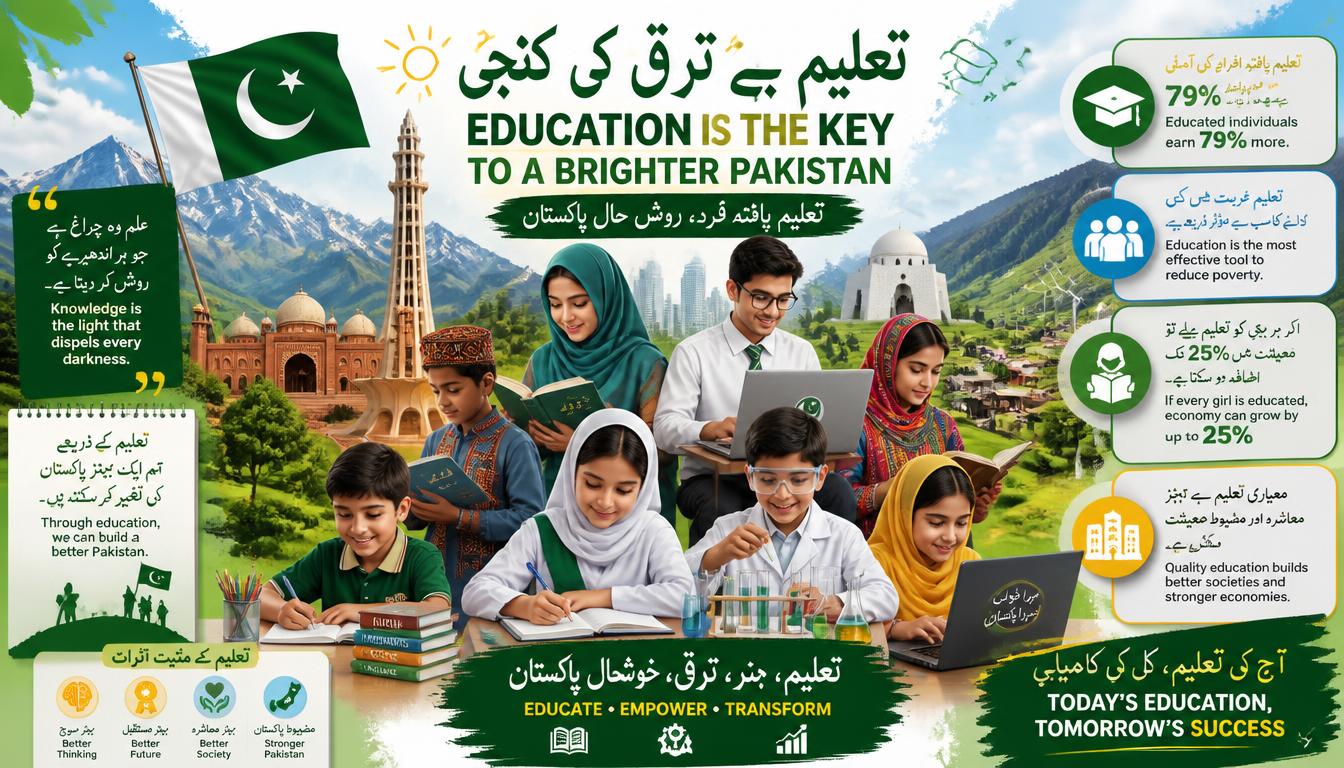
Impacts of Education in Pakistan: Imagine a country where more than 26 million children are not sitting in classrooms. Picture a future where a large portion of the young population lacks the skills to read a simple story or solve a basic math problem. This is not a hypothetical scenario; this is the reality in Pakistan today. The impacts of education in Pakistan are more critical and far-reaching than most people realize. It is an issue that touches the life of every citizen, from the bustling streets of Karachi to the remote villages of Balochistan.
Education is often called the “great equalizer,” a tool that can lift people out of poverty and set a country on the path to prosperity. However, Pakistan is facing a massive education emergency . While the government and various organizations are working hard to solve these problems, the scale of the challenge is immense. This blog post explores what education in Pakistan looks like today, the key challenges it faces, and the significant effects it has on the nation’s future. We will break down complex issues into simple terms to help everyone understand why education is the most important topic for Pakistan’s survival and growth.
The Current State of Education in Pakistan
To understand the impacts of education in Pakistan, we first need to look at the current situation. The picture is mixed, with some progress but many serious problems.
The “Education Emergency”
In 2024, the Pakistani government declared an “education emergency” . This was a big announcement because it showed that the leaders recognized how bad the situation had become. Unfortunately, a recent review of this emergency showed that even after two years, not much has changed. The money spent on education has dropped, and there is no clear plan to make things better . This means the emergency remains a promise that hasn’t been fully kept.
The Out-of-School Children Crisis
One of the biggest problems is the number of children who are not in school. Recent estimates suggest that there are between 25 million and 26 million out-of-school children in Pakistan . This is the second-highest number in the world. The province of Punjab has the highest number of these children, while Balochistan is the worst in terms of percentage, with thousands of schools not even functioning properly . These children are missing out on the chance to learn, grow, and build a better future for themselves and their families.
The Learning Crisis: “Schooling” vs. “Learning”
Even when children are in school, there’s another problem: they aren’t actually learning very much. This is often called the “learning crisis.” A report from the World Bank says that around 77% of children in Pakistan are in “learning poverty.” This means they cannot read and understand a simple story by the time they are ten years old . This is not just about children who are out of school; many children who sit in classrooms every day are also not learning effectively. They are “schooled” but not “educated.” They may be present in the class, but their minds are not engaged, and they are not picking up basic skills .
The “Shadow Education” System: Paying Twice for Failure
One of the most telling signs of a failing school system is the rise of private tuition, often called “shadow education.” In Pakistan, the tuition industry has become enormous. Parents are paying for extra classes because the regular school is not teaching their children properly .
Why is Tuition So Common?
- Overcrowded Classrooms: Government schools are often packed with too many students, making it impossible for teachers to give individual attention .
- Rote Learning: Schools often focus on memorization, not understanding. Students learn to pass exams but don’t develop critical thinking skills .
- Low Teacher Salaries: Teachers are often paid very little. For example, a government teacher might make only Rs 25,000 to Rs 35,000 a month. This means many talented teachers look for better-paying jobs in the private tuition market . In some cases, teachers even hold back important information to teach it later in paid tuition classes . In Lahore, 62% of secondary students rely on private tuition just to pass their exams . This shows how much trust has been lost in the formal education system.
Impacts of Education in Pakistan on the Economy
Education is not just about learning to read and write. It is the engine of a country’s economy. The impacts of education in Pakistan on its economic future are massive.
The Cost of Ignorance
When a child does not get a quality education, it costs the country money. According to experts, if Pakistan invested effectively in human capital—education, skills, and employment—the GDP per capita could increase by over 140% . Without this investment, the country’s economy will struggle to grow. The World Bank has estimated that school closures, like those during the COVID-19 pandemic, could cost Pakistan’s economy up to $155 billion in lost earnings . This is money that will never be earned by a generation of children who missed out on learning.
The Education-Employment Mismatch
Even with millions of children out of school, Pakistan is also producing university graduates who cannot find jobs. This is because the education system often teaches outdated information. There is a big gap between what students learn in school and the skills that employers are looking for. The tech industry in Pakistan, which exported over $2.8 billion in the last fiscal year, is finding it hard to grow because there aren’t enough skilled professionals available . So, while the country has a large number of young people, many of them lack the skills needed for the modern job market. This leads to a high unemployment rate among educated youth, which was over 31% in 2018 and is still very high today .
Brain Drain
Many bright Pakistani students go abroad for higher education or to find better jobs. This is called “brain drain.” The country invests in their early education, but then they leave to work in other countries, like Malaysia or Western nations, which offer better opportunities . This means Pakistan loses its most talented people, further weakening its economy and development potential. A Punjab Assembly Speaker recently pointed out that international education has value, but he urged students to return and use their skills to help Pakistan .
Social Impacts of Education
Beyond the economy, the impacts of education in Pakistan are deeply social. Education has the power to change people’s lives in profound ways.
Inequality and the Two-Tiered System
The education crisis is making inequality worse. Wealthy families can afford to send their children to expensive private schools and hire private tutors. Low-income families cannot. This creates a two-tiered system where rich children get a good education and poor children do not . UNESCO has warned that unregulated tuition like this widens inequality. This divide has a ripple effect: people from wealthy backgrounds get better jobs, more power, and a higher social status, while those from poorer backgrounds are left behind .
Impact on Girls
Girls are especially affected by the education crisis in Pakistan. In rural areas, especially in Balochistan and Sindh, more girls are out of school than boys . In Balochistan, 75% of girls are missing out on education . Many families cannot afford to send their daughters to school, or there are no schools nearby with female teachers . There’s also the issue of child marriage. Pakistan has the sixth-highest number of child brides in the world, with an estimated 19 million girls married before age 18 . When a girl is not educated, she is far more likely to be married off as a child, which traps her and her future children in a cycle of poverty.
Social Issues
The lack of education can lead to many social problems. It is harder for people to challenge extremist ideas or misinformation when they haven’t learned to think critically . Quality education is a weapon against poverty and extremism . Without it, a society becomes more fragile and divided.
How the World is Helping?
It is not just the Pakistani government trying to fix these problems. International organizations are also working to improve education in the country.
The Global Partnership for Education (GPE) and UNICEF
The Global Partnership for Education (GPE), along with UNICEF, is funding the Sindh Learning Program. This is a four-year program that started in 2025. It helps train early childhood education teachers in the districts of Umerkot, Dadu, Tharparkar, and Tando Allahyar . They are training over 750 teachers, who will then support over 30,000 children . These trainers learn how to use basic materials like stones, cardboard boxes, and beads to teach young children. The program focuses on the idea that early childhood is not just a “waiting period” before “real” school but the most important time to build a child’s mind .
The Way Forward: What Needs to Change?
The path to fixing the education crisis in Pakistan is difficult, but it is not impossible. Experts and leaders have many ideas on what needs to be done.
1. Make Education a Real Priority
The government needs to back up its words with action. This means spending more money on education. Currently, Pakistan spends less than 1% of its GDP on education, while the UN recommends 4-6% . The government set a target to reach 4% by 2029, but this is a huge jump . There is also a need for policy stability and long-term planning. The Minister for Planning, Ahsan Iqbal, said that Pakistan needs to prioritize education for at least ten years straight to see real results .
2. Improve Teacher Quality and Pay
A teacher is the most important person in a classroom. But in Pakistan, teachers are often underpaid, untrained, and demoralized. To fix the education system, the government needs to improve teacher training. Instead of just holding a few workshops, teachers need continuous coaching in the classroom . They also need to be paid enough so that they don’t have to rely on private tutoring to make a living. The teaching profession should be seen as a respectable career, not just a “stopgap job” .
3. Focus on “Learning,” Not Just Enrollment
The education system is obsessed with counting how many children are enrolled in schools. But as we have seen, enrollment does not mean learning. The government and schools need to focus on results. This means measuring what children actually know, like their reading and math skills, and linking funding to how well children are learning . We need to move away from a system that just rewards rote memorization (learning by heart) to one that encourages critical thinking, problem-solving, and creativity .
4. Strengthen Industry-Academia Linkages
Universities and schools need to work with businesses to make sure they are teaching skills that are needed in the job market. Ahsan Iqbal recently visited a university in the UK and was impressed by a system where students and businesses work together . He wants to bring this model to Pakistan . By building these partnerships, schools can ensure that their graduates are ready for the modern economy.
Summary
Point: Education is in a State of Emergency
Details: Despite a government declaration of an education emergency, 25+ million children are out of school, and funding for education has dropped .
Point: The Rise of “Shadow Education”
Details: Private tuition has become a massive industry because the formal school system is failing to teach students effectively. This is a sign of institutional collapse .
Point: Education’s Impact on the Economy
Details: A lack of quality education costs Pakistan billions in lost economic potential. The country is stuck with a large youth population that lacks the skills for modern jobs .
Point: Social Problems Worsened
Details: The education crisis worsens inequality, traps millions of girls in a cycle of poverty and early marriage, and creates social instability .
Point: The Way Forward
Details: Reform requires increasing funding, professionalizing teaching, focusing on actual learning instead of just enrollment, and bridging the gap between education and industry .
FAQs
1. Why are so many children out of school in Pakistan?
There are many reasons. Poverty, child labor, a lack of schools (especially in rural areas), security issues in some regions, and a shortage of female teachers are some of the biggest causes .
2. What is the “learning crisis” in Pakistan?
The “learning crisis” means that even children who are enrolled in school are not learning the basics. Many children can attend school for years but still cannot read a simple story or solve a basic math problem .
3. Why is private tuition so common in Pakistan?
Private tuition is common because many parents feel the regular school system is failing. Overcrowded classrooms and a focus on rote memorization mean children do not understand the material, so they need extra help to pass exams .
4. How does the education crisis affect Pakistan’s economy?
It hurts the economy in a big way. A poorly educated population means there aren’t enough skilled workers for modern industries. This slows down economic growth and makes it harder for the country to compete globally .
5. What can be done to improve education in Pakistan?
Experts suggest several steps: increase government spending on education, better training and pay for teachers, a shift from rote memorization to critical thinking, and creating stronger links between schools and the job market