Learn To Code Online For Beginner’s Guide
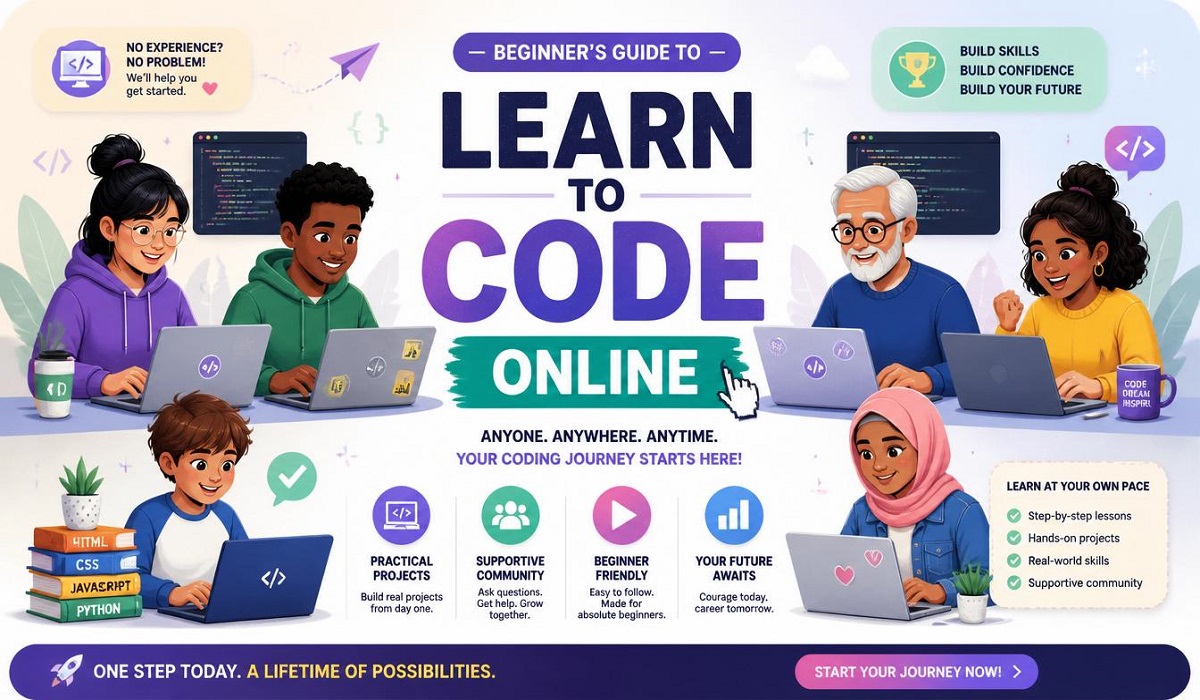
Learn To Code Online For Beginner’s Guide: A lot has changed in the world of technology, and the idea of teaching yourself to code from home is more common than ever before. In fact, it might surprise you to learn that a huge number of professional developers didn’t start in a fancy university classroom.
They took the same path you’re considering right now. Research shows that a whopping 82% of working developers learned their skills through online resources, not formal education. That’s a game-changer, right? It means you are not alone, and the path has already been paved by thousands of successful coders who started just where you are now.
This “Learn To Code Online For Beginner’s Guide in 2026” is your personal roadmap. We’re going to break down everything you need to know in simple, easy-to-understand language. We’ll figure out which coding language to start with, how to pick the best free courses, what a realistic timeline looks like, and how to use the newest AI tools to your advantage. Forget the fear and confusion—by the end of this guide, you’ll have a clear action plan to start your journey.
Why Learn To Code? (It’s Not Just About the Money)
Before we get into the nitty-gritty of how to learn, let’s talk about why. What’s in it for you? Learning to code isn’t just about becoming a nerd with a laptop. It’s one of the best investments you can make in your future right now.
The Numbers Don’t Lie
First, let’s talk about career opportunities. The job market for tech skills is booming and isn’t showing any signs of slowing down. The U.S. Bureau of Labor Statistics predicts that software developer jobs will grow by a massive 15% from 2024 to 2034, with over 129,000 new openings every year. That’s five times faster than the average for all other jobs!
And the pay? The median annual salary for a software developer in 2024 was $133,080. That kind of salary can be life-changing and provides amazing financial security. It’s not just about being a “software developer,” either. Jobs like web developer are growing fast too, at 7%. The demand is real and it’s everywhere.
The Best Part: You Don’t Need a Degree
This is the secret that many people don’t know. You don’t need a four-year computer science degree to get a great job in tech. In fact, only 49% of working developers learned to code in a school setting. The rest are self-taught, just like you can be. This levels the playing field. It means your skills and your ability to build things matter more than the piece of paper on your wall.
The AI Revolution is Your Friend
You’ve probably heard a lot about Artificial Intelligence (AI) and how it might take over the world. But when it comes to coding, AI is creating more jobs than it’s destroying. New roles like AI Engineer and Machine Learning Specialist barely existed a few years ago. By learning to code in 2026, you’ll be in a perfect position to work with AI, making you incredibly valuable to any company.
The 64,000 Dollar Question: Which Programming Language Should I Learn First?
This is the one question that stops almost every beginner in their tracks. You open your laptop, search “how to code,” and are immediately hit with a wall of languages: Python, JavaScript, C++, Java, Ruby… it’s overwhelming. Don’t panic! It’s actually simpler than it seems. The best “Learn To Code Online For Beginner’s Guide in 2026” should give you clear answers, not more confusion.
The golden rule of choosing a first language is simple: It depends on what you want to build. Here’s how to decide between the two heavyweights for beginners: Python and JavaScript.
Python vs. JavaScript: The Tale of Two Titans
1. Python: The Friendly All-Rounder
If you’re looking for a gentle introduction to the world of code, Python is your best friend. It’s often described as a language that reads like plain English. This means you spend less time wrestling with confusing symbols and more time learning the core logic of programming.
- What it’s good for: Python is the undisputed king of Data Science, Machine Learning, and Artificial Intelligence. If you want to work with data, build AI models, or automate boring tasks (like renaming thousands of files in a second), Python is the way to go. It’s also great for building backend web servers and is used by massive companies like Instagram, Spotify, and Reddit.
- Is it easy? Yes! Its syntax is super clean, making it the most beginner-friendly language to start with.
2. JavaScript: The Language of the Web
Do you want to see something appear on your screen immediately? Do you love the idea of building websites and interactive apps? Then JavaScript is for you.
- What it’s good for: JavaScript is the only language that runs natively in your web browser. It’s the magic that makes websites interactive. When you click a button and a menu drops down, that’s JavaScript. It’s the most-used programming language in the world.
- The Advantage: The main reason to start with JavaScript is speed. You can write code in a text file, save it as an
.htmlfile, and open it in your browser. You’ll see your changes instantly. That quick win can be a huge motivator when you’re just starting.
So, Which One Do You Pick?
Don’t overthink this, a trap most beginners fall into. Just use this simple decision chart:
The Secret to Success: How to Actually Learn (And Not Get Stuck)?
Okay, you’ve picked a language. Now what? You might be tempted to just start watching random YouTube tutorials. And while that can be helpful, it’s also the fastest way to fall into a dreaded trap called “Tutorial Hell.”
What is “Tutorial Hell” and How Do I Avoid It?
Tutorial hell is when you watch video after video, following along perfectly, but the moment you close the video and try to code something yourself, your mind goes completely blank. You can’t write a single line of code. It’s a terrible feeling and it causes many people to quit.
The problem is that watching someone code is not the same as writing code yourself. When you watch, you are using a part of your brain that recognizes things. But when you have to code from scratch, you need your brain to recall and create, which is much harder.
Think of it like learning to play guitar. Watching a master guitarist play “Stairway to Heaven” a hundred times won’t teach you how to play. You have to pick up the guitar, feel the strings, learn the chords, and practice the finger movements yourself. Coding is exactly the same.
The Cure: Active learning is the key. A huge research study involving 225 studies found that active learning methods (where you do the work) raised test scores and reduced failure rates by 1.5 times compared to passive learning (just watching).
The Step-by-Step Roadmap to Your First Project
Here is the simple, tried-and-true path to becoming a coder. This is the framework all successful self-taught developers use.
Step 1: Define a Clear Goal
Instead of saying “I want to learn to code,” pick a specific project. Say “I want to build a personal website to show off my photography” or “I want to build a to-do list app.” This gives you a finish line to aim for. Your goal will help you choose your language and your learning path.
Step 2: Pick ONE Language and Stick with It
You’ve already decided on Python or JavaScript. Now commit to it. Don’t switch after a week just because it gets hard. Every language is hard in week two. Push through. Experts recommend committing to one language for 4-8 weeks before you even think about switching.
Step 3: Choose a Structured Learning Platform
This is where a “Learn To Code Online For Beginner’s Guide in 2026” becomes your best friend. You need a structured path, not random, disconnected videos.
Here are some of the absolute best platforms to get you started. Many of them are 100% free.
Pro-Tip: Start with freeCodeCamp or The Odin Project. They are completely free, have massive supportive communities, and are recognized as top-tier resources.
Step 4: Write Code Every Day
Consistency is more important than marathon sessions. Code for 30 minutes every day is much better than sitting down for 6 hours once a week. This builds muscle memory and keeps you in the “coding zone.”
Step 5: Build Projects from Day One
Don’t wait until you “know everything” to start building. Start building small things right away. Your first projects won’t be amazing, and that’s perfectly fine. The goal is to apply what you’ve learned. A few great starter projects are:
- A personal portfolio website
- A to-do list app
- A calculator
- A weather app that pulls data from an API
Step 6: Join a Community
Coding alone is tough. There will be bugs you can’t solve and concepts that just don’t click. Joining a community solves this. The freeCodeCamp forum, The Odin Project Discord, and Reddit’s r/learnprogramming are amazing places to ask for help, get feedback, and feel less alone.
How to Use AI to Supercharge Your Learning? (The Smart Way)
This is the biggest piece of advice for 2026. AI is not here to replace you; it’s here to help you.
The Ultimate Personal Tutor
Think of ChatGPT or Google Gemini as your 24/7 personal tutor. But you have to use it the right way. Avoid the temptation to ask it to just “write code to solve X.” That would be like paying someone to do your homework for you. You’d get the answer but learn nothing.
How to Use AI for Learning?
Instead of asking for the code, ask it to explain the code. For example, if you’re writing a “for loop” and don’t get it, you can say:
- “Hey AI, here is a ‘for loop’ I wrote. Can you explain it to me line-by-line like I’m a complete beginner?”
You can also use it to debug your errors:
- “I’m trying to build a to-do list in JavaScript. I keep getting ‘Uncaught TypeError’ when I click the add button. Here is my code. What is wrong with my logic?”
When you use AI this way, you learn the why behind the code, which is infinitely more valuable than just having the code.
How Long Does It Take? (Be Realistic)
This is a hard truth for many beginners. Learning to code is not a “get rich quick” scheme. It takes time and consistent effort.
- The Self-Taught Path: If you’re learning in your spare time, putting in 10-15 hours a week, expect to spend 6 to 18 months to get job-ready.
- The Bootcamp Path: This is a more intense route. An average bootcamp lasts about 14 weeks of full-time (40+ hours a week) study. According to Course Report, 79% of bootcamp grads are employed full-time, with an average starting salary of $70,698.
The cost difference is huge. A self-taught path can be nearly free (using freeCodeCamp and The Odin Project), while a coding bootcamp costs around $12,000 on average.
Are Coding Bootcamps Worth It?
A coding bootcamp can be a great option if you need structure, thrive in a fast-paced environment, and want a community and career support. However, you need to be careful. Many bootcamps are expensive, but they promise a fast track to a job. If you go down this route, do your research. Look for CIRR-verified outcomes to ensure the school’s reported job placement rates are legitimate.
Final Word: How to Make Your Dream a Reality
The most important thing to remember is that anyone can learn to code. You don’t need to be a math genius. You don’t need to be a teenager. The only things you need are consistency, patience, and a curious mind.
Remember, the journey is just as important as the destination. The time will pass anyway, so why not use it to learn an incredible, life-changing skill? The world is moving towards technology, and this “Learn To Code Online For Beginner’s Guide in 2026” is your invitation to be part of it.
So, what are you waiting for? Pick your language, choose your platform, and write your first line of code today. You’ve got this!
Frequently Asked Questions (FAQs)
1. Can I really learn to code for free?
Yes, 100%! You can learn to code for free using amazing platforms like freeCodeCamp, The Odin Project, and Harvard’s CS50x. These are high-quality, complete curriculums that have led thousands of people to successful careers without them paying a single penny.
2. Which is easier, Python or JavaScript?
For an absolute beginner, Python is considered easier because its syntax reads much like plain English, making it very intuitive. JavaScript has more quirks, like confusing type coercion, that can trip up a new learner. However, JavaScript gives you the instant satisfaction of seeing your code work in a web browser.
3. Should I learn Python or JavaScript first in 2026?
It depends on your goal. If you want to build websites and web apps, learn JavaScript. If you’re interested in data science, AI, or automation, learn Python. You have no specific goal yet, start with Python because it’s the easiest to learn.
4. Can I learn coding on my phone?
Yes, you can! There are apps like Sololearn and Simzy that provide mobile-friendly, bite-sized lessons. They are great for practicing on the go or learning the basics. However, for serious project-building, you’ll eventually need a proper computer.
5. How much can I earn as a self-taught developer?
A lot! The average first job salary for a coding bootcamp grad is **$70,698**, but this can be higher or lower depending on your location and skills. With a few years of experience, many developers earn well over $100,000 a year. The work itself is incredibly rewarding, both intellectually and financially.
Summary
Learning to code online as a beginner in 2026 is not just possible; it’s a smart and accessible move. The key is to choose a language based on your goals (Python for data/AI, JavaScript for web), use a structured platform like freeCodeCamp, and prioritize active learning by building projects. Avoid “tutorial hell” by writing code every day and using AI as a tutor to explain concepts, not just write code for you. While the journey requires 6-18 months of consistent effort, the reward is a high-paying, future-proof career that doesn’t require a traditional degree. The best time to start is now!