Pedagogy and Assessment
Pedagogy and Assessment: The basic, unwritten rule of the classroom has been in place for decades: the instructor teaches, the student learns, and an exam at the end verifies it. For many generations, this approach—which views instruction and evaluation as distinct processes—has been the norm. But the classroom is evolving along with the world. Our understanding of teaching and learning is undergoing a dramatic change right now.
“How do they learn, and how can we best support that journey?” is the key topic of today’s pedagogy and assessment discourse, rather than merely “What do students know?” Learning must be understood and actively guided throughout the entire process; measuring it at the end is no longer sufficient.
You will be guided via this intriguing transition by this essay. In order to provide all students with more interesting, equitable, and significant educational experiences, we will examine why traditional assessments are no longer the gold standard and how the connection between teaching and assessment is changing. In order to give parents, educators, and everyone else interested in the future of education a road map, we will simplify complicated issues into straightforward, understandable principles.
Consider evaluation and education as two sides of the same coin rather than as two distinct islands. When they collaborate well, students do something amazing: they comprehend and are able to apply what they have learned, rather than merely memorizing facts.
The Conventional Perspective on Instruction and Evaluation
An Account of Two Silos
We must first examine where we have been in order to comprehend where we are heading. Teaching and testing are frequently viewed as distinct activities in traditional education. In this traditional approach, the instructor serves as the “sage on the stage,” imparting knowledge, and the test, which is typically administered at the conclusion of a chapter or semester, serves as the ultimate assessment of the students’ memorization. This is sometimes referred to as “teaching to the test,” and it has a number of major problems.
“Teaching to the Test” is problematic.
This method creates a culture of memorization rather than comprehension and places a great deal of pressure on students. Its emphasis on “summative assessment,” or evaluation of learning, is the primary problem. Finding out if a student can recall information at one particular moment is the aim.
For instance, a student may successfully pass a history test by memorizing a list of dates. However, a week later, they might not recall the significance of those dates or how they relate to the modern world. Because the assessment did not push them to think critically, their learning was superficial. Some students may even fall behind due to this reliance on recall-based tests, which can make learning seem tedious. Additionally, it perpetuates inequality because a single test might not fairly represent the skills of all students, especially those with different learning needs or backgrounds.
What is “Assessment of Learning”?
“Assessment of learning” is the traditional benchmark. Think of final exams, state tests, and standardized assessments. Its purpose is to evaluate and assign a grade or score. It’s like the final scoreboard at the end of a game; it tells you who won, but it doesn’t show you the plays, the strategies, or the teamwork that led to the result.
According to experts like those at Cambridge Assessment, while summative assessment has its place in awarding grades and evaluating the overall effectiveness of a program, it provides limited opportunities for students to practice higher-order thinking during a course of study . Its primary purpose is not to help students learn, but to measure what they’ve already, presumably, learned.
A New Way Forward: The Shift to Assessment for Learning
What is “Assessment for Learning”?
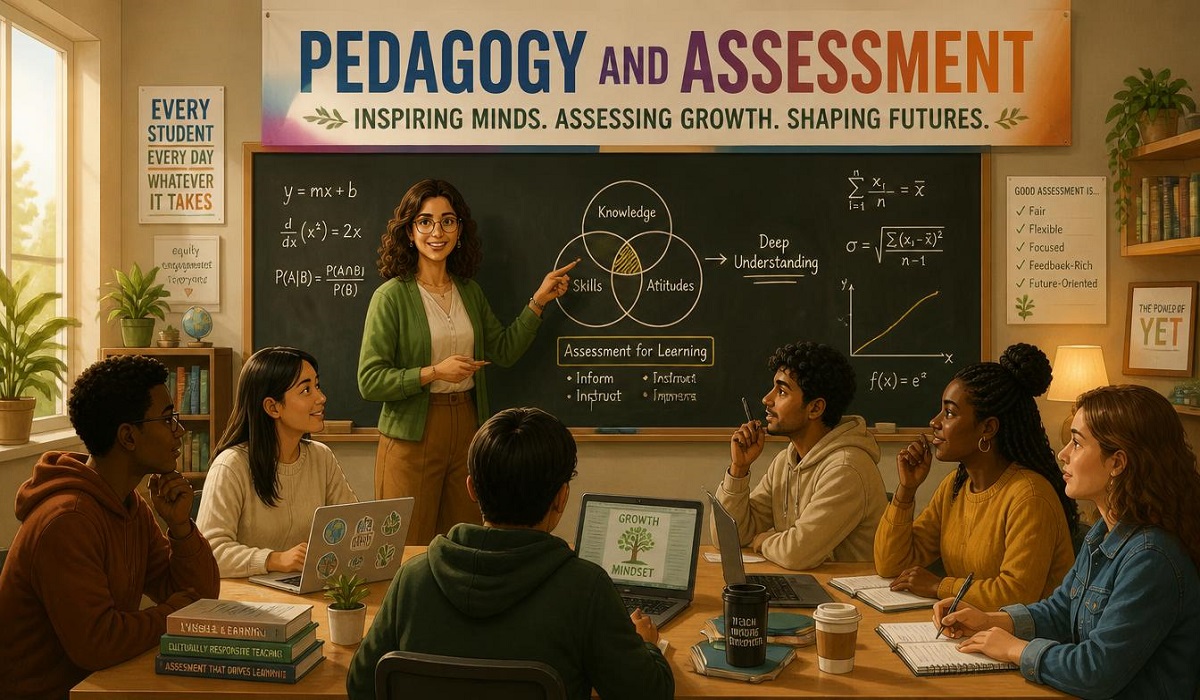
This is where the modern revolution in pedagogy and assessment begins. “Assessment for learning” (AfL) flips the script. Instead of just measuring learning at the end, it’s about using assessment during the learning process to actively help students improve. It is an approach where teachers use assessment to understand what students need and adjust their teaching accordingly .
A great analogy comes from author Daisy Christodoulou, who suggests that teachers should be like “thermostats, not thermometers” . A thermometer just takes a temperature reading; it tells you the room is too hot, but it doesn’t do anything about it. A thermostat, on the other hand, reads the temperature and then makes an adjustment to heat or cool the room. In the same way, a teacher using assessment for learning doesn’t just record a student’s grade; they use that information to adjust their lessons to meet the student’s needs.
How Does it Work in the Classroom?
Assessment for learning happens all the time. It could be:
- A teacher asking questions throughout the lesson to check for understanding.
- A quick quiz at the start of class to see what students remember from yesterday.
- An “exit ticket”—a small piece of paper where students write down one thing they learned and one question they still have—at the end of the lesson .
- Peers giving each other feedback on a draft of an essay.
- A student reflecting on their own work and setting a goal to improve.
The key is that the feedback is immediate and helps the student and the teacher see where they are and what to do next . As the NSW Department of Education explains, this ongoing feedback is designed to “close the gap between current and desired performance” .
The Power of Feedback
One of the most powerful parts of assessment for learning is feedback. Not just a grade, but specific, helpful information. Educational researcher John Hattie’s research shows that feedback is one of the most impactful factors on student achievement, with a huge effect size .
However, not all feedback is created equal. Telling a student “Good job!” is nice, but it’s not as useful as saying, “Your argument in the second paragraph is very strong. To make it even better, try using a specific example from the text to support it.” This kind of specific, task-focused feedback gives students a clear roadmap for improvement.
The Perfect Partnership: Good Pedagogy + Good Assessment
The Relationship is Key
Some of the world’s leading educational researchers, like Paul Black and Dylan Wiliam, have argued that any successful theory of formative assessment must be embedded within a wider theory of pedagogy . In simple terms, how you teach and how you assess are deeply connected. You can’t have one without the other. When you design a great lesson (pedagogy), you also need to design a smart way to check for understanding (assessment) that is part of the lesson itself.
This powerful partnership between pedagogy and assessment is what makes a classroom truly dynamic. Pedagogy is not just “teaching”; it’s the art and science of how students learn, and assessment is the tool that makes that learning visible.
Creating a Shared Vision
A key part of this partnership is making learning goals crystal clear for students. When they know exactly what they’re aiming for, and what success looks like, they can take ownership of their learning. Teachers can do this by:
- Using Learning Intentions: Clearly stating what students will learn in a lesson. For example, “Today you will be able to explain the water cycle.”
- Sharing Success Criteria: Showing what a “good one” looks like. For example, “To achieve this, your explanation must name the four main stages of the water cycle (evaporation, condensation, precipitation, collection) and describe how they are connected.”
This is a huge shift from traditional classrooms where the teacher holds all the secrets to the test. In a modern classroom, learning is a shared journey, and pedagogy and assessment are the navigational tools.
Examples of Assessment for Learning Strategies
Here are some everyday strategies that show how teaching and assessment work together in the modern classroom :
- Effective Questioning: Instead of asking “Who knows the answer?”, teachers ask questions that get students to think, like “Explain why you think that” or “What is the evidence for that perspective?”.
- Peer Feedback: Students are taught how to give kind, specific, and helpful feedback to their classmates. This helps both the reviewer and the writer deepen their understanding.
- Goal Setting: Students don’t just get a grade; they use feedback to set a goal for their next piece of work. “I need to work on using more descriptive language,” for example. This promotes a growth mindset.
Real-World Learning: How Authentic Assessment Makes Learning Stick
Going Beyond Rote Memorization
We all know the frustration of studying for a test, getting a good grade, and then forgetting everything a month later. That’s because traditional tests often focus on rote memorization of facts. But what if students could learn by solving a real-world problem?
This is the idea behind “Authentic Assessment” . Instead of a paper test, students might be asked to:
- Write a business plan for a new product.
- Create a digital infographic explaining a complex scientific concept .
- Build a model of a sustainable city.
Design and run a campaign to solve a problem in their school.
These tasks are more engaging because they feel relevant. They show that learning isn’t just about getting an answer right but about applying knowledge to create something new or solve a problem. As one study from a medical school found, replacing a traditional final exam with a group project where students created a visual representation of how body systems interact led to more engaging and deeper learning .
Deeper Learning with “Assessment as Pedagogy”
An even more exciting concept is the idea of “assessment as pedagogy” . This means that the assessment task itself is a powerful learning experience. It’s not just a test at the end; the process of completing the assessment deepens the student’s understanding.
For example, imagine a history class where students are asked to create a short documentary about a historical event. To do this, they have to:
- Research the event (history).
- Analyze primary sources (critical thinking).
- Learn new technology skills (digital literacy).
- Work together as a team (collaboration).
Write a script and tell a compelling story (communication).
In this case, the “assessment” isn’t just a project they turn in; it’s a rich, multi-layered learning experience that builds far more skills than a standard test ever could. This shifts students from being passive recipients of information to active creators of knowledge, a concept deeply rooted in constructivist pedagogy. This technique is currently being reinforced by new technology, as we shall explore next.
The AI Revolution and Rethinking Assessment
A New Partner in the Classroom
Artificial intelligence (AI) is revolutionizing education. Powerful AI tools like ChatGPT and other large language models (LLMs) can now create essays, solve complicated issues, and brainstorm ideas . This has generated a significant concern for educators: If AI can produce the final solution, how do we actually know if a pupil has learnt anything?
This dilemma is driving us to reconsider teaching and evaluation once again. The attention is changing from the ultimate result (the essay) to the journey of production (the process). We need to understand how a kid thinks, collaborates, and develops ideas—skills that are difficult for AI to fake .
Assessing the Process, Not Just the Product
Researchers are researching new tools to trace the learning process. For example, a team lead by The Education University of Hong Kong created a method called Movement Analysis (MOVA) . MOVA examines how students advance through several phases of learning during group activity, such as:
- Exploring an issue
- Exchanging concepts
- Combining various viewpoints
- Striving for a definitive resolution
Teachers can use this to determine which groups are thinking deeply and which may be in a rut. It shifts the focus away from just the finished product by demonstrating how students think, work together, and react to criticism. These sophisticated “learning analytics” are an excellent illustration of how contemporary assessment is changing to address the issue of how students learn.
In a similar vein, frameworks for analyzing student interaction with AI tools are being developed. Teachers can gain insight into their critical thinking and problem-solving techniques by examining the questions they pose, how they narrow down their searches, and how they synthesize the data.
What Does This Mean for Students and Teachers?
We shouldn’t be afraid of AI just because it’s becoming more prevalent. Rather, it offers a chance. Teachers are starting to view AI as a “assistant rather than an authority,” according to a study on AI and assessment. The difficulty lies in creating tests that are “AI-resistant” by concentrating on:
- Original Idea: Students should be asked to relate new knowledge to their personal experiences and lives, as AI is unable to do.
- Real-World Application: Using genuine evaluation tasks that call for ingenuity and intricate, methodical problem-solving.
- The Learning Journey: Monitoring a student’s development and changes over time with tools like e-portfolios.
This new world also demands a fresh focus on ethics and integrity, ensuring that students understand how to utilize AI as a tool to improve, not replace, their own learning. This ensures that pedagogy and assessment remain focused on genuine student development.
Practical Strategies for Teachers and Schools
So, what does this all look like in practice? Here’s a practical guide for educators who want to modernize their pedagogy and assessment strategies.
For Your Classroom
- Start with “Why”: Be crystal clear about what you want students to know, understand, and be able to do. Use simple learning intentions and success criteria.
- Make Checking for Understanding a Habit: Use quick strategies like “mini whiteboards” (students hold up their answers), exit tickets, online quizzes, and “think-pair-share” activities to gauge understanding in real-time .
- Give Better Feedback: Focus your feedback on the task, not the student. Instead of “Good job,” try “You have a great start here. To meet the success criteria, you could add a specific example in the second paragraph to support your point.”
- Empower Students: Teach students how to self-assess their own work and give useful feedback to their peers. This helps kids become autonomous learners. Use models and samples of both excellent and weak work so students have a clear image of what is required .
- Design Authentic Tasks: Whenever possible, create assessments that connect to the real world. A math class may budget for a class activity, while a science class might design a “green” building. This appeals to the constructivist notion that students acquire knowledge by experience.
For Administrators and Schools
- Support Professional Learning: Provide training for instructors on formative assessment tools and how to integrate them into their everyday practice.
- Create a Culture of Feedback: Shift the school culture from one that stresses grades to one that encourages progress. Encourage a development mentality for both students and staff.
- Invest in Tools: Provide instructors with tools and technology that may support modern evaluation, such as digital portfolios, online quiz platforms, and collaborative workspaces.
- Rethink Report Cards: Move beyond mere letter grades to include more extensive assessments on student development, including habits of learning, critical thinking, and teamwork.
Conclusion: The Future is a Learning Journey
The world is evolving quicker than ever. Our pupils are entering a world full of professions that don’t yet exist and difficulties we can’t even envision. The old model of teaching and testing is no longer enough.
The future of education is not about finding a silver bullet; it’s about embracing a continuous cycle of growth. The strong collaboration between pedagogy and assessment is currently the most exciting development. By utilizing evaluation not as a final judgment but as a guiding light, we can establish classrooms where every student is empowered to become an active, engaged, and lifelong learner. It’s a change from emphasizing what pupils can remember to honoring their development.
FAQs, or frequently asked questions
1. What distinguishes formative assessment from summative assessment?
Formative assessment is an ongoing process that is used to give feedback, enhance instruction, and increase student comprehension. During practice, it’s similar to a coach providing feedback. Summative assessments are used to gage student progress at the conclusion of a class period. It’s similar to how a grade is determined by the final game score.
2. How can I use evaluation to support struggling students?
To quickly pinpoint the precise areas in which a student is having difficulty, employ formative assessment techniques. A brief test, for instance, can reveal which math concept a student is still struggling with. Then, to help them bridge the gap, you can offer focused assistance, such as a lesson in small groups or a particular exercise. Treating assessment as a diagnostic tool rather than merely a grade is crucial.
3. What does “authentic assessment” mean, and why is it crucial?
Students are required to apply their knowledge and abilities to practical tasks, such as constructing a model, drafting a business plan, or producing a documentary, as part of authentic assessment. It’s important because it makes learning more engaging and relevant, helping students see the value of what they are learning beyond the classroom .
4. How is AI affecting the way teachers assess students?
The rise of AI tools is making teachers shift their focus from assessing final products (like essays) to assessing the learning process. Teachers are finding new ways to evaluate how students think, collaborate, and develop ideas. They are using tools to trace student work and focusing on assignments that require personal reflection and creativity .
5. What are simple ways I can start using formative assessment in my classroom tomorrow?
You can start with:
- Exit Tickets: At the end of class, ask students to write down one thing they learned and one question they still have.
- Mini-Whiteboards: Ask a question and have all pupils write their answer on a little whiteboard and hold it up at the same time. This shows you who understands it and who doesn’t.
- “Think-Pair-Share”: Have students think about a question, then discuss it with a partner, and finally share their views with the class .
- Wait Time: Before calling on someone to answer a question, give yourself a few more seconds. Every student has time to reflect as a result.